



About Anton Raphael Mengs
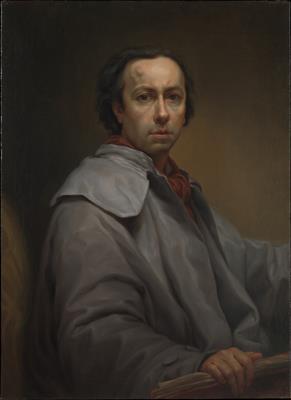
- portrait
Bohemian painter named after Raphael by his ambitious father, who became the most acclaimed Neoclassicist in Europe and died in Rome with twenty children.
Where to see Anton Raphael Mengs
Collection holdings are reported here; current display varies. Check with each museum before visiting.
-
32 recorded works
Museo del Prado
Madrid, Spain
-
12 recorded works
Hermitage Museum
Saint Petersburg, Russia


-
6 recorded works
Gemäldegalerie Berlin
Berlin, Germany
-
6 recorded works
Nationalmuseum
Stockholm, Sweden
-
6 recorded works
Kunsthistorisches Museum
Vienna, Austria
-
4 recorded works
National Trust
Swindon, United Kingdom
-
4 recorded works
Metropolitan Museum of Art
New York City, United States
-
3 recorded works
National Museum in Warsaw
Warsaw, Poland
-
2 recorded works
Gemäldegalerie Alte Meister
Dresden, Germany
-
2 recorded works
Louvre
Paris, France


View all 53 museums
-
2 recorded works
Royal Palace of Madrid
Madrid, Spain
-
2 recorded works
Rijksmuseum
Amsterdam, Netherlands
-
2 recorded works
Art Institute of Chicago
Chicago, United States
-
2 recorded works
Royal Academy of Fine Arts of San Fernando
Madrid, Spain
-
2 recorded works
Museum of Fine Arts, Houston
Houston, United States
-
2 recorded works
National Gallery of Canada
Ottawa, Canada
-
1 recorded work
Lázaro Galdiano Museum
Madrid, Spain
-
1 recorded work
Hispanic Society of America
New York City, United States
-
1 recorded work
National Galleries Scotland
Edinburgh, United Kingdom
-
1 recorded work
Germanisches Nationalmuseum
Nuremberg, Germany
-
1 recorded work
National Gallery Prague
Prague, Czech Republic
-
1 recorded work
Museo Camón Aznar
Zaragoza, Spain
Also here (3)
-
1 recorded work
Museo di Capodimonte
Naples, Italy
-
 1 recorded work
Weston Park
Weston-under-Lizard, United Kingdom
-
1 recorded work
Christ Church Picture Gallery
Oxford, United Kingdom
-
1 recorded work
Pinacoteca Nazionale di Bologna
Bologna, Italy
-
1 recorded work
Colchester and Ipswich Museums Service
Colchester, United Kingdom
-
1 recorded work
Walker Art Gallery
Liverpool, United Kingdom
-
1 recorded work
National Gallery
London, United Kingdom
-
1 recorded work
J. Paul Getty Museum
Los Angeles, United States
-
1 recorded work
Museum of John Paul II Collection
Warsaw, Poland
-
1 recorded work
Finnish National Gallery
Helsinki, Finland
Also here (6)
-
1 recorded work
Pollok House
Glasgow, United Kingdom
-
1 recorded work
Galleria Nazionale d'Arte Antica
Rome, Italy
-
1 recorded work
National Gallery of Art
Washington D.C., United States
-
1 recorded work
Alte Nationalgalerie
Berlin, Germany
-
1 recorded work
Manchester Art Gallery
Manchester, United Kingdom
-
1 recorded work
National Museum Cardiff
Cardiff, United Kingdom
-
1 recorded work
Hessen Kassel Heritage
Kassel, Germany
-
1 recorded work
Victoria and Albert Museum
London, United Kingdom
-
1 recorded work
RISD Museum
Providence, United States
-
1 recorded work
Walters Art Museum
Baltimore, United States
-
1 recorded work
Los Angeles County Museum of Art
Los Angeles, United States
-
1 recorded work
Museu Nacional d'Art de Catalunya
Barcelona, Spain
-
1 recorded work
National Gallery of Victoria
Melbourne, Australia
-
 1 recorded work
Kunsthalle Bremen
Bremen, Germany
-
1 recorded work
National Gallery of Ireland
Dublin, Ireland
Also here (6)
-
1 recorded work
San Diego Museum of Art
San Diego, United States
-
1 recorded work
Vatican Museums
Vatican City, Vatican City
-
1 recorded work
Yale University Art Gallery
New Haven, United States


3 more museums hold works by Anton Raphael Mengs with smaller collections, not listed here.
Frequently Asked Questions
Where can I see Anton Raphael Mengs's work?
Paintings by Anton Raphael Mengs are held by many museums and collections, mainly in Europe and the United States. These include the Staatliche Museen (East and West Berlin), the Musée Fesch (Ajaccio, Corsica), the Royal Museum of Fine Arts (Copenhagen), and the Staatliche Kunstsammlungen (Dresden). In England, his work can be seen at the Barber Institute of Fine Arts, University of Birmingham; and in a private collection in Surrey. In the United States, Mengs's paintings are in the Art Institute of Chicago; the Detroit Institute of Arts; the Fogg Art Museum, Harvard University (Cambridge, Massachusetts); the Museum of Fine Arts, Boston; the Baltimore Museum of Art; the National Gallery of Art (Washington, D.C.); and the John and Mable Ringling Museum of Art (Sarasota). Other locations include the Nationalmuseum (Stockholm); the National Trust (Stour Head, Wiltshire); the Galleria Sabauda (Turin); and the Kunsthistorisches Museum and Graf Harrach’sche Gemäldegalerie (Vienna).What should I know about Anton Raphael Mengs's prints?
Anton Raphael Mengs (1728[5]-1779[5]) was a painter who helped introduce Neoclassicism in Rome. His father, Ismael Mengs, was a court painter in Dresden. Ismael relocated the family to Rome so Anton could study classically inspired art. By 1749[5], Anton was appointed first painter to Frederick Augustus, elector of Saxony. After a short time in Dresden, he returned to Rome. He secured a teaching position at the Accademia Capitolina by 1754. Mengs believed line was less important than colour. This view supported a revival of the disegno versus colore debate between the "Poussinistes" and the "Rubenists". Mengs also completed commissions in Spain for Carlos III, whose portrait[5] he painted in 1761. A well-known work from his time in Spain is the ceiling of the banqueting hall of the Palacio Real in Madrid. Mengs painted religious and historical subjects in the heroic style of the Neoclassical era. He also painted portraits of Augustus III, King of Poland, and Johann Winckelmann.Who was Anton Raphael Mengs?
Anton Raphael Mengs was a painter born in Bohemia. He is credited with introducing neoclassicism to Rome, according to the Historical Dictionary of Neoclassical Art and Architecture.What techniques or materials did Anton Raphael Mengs use?
Anton Raphael Mengs was a painter active in the mid-1700s. Historical accounts suggest he focused on oil-on-canvas techniques, avoiding fresco painting. This specialisation allowed him to master the medium, using excellent pigments and binders that he prepared himself. Mengs employed oil glazes to achieve clarity in his compositions. He used heavy, viscous binders early in his career. This allowed a fluid application, especially in Naples and later works, permitting independent treatment of his subjects. Mengs did not try to disguise his brushstrokes. The fluidity of his paintings is apparent, and his working methods are visible in the finished work. Some contemporaries claimed that Mengs concentrated solely on the complexion, skin, blood, and natural surfaces, setting aside other artistic considerations. One went so far as to suggest that Mengs mixed real flesh into his colours to achieve certain skin tones.Who did Anton Raphael Mengs influence?
Anton Raphael Mengs (1728[5]-1779[5]) is credited with introducing neoclassicism in Rome. Mengs gained a teaching position at the Accademia Capitolina, a public school of drawing established in 1754[5] by Pope Benedict XIV. In that role, he taught drawing and espoused the idea that line was subordinate to colour. His position helped revive the earlier disegno versus colore debate between the “Poussinistes” and the “Rubenists”. He is credited with training a large number of artists at the Imperial Academy of Arts until his death in Saint Petersburg in 1835. Mengs met many English patrons of the arts at the Academy of Saint Luke. Mengs's reputation in Rome owed much to Johann Joachim Winckelmann, whose aesthetic theories he espoused. Mengs painted portraits of King August III (1745), Frederick Christian, Pope Clement XIII (1758), and Johann Winckelmann.What is Anton Raphael Mengs's most famous work?
Anton Raphael Mengs (1728[5]-1779[5]) was a painter born in Bohemia. His father, Ismael Mengs, who served as court painter to Augustus III in Dresden, gave Anton his first lessons. The family relocated to Rome so Anton could study classical art. By 1749[5], Anton was appointed first painter to Frederick Augustus, though he soon went back to Rome. There, he married a former model, gave up Protestantism, and secured a teaching position at the Accademia Capitolina. Mengs received commissions for portraits and frescoes. These included portraits of Frederick-Christian, Elector of Saxony (1751), Pope Clement XIII (1758), and Johann Joachim Winckelmann. He painted the fresco La Gloria di Sant’ Eusebio in the church of Saint Eustache and worked in the chapel of the Palace of Caserta. While employed by Carlos III of Spain, Mengs painted the ceiling of the banqueting hall of the Palacio Real in Madrid. He is sometimes described as slightly more famous than Pompeo Batoni.What style or movement did Anton Raphael Mengs belong to?
Anton Raphael Mengs (1728[5]-1779[5]) is credited with introducing Neoclassicism to Rome. Born in Bohemia, Mengs received early training from his father, Ismael Mengs, a court painter in Dresden. Ismael named his son Raphael after the Renaissance artist. In 1741[5], the family relocated to Rome to study classical art. By 1749, Mengs was appointed first painter to Frederick Augustus, elector of Saxony. However, he soon returned to Rome. There, he secured a teaching position at the Accademia Capitolina in 1754. Mengs advocated for colour over line, contributing to the "disegno versus colore" debate. Mengs's association with Johann Joachim Winckelmann, an aesthetic theorist, aided his career. Winckelmann introduced him to Cardinal Alessandro Albani, a collector of antiquities. Mengs's commissions included a copy of Raphael’s School of Athens in 1755. From the late 1750s until his death, Mengs produced major Neoclassical paintings, including a portrait[5] of Pope Clement XIII (1758). He also worked in Spain for Carlos III, painting the ceiling of the banqueting hall at the Palacio Real in Madrid.What was Anton Raphael Mengs known for?
Anton Raphael Mengs (1728[5]-1779[5]) was a painter born in Bohemia. He is credited with introducing neoclassicism to Rome. His father, Ismael Mengs, was a portrait[5] painter in Dresden. Ismael ensured that Anton studied painting from the age of twelve, and took his family to Rome to study classically inspired art. By 1749[5], Anton was appointed first painter to Frederick Augustus, elector of Saxony. After a short period in Dresden, he returned to Rome. Mengs gained a teaching position at the Accademia Capitolina, a public drawing school established in 1754. He was a proponent of colour over line, reviving the disegno versus colore debate. Mengs made brief trips to Spain at the request of Carlos III, whose portrait he painted in 1761. A well-reputed work from his time in Spain is the ceiling of the banqueting hall of the Palacio Real in Madrid. He painted portraits of Augustus III in 1745, Pope Clement XIII in 1758, and Johann Joachim Winckelmann.
Sources
Where to See guide aggregates verified holdings of Anton Raphael Mengs's works across the following collections.
- [1] museum Weston Park Used for: museum holdings.
- [2] museum Kunsthalle Bremen Used for: museum holdings.
- [3] museum Samuel H. Kress Collection Used for: museum holdings.
- [4] academic Anton Raphael Mengs | Bohemian painter, Neoclassical art - Britannica Used for: biography.
- [5] wikipedia Wikipedia: Anton Raphael Mengs Used for: biography.
- [6] book Beard, Lee, 1973- author, Butler, Adam, author; Van Cleave, Claire, author; Fortenberry, Diane, author; Stirling, Susan, author, Beard, Lee, 1973- author, Butler, Adam, author; Van Cleave, Claire, author; Fortenberry, Diane, author; Stirling, Susan, author - The Art Book_ New Edition, Mini Format Used for: biography.
- [7] book Palmer, Allison Lee, Historical Dictionary of Neoclassical Art and Architecture Used for: biography.
- [8] book Allison Lee Palmer, Historical Dictionary of Neoclassical Art and Architecture Used for: biography.
- [9] museum Anton Raphael Mengs - Getty Museum Used for: biography.
- [10] museum Anton Raphael Mengs - Self-Portrait - The Metropolitan Museum of Art Used for: notable works.
- [11] museum Anton Raphael Mengs - The Collection - Museo Nacional del Prado Used for: biography.
Editorial overseen by Solis Prints. Sources verified 2026-09-30. Click a source for details, or hover over [N] in the page above to preview.
Editorial standardsMethodologyCorrectionsAI disclosureAbout the editorial team