



About Robert Motherwell
American · 1915–1991
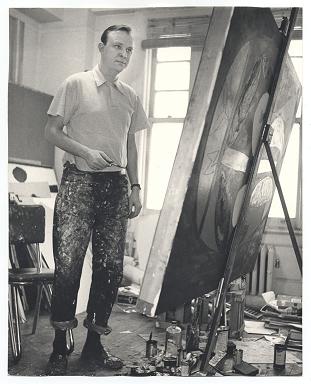
Robert Motherwell transitioned from philosophy to become a leading American Abstract Expressionist.
Museums4
Countries1
Most worksMuseum of Fine Arts, Houston, Houston · 11 works
Loading map…
Where to see Robert Motherwell
Ranked by works you can see in person.
-
11 works
Museum of Fine Arts, Houston
Houston, United States
-
10 works
Museum of Modern Art
New York City, United States


-
9 works
Metropolitan Museum of Art
New York City, United States
-
4 works
National Gallery of Art
Washington D.C., United States


Frequently Asked Questions
Where can I see Robert Motherwell's work?
Robert Motherwell's art can be viewed in many prominent collections. In New York City, major museums holding his works include the Solomon R. Guggenheim Museum, the Metropolitan Museum of Art, and the Museum of Modern Art. You can also find examples at the Whitney Museum of American Art. Elsewhere in the United States, notable institutions with Motherwell pieces are the Art Institute of Chicago; the Museum of Fine Arts, Boston; the Philadelphia Museum of Art; the National Gallery of Art in Washington, D.C.; and the Los Angeles County Museum of Art. University collections such as the Fogg Art Museum at Harvard and the Yale University Art Gallery also hold his work. Internationally, Motherwell's art can be seen at the Musée National d'Art Moderne in Paris, the Moderna Museet in Stockholm, the National Gallery of Canada in Ottawa, and the Tate Gallery in London. These various locations offer opportunities to study the scope and development of his artistic output.What should I know about Robert Motherwell's prints?
Robert Motherwell (1915-1991) is recognised as one of the most important figures in American abstract expressionism. Although he is best known for his paintings and collages, printmaking was an important part of his practice. Motherwell made his first prints in the early 1940s, and he continued to produce them throughout his career. He experimented with a range of printmaking techniques, including lithography, etching, aquatint, and screenprinting. He often combined these methods in a single print. His prints often feature the same motifs and themes as his paintings, such as bold, gestural marks, simple shapes, and a limited colour palette. Black is a frequent feature. Motherwell was interested in the expressive potential of colour and form, and he used printmaking to explore these ideas in a different medium. Some of his most well-known prints include the "Beside the Sea" series (1962), and "Africa" (1970). These works demonstrate Motherwell's interest in spontaneity, chance, and the subconscious. His prints are held in the collections of major museums around the world.Why are Robert Motherwell's works important today?
Robert Motherwell (1915-1991) was a central figure in the Abstract Expressionist movement. His art is important for several reasons. He helped to articulate the movement's theoretical foundations. Motherwell was an accomplished writer and editor. He promoted the work of his peers, and he explained the group's aims to a wider audience. Motherwell's paintings explored themes of political and social concern. The *Elegies to the Spanish Republic* series, which he began in the late 1940s, is a well-known example. These works use abstract forms to express grief and protest against fascism. Motherwell's use of scale and gesture created emotionally charged images. His exploration of personal and collective experience continues to resonate with viewers. Motherwell's work invites reflection on the human condition. His influence can be seen in the work of subsequent generations of artists who have explored abstraction as a means of expression. He remains a significant figure in 20th-century art.What techniques or materials did Robert Motherwell use?
Robert Motherwell, born in 1915, experimented with various techniques and materials throughout his career. In 1943, he and Jackson Pollock explored collage, coinciding with Peggy Guggenheim's preparations for an exhibition at Art of This Century. Although Pollock soon lost interest, Motherwell continued to work with collage. His 1943 work, "Surprise and Inspiration", combines gouache and oil paint with paper collage on cardboard. Motherwell employed cut, torn, and glued paper to create a grid-like structure, which served both as an architectural element and a support for paint application. The handling of materials and the use of shapes separated by black lines in this early collage anticipate the methods and recurring motifs of Motherwell's later output. He is also known for his series of "Elegies to the Spanish Republic", which use a limited black-and-white palette.Who did Robert Motherwell influence?
Robert Motherwell (1915-1991) was associated with Pollock, de Kooning and Rothko in the 1950s. He is considered an action painter and a central figure in the Abstract Expressionist movement in New York. In 1948, Motherwell, Rothko, Newman and other artists founded the short-lived cooperative The Subjects of the Artist. From this period onward, Motherwell began his series *Elegy to the Spanish Republic*, completing over one hundred versions in the next three decades. Motherwell's work was intellectual. His *Elegies* were not intended as coded reports or descriptions of specific events. Instead, Motherwell characterised an elegy as a funeral lament, or song, for something one cared about. The Spanish elegies, he stated, were not political, but a personal insistence that a terrible death happened that should not be forgotten. He saw the pictures as general metaphors contrasting life and death. Although black and white dominate the *Elegies*, his palette later became more colourful.Who influenced Robert Motherwell?
Robert Motherwell (1915-1991) was an American Abstract Expressionist painter. His artistic development involved several influences, both European and American. Early in his career, Motherwell was stimulated by the Surrealist movement. After moving to New York in the early 1940s, he met several European Surrealists in exile, including Max Ernst, Marcel Duchamp, and André Breton. These figures encouraged Motherwell's interest in automatism, a technique for releasing unconscious thoughts and feelings through spontaneous mark-making. Motherwell was also affected by the work of modern masters such as Henri Matisse and Pablo Picasso. He studied their use of colour, form, and composition. In addition, Motherwell was part of a circle of American artists, including Jackson Pollock, Willem de Kooning, and Mark Rothko. They shared ideas and approaches to painting, contributing to the emergence of Abstract Expressionism. Motherwell's intellectual interests also shaped his art. He studied philosophy and literature, and his paintings often engage with themes related to existentialism and political concerns.What is Robert Motherwell's most famous work?
Robert Motherwell is best known for his series *Elegies to the Spanish Republic*. He created these paintings over many years; the first was made in 1948, and he continued to produce versions of the composition until his death in 1991. The *Elegies* are abstract paintings, typically featuring large black ovoid forms and vertical bars arranged against a white background. Motherwell intended these shapes to evoke feelings of mourning and loss, specifically relating to the Spanish Civil War. He did not see them as direct representations. While the *Elegies* are his most recognised works, Motherwell had a long career and produced a varied output. He was associated with the Abstract Expressionist movement, and he experimented with different styles and media throughout his life. His other notable series include the *Beside the Sea* paintings and his open compositions.What style or movement did Robert Motherwell belong to?
Robert Motherwell (1915-1991) was a key figure in the Abstract Expressionist movement in New York. Though considered an action painter, the spontaneous elements of this style are relatively subdued in his work, which is invariably intellectual. He was one of the founders of the short-lived cooperative The Subjects of the Artist in 1948, along with Mark Rothko and Barnett Newman. His work has connections to myth, atavistic symbolism, Surrealism, and a tragic sense of history. Motherwell's paintings use simplified, quasi-geometric designs derived from Picasso and Matisse. He often preferred clear, simple colour contrasts within a restricted range. His early collages have been described as a kind of explosive Cubism. His *Elegies to the Spanish Republic* series, which occupied him for three decades, was not intended as political commentary. Instead, Motherwell described them as a private insistence that a terrible death happened that should not be forgotten; metaphors of the contrast between life and death and their interrelation.
Sources
Where to See guide aggregates verified holdings of Robert Motherwell's works across the following collections.
- [1] book Jed Perl, Art in America 1945-1970 Used for: biography, stylistic analysis.
- [2] book Susie Hodge, Artistic Circles Used for: biography.
- [3] book guggenheim-handboo00pegg Used for: biography, stylistic analysis.
- [4] book Masterpieces of western art : a history of art in 900 individual studies from the Gothic to the present day Used for: biography, stylistic analysis.
Editorial overseen by Solis Prints. Sources verified 2026-09-24. Click a source for details, or hover over [N] in the page above to preview.
Editorial standardsMethodologyCorrectionsAI disclosureAbout the editorial team