



About Akseli Gallen-Kallela
- Romanticism
- Symbolism
- romantic nationalism
Finland's defining national artist, whose Kalevala paintings of the 1890s established the visual language of Finnish independence.
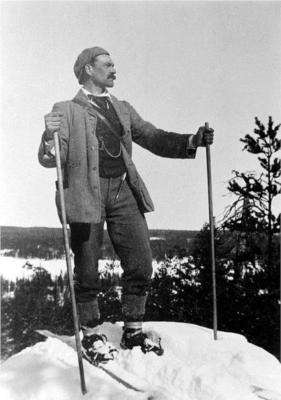
Where to see Akseli Gallen-Kallela
Collection holdings are reported here; current display varies. Check with each museum before visiting.
-
132 recorded works
Finnish National Gallery
Helsinki, Finland
Also here (6)


-
2 recorded works
Sparebankstiftelsen DNB’s collection
Oslo, Norway
Also here (2)
-
2 recorded works
Nationalmuseum
Stockholm, Sweden
-
1 recorded work
Pushkin Museum of Fine Arts
Moscow, Russia
-
1 recorded work
Hungarian National Gallery
Budapest, Hungary
Also here (6)
Bertalan SzekelyVilmos Aba-NovakEndre BalintAladar Korosfoi-KrieschEgry JózsefAugust von Pettenkofen -
1 recorded work
National Gallery
London, United Kingdom
-
1 recorded work
Art Institute of Chicago
Chicago, United States
-
1 recorded work
Musée d'Orsay
Paris, France
-
1 recorded work
Belvedere
Vienna, Austria


Own a piece of it
Akseli Gallen-Kallela prints
Hand-finished archival prints from Akseli Gallen-Kallela's body of work.

View all 11 museums
-
1 recorded work
Gothenburg Museum of Art
Gothenburg, Sweden

Can't travel? Bring Akseli Gallen-Kallela home.
See all Akseli Gallen-Kallela prints →Frequently Asked Questions
Where can I see Akseli Gallen-Kallela's work?
Akseli Gallen-Kallela's paintings and prints are held in numerous public collections. The Gallen-Kallela Museum is located in Espoo, Finland, in a studio-home the artist designed himself, and holds a large collection of his work. The Ateneum Art Museum in Helsinki also has a substantial collection of his paintings, drawings, and prints. These include major works such as *Aino Myth* (1891[2]) and *Lemminkäinen's Mother* (1897). Other Finnish museums with works by Gallen-Kallela include the Turku Art Museum and the Didrichsen Art Museum, Helsinki. Outside Finland, Gallen-Kallela's art can be found in museums such as the Gothenburg Museum of Art in Sweden, which holds his painting *Autumn* (1894). The Nationalmuseum in Stockholm also possesses examples of his graphic work. Further afield, the Musée d’Orsay in Paris has his *Lake Keitele* (1905), and smaller collections are held in various museums in the United States and elsewhere. Catalogues of Finnish art may provide further details of specific holdings.What should I know about Akseli Gallen-Kallela's prints?
Akseli Gallen-Kallela, a Finnish artist, was a prominent figure in the Symbolist movement. He gained international recognition for his illustrations of the Kalevala, Finland's national epic. In 1902[2], Gallen-Kallela exhibited thirty-six works at the Phalanx exhibition in Munich, where he was a star attraction. The selection included both decorative Symbolist pieces and more naturalistic works. Landscape Under Snow (1902) demonstrated a formal abstractness, blurring the line between the real and the symbolic. Gallen-Kallela's illustrations of the Kalevala saga made a significant impression. Episodes such as Knllervo Goes to War (1901) were exhibited at Phalanx. His reliance on folk legend as a basis for symbolism, his use of colour, and the degree of abstraction in his applied-art designs were all notable. Examples include Seaflower (1900-02) and Defense of the Sampo (1900). Kandinsky was influenced by Gallen-Kallela's imagery and approach to art.Why are Akseli Gallen-Kallela's works important today?
Akseli Gallen-Kallela (1865[2]-1931[2]) was a Finnish painter associated with the Art Nouveau style. His importance today stems from his contribution to Finnish national identity and his synthesis of tradition with modernity. The late 19th century saw artists attempting to reconcile references to national identity with a forward-looking vision. Gallen-Kallela integrated new technology with high-quality craftsmanship. He drew inspiration from Finnish folklore, especially the Kalevala, Finland's national epic, using its stories to create paintings that resonated with a desire for national self-expression. Gallen-Kallela's work also reflects the broader European Art Nouveau movement, which sought to extend beauty to all and repair the fractured modern soul through rational design. His exploration of Finnish mythology and his application of Art Nouveau principles contributed to a unique artistic vision. The developments of the 1910s and the First World War had comparatively little impression on his vision.What techniques or materials did Akseli Gallen-Kallela use?
Akseli Gallen-Kallela was a Finnish artist who worked across several media. Although specific details of his studio practice are scarce, we can infer some techniques from the practices of his contemporaries. Artists such as James McNeill Whistler often used specific materials to achieve particular effects. Whistler favoured heavy canvases for larger works, applying thin grounds to maintain the texture. He also employed light gray imprimaturas, later transitioning to darker gray grounds to create chiaroscuro effects. For dark grounds, ivory black and lead white were mixed, sometimes with other pigments. Whistler also prepared his palette meticulously, arranging colours in a specific order. Similarly, J.M.W. Turner, initially a watercolourist, transferred many watercolour techniques to oil painting. He preferred absorbent primings and developed optical greens by layering washes of brown and blue. Turner also used white grounds to enhance luminosity. While it is not possible to state definitively that Gallen-Kallela used these exact methods, these examples provide insight into the materials and techniques common among artists of the period.Who did Akseli Gallen-Kallela influence?
It is difficult to say precisely who Akseli Gallen-Kallela influenced. Evidence from the Budapest art market suggests some artists were accused of mimicking masters such as Gauguin. József Yartin, for example, commented on Béla Iványi-Grünwald’s imitation of Gauguin, joking that the similarity lay in Gauguin painting Samoans in Tahiti, while Iványi painted Gypsies in Tahitót-falu. The French Masters show of December 1907[2], which included Manet, Claude Monet, Edgar Degas and Camille Pissarro, introduced Impressionism to Hungary. Lajos Ernst stated that the goal of the exhibitions was to "familiarize the art-loving public with Modern Western movements, with the purpose being to serve in promoting the development of local Modern art." The inserted Hungarian works made an odd counterpart, with no participation by any local practitioners of Impressionism, with the exception of Simon Hollósy.Who influenced Akseli Gallen-Kallela?
Akseli Gallen-Kallela (1865[2]-1931[2]) was a Finnish artist associated with Symbolism[2]. He drew inspiration from the Kalevala, the Finnish national epic, which provided subject matter for many of his works. Gallen-Kallela's association with the German artist Wassily Kandinsky is documented by their correspondence. Kandinsky invited Gallen-Kallela to exhibit with the Phalanx group in Munich in 1901[2]. The Phalanx exhibitions aimed to give artists opportunities to display their work. Gallen-Kallela exhibited thirty-six works in 1902. These included illustrations from the Kalevala saga, such as *Knllervo Goes to War*, as well as more naturalistic pieces such as *Landscape Under Snow*. Kandinsky was impressed by Gallen-Kallela's use of folk legend as a basis for his symbolism. He also noted the bold colours and degree of abstraction in Gallen-Kallela's decorative works, such as *Seaflower* and *Flame*. The horse-and-rider motif in Gallen-Kallela's *Knllervo Goes to War* also made a lasting impression on Kandinsky.What style or movement did Akseli Gallen-Kallela belong to?
Akseli Gallen-Kallela is associated with the Symbolist movement, which gained traction during the Post-Impressionist era. Symbolism[2], in the words of Remy de Gourmont, was an anti-naturalist movement. Therefore, in painting, sculpture, and graphics, it stood in opposition to both realism and impressionism. Symbolism in the plastic arts was more a reflection of literary and intellectual trends. The movement encompassed artists with diverse creative approaches. Symbolism's forerunners included artists such as Francisco Goya, William Blake, and Johann Heinrich Füssli, as well as the German Romantics, the Nazarenes, and the Pre-Raphaelite Brotherhood. Many artists at the end of the nineteenth century connected their work to the concepts, symbols, and subjects of symbolist literature. Other symbolist artists include Edvard Munch, Mikhail Vrubel, and Ferdinand Hodler. Some Symbolists contributed to the development of art nouveau, also known as Jugendstil and Modern in other countries.What was Akseli Gallen-Kallela known for?
Akseli Gallen-Kallela (1865[2]-1931[2]) was a Finnish painter known for his contributions to Finnish national romanticism. He is particularly well known for his illustrations of the *Kalevala*, the Finnish national epic. Gallen-Kallela's early work was influenced by naturalism and realism. However, he soon developed a style that combined these influences with elements of symbolism and Art Nouveau. This style is evident in his *Kalevala* illustrations, which depict scenes from Finnish mythology in a dramatic and stylised manner. Among his best-known paintings are *The Defence of the Sampo*, *Lemminkäinen's Mother*, and *Kullervo's Curse*. Beyond his *Kalevala* works, Gallen-Kallela also produced portraits and works depicting the Finnish countryside. He was a versatile artist who experimented with various media, including painting, printmaking, and design. He also designed the Finnish pavilion for the Paris Exposition of 1900[2]. Gallen-Kallela's art played a significant role in shaping Finnish national identity during the late 19th and early 20th centuries.
Sources
Where to See guide aggregates verified holdings of Akseli Gallen-Kallela's works across the following collections.
- [1] academic The Editors of Encyclopaedia Britannica, Akseli Gallen-Kallela | Finnish artist | Britannica Used for: biography.
- [2] wikipedia Wikipedia: Akseli Gallen-Kallela Used for: biography.
- [3] book Brodskaya Nathalia, Brodskaya Nathalia - Symbolism Used for: biography.
- [4] book guggenheim-guhe00solo Used for: biography.
- [5] book Masterpieces of western art : a history of art in 900 individual studies from the Gothic to the present day Used for: biography.
- [6] museum Akseli Gallen-Kallela (1865 - 1931) | National Gallery, London Used for: biography.
- [7] museum Akseli Gallen-Kallela | Lake Keitele | NG6577 | National Gallery, London Used for: notable works.
- [8] museum Akseli Gallen-Kallela | MoMA Used for: museum holdings.
Editorial overseen by Solis Prints. Sources verified 2026-09-30. Click a source for details, or hover over [N] in the page above to preview.
Editorial standardsMethodologyCorrectionsAI disclosureAbout the editorial team