



About Alfred Stieglitz
an engineering student turned photographer who gave Picasso his American debut, exhibited O'Keeffe's drawings without asking, and photographed clouds as music
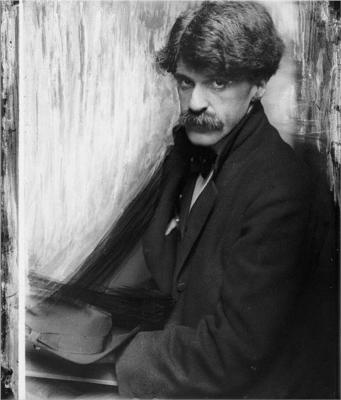
Where to see Alfred Stieglitz
Ranked by works you can see in person.
-
 1704 works
National Gallery of Art
Washington D.C., United States
-
 11 works
Metropolitan Museum of Art
New York City, United States
-
10 works
Cleveland Museum of Art
Cleveland, United States
-
 3 works
Museum of Modern Art
New York City, United States
-
2 works
J. Paul Getty Museum
Los Angeles, United States
-
2 works
Musée d'Orsay
Paris, France
-
1 work
Buffalo AKG Art Museum
Buffalo, United States
-
1 work
Museum of Fine Arts Boston
Boston, United States
-
1 work
Museo Nacional Centro de Arte Reina Sofía
Madrid, Spain
-
1 work
Art Institute of Chicago
Chicago, United States


Own a piece of it
Alfred Stieglitz prints
Hand-finished archival prints from Alfred Stieglitz's body of work.


View all 12 museums
-
1 work
collection of the Musée d’art contemporain de Montréal
Montreal, Canada
-
1 work
Philadelphia Museum of Art
Philadelphia, United States

Can't travel? Bring Alfred Stieglitz home.
See all Alfred Stieglitz prints →Frequently Asked Questions
Where can I see Alfred Stieglitz's work?
Alfred Stieglitz's photographs can be viewed at the Museum of Modern Art[6] in New York; their collection includes "The Flatiron Building" (1903). Stieglitz was active in New York's art scene, and his 291 gallery held some of the earliest exhibitions of European modernists, such as Picasso, Matisse, and Brancusi, in the United States. A show in 2004 at the Musée D'Orsay (Paris) explored Stieglitz's cultural role in New York during the early 1900s; the exhibition catalogue was titled "New York et l'art moderne: Alfred Stieglitz et son cercle". Stieglitz initially adhered to Pictorialism. This movement used manipulation and printing processes to give photographs a painterly aesthetic, with soft tones and diffused effects. Around 1907, Stieglitz moved toward straight photography, which favoured the specific technical and expressive capabilities of the camera without manual intervention. Straight photography often depicted modern life, cities, and machines.When did Alfred Stieglitz start photography?
Alfred Stieglitz started photography while studying engineering in Berlin. He discovered photo-chemistry in 1882, bought his first camera, and abandoned his degree plan.Did Alfred Stieglitz have a studio?
In 1905, Alfred Stieglitz opened the Little Galleries of the Photo-Secession at 291 Fifth Avenue. It was known simply as 291.How did Alfred Stieglitz get into photography?
Alfred Stieglitz discovered photo-chemistry while studying engineering in Berlin. He then bought his first camera and abandoned his degree plan.Why did Alfred Stieglitz become a photographer?
Alfred Stieglitz went to Berlin to study engineering, discovered photo-chemistry, and bought his first camera. He then abandoned his degree plan to become a photographer.Is Alfred Stieglitz associated with pure photography?
Alfred Stieglitz believed in making only straight, unmanipulated photographs. He exposed and printed them using basic photographic processes.Who did Alfred Stieglitz influence?
Alfred Stieglitz influenced many through his photography and promotion of modern art. He championed photography as a fine art, founding the Photo-Secession group and publishing the journal *Camera Work*. His photographs, such as *The Steerage* (1907), reveal his interest in formal elements and their emotional impact. Stieglitz's efforts to gain recognition for photography as an art form also inspired Edward Weston, who experimented with abstraction in his photographs. Beyond photography, Stieglitz was a catalyst for modernism in the United States. His galleries, including the Little Galleries of the Photo-Secession (known as 291), introduced Americans to European artists such as Pablo Picasso, Henri de Toulouse-Lautrec, Henri Matisse, and Paul Cézanne. He also exhibited American modernists, including Arthur Dove, John Marin, and Marsden Hartley. Stieglitz married Georgia O'Keeffe, a major figure in American art, and photographed her extensively. He connected many figures in the early American art scene.Who influenced Alfred Stieglitz?
Alfred Stieglitz's influences came from multiple sources. He studied photochemistry in Germany, where he began to advocate for photography as a fine art. His aesthetic approach took shape while making *The Steerage* (1907). He saw subjects as arrangements of forms and the "colours" of black-and-white materials. Stieglitz's photography of the period was influenced by Japanese woodcut prints. This is evident in the silhouetted tree and the tiny figures in *The Flatiron Building* (1903). As the founder of the 291 gallery in New York, Stieglitz promoted avant-garde painters and sculptors. The gallery organised some of the earliest exhibitions in America of contemporary European artists, including Picasso, Matisse and Brancusi. He exhibited Auguste Rodin, Henri Rousseau, Paul Cézanne, John Marin, and Marsden Hartley. Stieglitz aimed to create a dialogue between artists of all types: painters, draftsmen, sculptors, and photographers; European and American artists; older and younger practitioners. Stieglitz married Georgia O'Keeffe, herself a force in American art.
Sources
Where to See guide aggregates verified holdings of Alfred Stieglitz's works across the following collections.
- [1] museum Cleveland Museum of Art Used for: museum holdings.
- [2] museum Museum of Fine Arts Boston Used for: museum holdings.
- [3] museum J. Paul Getty Museum Used for: museum holdings.
- [4] museum National Gallery of Art Used for: museum holdings.
- [5] museum Museo Nacional Centro de Arte Reina Sofía Used for: museum holdings.
- [6] museum Museum of Modern Art Used for: museum holdings.
- [7] book Fred S. Kleiner, Gardner's Art through the Ages Used for: biography.
- [8] book Fred S. Kleiner, Gardner's Art through the Ages: A Concise History of Western Art, 2nd ed. Used for: biography.
Editorial overseen by Solis Prints. Sources verified 2026-09-26. Click a source for details, or hover over [N] in the page above to preview.
Editorial standardsMethodologyCorrectionsAI disclosureAbout the editorial team