



About Eugene von Guerard
1811–1901
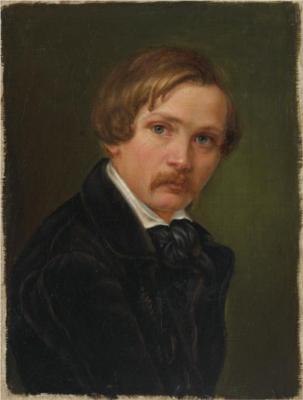
Vienna-born, Düsseldorf-trained landscape painter who spent thirty years mapping the Australian interior with Romantic precision and scientific exactitude.
Museums3
Countries2
Most worksNational Gallery of Victoria, Melbourne · 14 works
Loading map…
Where to see Eugene von Guerard
Ranked by works you can see in person.
-
14 works
National Gallery of Victoria
Melbourne, Australia
Also here (6)
-
8 works
Art Gallery of South Australia
Adelaide, Australia


-
1 works
Auckland Art Gallery Toi o Tāmaki
Auckland, New Zealand

Own a piece of it
Eugene von Guerard prints
Hand-finished archival prints from Eugene von Guerard's body of work.
 View of Geelong - Eugene von Guerard
From £28.00
View of Geelong - Eugene von Guerard
From £28.00
 View of Geelong, the Corio Bay and Indented Heads from the southern declivity of Station Peak - Eugene von Guerard
From £28.00
View of Geelong, the Corio Bay and Indented Heads from the southern declivity of Station Peak - Eugene von Guerard
From £28.00
 Lake Illawarra, N.S.W. - Eugene von Guerard
From £28.00
Lake Illawarra, N.S.W. - Eugene von Guerard
From £28.00
 North East View from the Top of Mount Kosciusko - Eugene von Guerard
From £28.00
North East View from the Top of Mount Kosciusko - Eugene von Guerard
From £28.00
 Fresh water lake near the coast between the mouth of the Glenelg and Cape Bridgewater - Eugene von Guerard
From £28.00
Fresh water lake near the coast between the mouth of the Glenelg and Cape Bridgewater - Eugene von Guerard
From £28.00
 Crater of Mount Eccles, West from Mount Napier - Eugene von Guerard
From £28.00
Crater of Mount Eccles, West from Mount Napier - Eugene von Guerard
From £28.00
 Mount William and part of the Grampians in West Victoria - Eugene von Guerard
From £28.00
Mount William and part of the Grampians in West Victoria - Eugene von Guerard
From £28.00
 The Warrion Hills seen from Robertson's Hill near Colac and in the distance part of the Lake Corangamite and the Australian Pyrenees - Eugene von Guerard
From £28.00
The Warrion Hills seen from Robertson's Hill near Colac and in the distance part of the Lake Corangamite and the Australian Pyrenees - Eugene von Guerard
From £28.00
Can't travel? Bring Eugene von Guerard home.
See all Eugene von Guerard prints →Frequently Asked Questions
Where can I see Eugene von Guerard's work?
Eugene von Guerard's artwork can be viewed in several galleries and museums. In Australia, the Art Gallery of New South Wales (in Sydney) holds works by von Guerard. In Canada, the Art Gallery of Ontario (in Toronto) has von Guerard's pieces in its collection. In the United States, several institutions hold his art. These include the Metropolitan Museum of Art (New York), the Museum of Modern Art (New York), the Yale University Art Gallery (New Haven), the Philadelphia Museum of Art, the Carnegie Museum of Art (Pittsburgh), the Corcoran Gallery of Art (Washington DC), the Hirshhorn Museum and Sculpture Garden (Washington DC), the National Gallery of Art (Washington DC), and the National Museum of American Art (Washington DC). Other US locations include the Los Angeles County Museum of Art, the Minneapolis Institute of Arts, the Virginia Museum of Fine Arts (Richmond), and the Charles Hosmer Morse Museum of American Art (Winter Park, Florida).What should I know about Eugene von Guerard's prints?
Prints relating to Eugene von Guerard are not widely discussed in the art historical record. However, prints were a popular medium during his lifetime, and some context about printmaking in the 19th century may be useful. During the 1800s, various printmaking techniques saw extensive use. Mezzotint, etching, and mixed methods were employed to reproduce paintings and original works. The Pre-Raphaelite artists, for example, relied on printmakers to disseminate their images. Publishers such as Thomas Agnew and Gambart commissioned engravings of popular paintings, making them accessible to a wider audience. The rise of photoengraving, a quicker and cheaper method, eventually undermined the fine art engraver. While offering the possibility of larger editions and greater fidelity to the original, it involved less artistic input. Despite this shift, some artists remained selective about using photoengraving for direct reproductions of their work.Why are Eugene von Guerard's works important today?
Eugene von Guerard (1811[2]-1901[2]) was an Austrian-born artist who worked extensively in Australia. His paintings are valued today, not only for their aesthetic qualities, but also as historical records. Von Guerard's detailed depictions of the Australian terrain, particularly his early works from the 1850s and 1860s, offer insights into the environment before extensive European settlement. His paintings document specific locations, geological formations, and vegetation, creating a visual archive of a changing continent. His work is significant to the history of Australian art. He combined European painting traditions with the unique characteristics of the Australian environment, contributing to the development of a distinct Australian artistic identity. His attention to detail and scientific accuracy make his paintings valuable resources for researchers in fields such as environmental history and botany. They provide a window into the past, allowing us to understand the transformations that have occurred in the Australian environment over time.Who did Eugene von Guerard influence?
Eugene von Guerard's artistic impact is complex. While not directly associated with a formal school, his detailed realism and approach to representing the Australian terrain influenced later generations of Australian artists. Some art historians suggest that his influence can be seen in the work of painters who followed him in depicting the Australian bush. However, it is difficult to trace a direct line of influence, as many artists developed independently, responding to the same environment. Von Guerard's paintings also provided a visual record of the landscape during a period of significant change, due to European settlement. In this sense, his work has had an impact on how subsequent generations have perceived the Australian environment, both artistically and historically. His detailed depictions offer a valuable resource for understanding changes in the environment over time.Who influenced Eugene von Guerard?
It is difficult to summarise the influences on Eugene von Guerard. However, loose connections can be drawn between von Guerard and other artists. Pierre Puvis de Chavannes (1824[2]-98) was a French painter known for his mural and decorative painting. Uninfluenced by Impressionism, he favored mythological and symbolic subjects. Younger artists admired him, but seldom imitated him. Gustave Moreau (1826-98) taught most of the Fauves, and had a considerable influence on aspects of Post-Impressionism. His own style was ornate and appealed to writers. Georges Seurat (1859-91) devoted himself to tonal drawings influenced by Ingres and Puvis de Chavannes. These artists were active in Europe during von Guerard's lifetime and represent some of the artistic trends of the period.What is Eugene von Guerard's most famous work?
It is difficult to identify one single "most famous work" by Eugene von Guerard, as fame and recognition can shift over time and across different audiences. However, some of his best-known paintings include "Mount Kosciusko", completed in 1863[2], and "North-east View from the Summit of Mount Kosciusko", completed c. 1863. These paintings are celebrated for their detailed depiction of the Australian alpine region. Another notable work is "Ferntree Gully in the Dandenong Ranges", created in 1857. This piece captures the lushness of the Australian bush and demonstrates von Guerard's skill in portraying natural environments. Ultimately, the "most famous" work is subjective and may depend on individual preferences and art historical perspectives.What style or movement did Eugene von Guerard belong to?
Art styles are devices by which artworks are created; each work possesses a style specific to itself, regardless of the general style of its era. Styles are devices or manners of creating art. When a style appears, especially if given immediate expression, it can be incomprehensible, like the style of a remote age. A new style refracts previous styles and life. There is no such thing as a copy, but there is such a thing as a work of art with the same departure point, whether another artwork or nature. Cubism, for example, manifests in classical, academic, romantic, realist, and abstract forms. Futurism promotes dynamism, concerned with all kinds of art, not merely painting. Impressionism advocated the coloured surface, leading to theories of displaced coloured surfaces and movement.What was Eugene von Guerard known for?
Information on Eugene von Guerard is not available in the reference passages. The passages contain biographical notes on Edouard Vuillard, Edward Wadsworth, Jean Xceron, Henri Rousseau, Rolph Scarlett, Kurt Schwitters, Georges-Pierre Seurat, W. Shwab, Vieira da Silva, Styrsky, Toyen, Georges Valmier, F. Vordemberge-Gildewart, Rudolf Bauer, Pierre Bonnard, David Burliuk, Heinrich Campendonk, and Penrod Centurion. Edouard Vuillard (born 1868[2]) was a French artist known for his lithographs and association with the Nabis, a group of artists including Paul Serusier, Paul Ranson, Maurice Denis, and Bonnard. The Nabis, meaning "prophets" in Hebrew, used colour inspired by Gauguin and sought practical applications for their art, such as stage design. Vuillard designed theatrical sets, posters, and illustrations. Ambroise Vollard commissioned him to create an album of colour lithographs in 1896. He exhibited at the Salon des Independants until 1910 and at the Salon d'Automne until 1913. A major retrospective of his work was held at the Musee des Arts Decoratifs in Paris in 1938. He died in La Baule in 1940.
Sources
Where to See guide aggregates verified holdings of Eugene von Guerard's works across the following collections.
- [1] museum Art Gallery of South Australia Used for: museum holdings.
- [2] wikipedia Wikipedia: Eugene von Guerard Used for: biography.
- [3] book Palmer, Allison Lee, Historical Dictionary of Neoclassical Art and Architecture Used for: biography.
- [4] book Masterpieces of western art : a history of art in 900 individual studies from the Gothic to the present day Used for: biography.
- [5] book Post-impressionism : cross-currents in European painting Used for: biography.
Editorial overseen by Solis Prints. Sources verified 2026-09-24. Click a source for details, or hover over [N] in the page above to preview.
Editorial standardsMethodologyCorrectionsAI disclosureAbout the editorial team