



About Augustus John
Welsh Slade-trained painter whose A Family Group (1908[2], Dublin) and 1910 Martigues panels drew comparisons with Cézanne and Van Gogh.
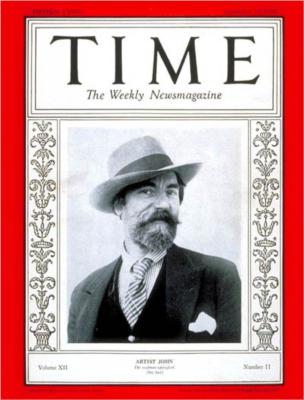
Where to see Augustus John
Ranked by works you can see in person.
-
135 works
National Museum Cardiff
Cardiff, United Kingdom
-
25 works
Tate
London, United Kingdom


-
21 works
National Gallery
London, United Kingdom
-
21 works
Fitzwilliam Museum
Cambridge, United Kingdom
-
13 works
National Gallery of Canada
Ottawa, Canada
-
8 works
Manchester Art Gallery
Manchester, United Kingdom
-
6 works
National Portrait Gallery
London, United Kingdom
-
5 works
Aberdeen Archives, Gallery and Museums collections
Aberdeen, United Kingdom
-
5 works
National Gallery of Victoria
Melbourne, Australia
-
5 works
National Gallery of Ireland
Dublin, Ireland
Also here (6)


Own a piece of it
Augustus John prints
Hand-finished archival prints from Augustus John's body of work.

View all 52 museums
-
4 works
Buffalo AKG Art Museum
Buffalo, United States
-
4 works
UCL Art Museum
London, United Kingdom
-
4 works
National Trust
Swindon, United Kingdom
-
4 works
Yale University Art Gallery
New Haven, United States
-
3 works
Walker Art Gallery
Liverpool, United Kingdom
-
3 works
Art Gallery of South Australia
Adelaide, Australia
-
3 works
Metropolitan Museum of Art
New York City, United States
-
3 works
Hugh Lane Gallery
Dublin, Ireland
-
2 works
Ulster Museum
Belfast, United Kingdom
-
2 works
National Galleries Scotland
Edinburgh, United Kingdom
-
2 works
Royal Academy of Arts
London, United Kingdom
-
2 works
Laing Art Gallery
Newcastle upon Tyne, United Kingdom
-
2 works
National Gallery of Art
Washington D.C., United States
-
2 works
Harvard Art Museums
Cambridge, United States
-
2 works
Art Institute of Chicago
Chicago, United States
-
2 works
Birmingham Museums Trust
Birmingham, United Kingdom
-
2 works
Auckland Art Gallery Toi o Tāmaki
Auckland, New Zealand
-
1 works
Courtauld Gallery
London, United Kingdom
-
1 works
Harris Museum
Preston, United Kingdom
-
1 works
Newport Museum and Art Gallery
Newport, United Kingdom
-
1 works
Canadian War Museum
Ottawa, Canada
-
1 works
Museum of Fine Arts Boston
Boston, United States
-
1 works
Carnegie Museum of Art
Pittsburgh, United States
-
1 works
Glasgow Museums Resource Centre
Glasgow, United Kingdom
-
1 works
Stanley & Audrey Burton Gallery
Leeds, United Kingdom
-
1 works
Bolton Museum
Bolton, United Kingdom
-
1 works
Hunterian Museum and Art Gallery
Glasgow, United Kingdom
-
1 works
Tate Britain
London, United Kingdom
-
1 works
Atkinson Art Gallery and Library
Southport, United Kingdom
-
1 works
Imperial War Museums
London, United Kingdom
-
1 works
Dumbarton Oaks
Washington D.C., United States
-
1 works
Nationalmuseum
Stockholm, Sweden
-
1 works
Rijksmuseum
Amsterdam, Netherlands
-
1 works
Lady Lever Art Gallery
Port Sunlight, United Kingdom
-
1 works
RISD Museum
Providence, United States
-
1 works
Leicester Museum & Art Gallery
Leicester, United Kingdom
-
1 works
Cartwright Hall Art Gallery
Bradford, United Kingdom
-
1 works
Detroit Institute of Arts
Detroit, United States
-
1 works
Musée National d'Art Moderne
Paris, France
-
1 works
Royal Collection
London, United Kingdom


2 more museums hold works by Augustus John with smaller collections, not listed here.
Can't travel? Bring Augustus John home.
See all Augustus John prints →Frequently Asked Questions
Where can I see Augustus John's work?
Augustus John[6]'s works can be found in numerous public and private collections. These include the National Gallery, the National Portrait Gallery, the Tate Gallery, and the Victoria and Albert Museum, all in London. Other UK institutions holding his work are the Ulster Museum in Belfast; the Barber Institute of Fine Arts in Birmingham; Bradford Museums and Art Galleries; Bristol Art Gallery; the Fitzwilliam Museum in Cambridge; the National Museum of Wales in Cardiff; the National Gallery of Scotland and the Scottish National Gallery of Modern Art in Edinburgh; the Glasgow Art Gallery and Museum; Hull University Art Collection; Ipswich Museum; Kirkcaldy Museum and Art Gallery; Leeds City Art Gallery; the Walker Art Gallery in Liverpool; Manchester City Art Gallery; the Laing Art Gallery in Newcastle-upon-Tyne; the Central Museum and Art Gallery in Northampton; the Ashmolean Museum in Oxford; the Plymouth City Museum and Art Gallery; the Graves Art Gallery in Sheffield; and the Southampton Art Gallery.What should I know about Augustus John's prints?
During the late 19th century, fine art etchings gained considerable popularity, leading publishers to launch specialist magazines like *The Etcher* and *English Etchings*. Etching was considered a medium for the cultured, in contrast to the mass appeal of engravings. Publishers also looked to the Continent, where talented reproductive etchers were more affordable than their British[6]","author":null,"year":null,"publisher":null,"type":"wikipedia","url":"https://en.wikipedia.org/wiki/Augustus_John","used_for":"biography"}">[2] counterparts. Although the Printsellers’ Association did not fully track etching editions, the market for fine art etchings became increasingly international. Edward Burne-Jones, a highly respected painter, recognised the potential of engraving and collaborated with engravers to reproduce his works. He believed that etchings and mezzotints could even improve the ethereal qualities of his subjects. To ensure quality and exclusivity, plates were often destroyed after small editions of 200 to 400 prints. Printmakers often limit editions, marking each print with a fraction indicating the print number and the total edition size. The title is written in the centre, and the signature on the right, all in pencil. While these conventions are not legally binding, they are widely respected within the printmaking community.Why are Augustus John's works important today?
Augustus John[6] (born in Wales, 1878[2]; died 1961[2]) studied at the Slade and taught at Liverpool University. He was co-principal, with William Orpen, of the Chelsea Art School. John exhibited widely, becoming a member of the New English Art Club in 1903[2]. He joined the Camden Town Group, but only sent work to their first exhibition in June 1911. His paintings are important for several reasons. In 1907, John met Picasso in Paris. The same year, seeing an exhibition of drawings by Puvis de Chavannes encouraged him to simplify his compositions, use large figures, and experiment with colour. His painting *A Family Group* (circa 1908) shows his wives, Ida and Dorelia, with their children. It anticipates later paintings such as *The Way Down to the Sea* and *The Lyric Fantasy*, both of which depict Dorelia and Ida in similar settings. Contemporary critics noted that John's simplification of form rejected the 'accessory facts' that viewers expected. Around 1910, John painted a series of smaller works in Provence. Critics such as C. J. Holmes considered John one of the few significant post-impressionist painters, alongside Cézanne, Van Gogh, and Gauguin.What techniques or materials did Augustus John use?
Details of Augustus John[6]'s techniques are not included in the reference passages. The passages do, however, discuss the materials and approaches of some contemporary British[2] artists. Turner, a generation before John, spent a decade as a watercolourist, developing techniques he later used in oils. His early watercolours featured transparent washes over white paper, reserving highlights. Greens were achieved by mixing or overlaying washes of brown and blue. Turner produced over 20,000 sketches and watercolours, but few had direct counterparts in oil. He used white priming for many of his oils, both finished and unfinished, in the early 1800s; later, most of his supports had white grounds. These absorbent surfaces allowed him to rapidly assess the final colour and develop compositions quickly. Gainsborough favoured warm, red-brown grounds, described as resembling tanned leather, particularly for pictures of the countryside. He began work in subdued light, assessing his subject in basic shapes and tonal areas. He used rapid strokes of black, umber, lake, or white paint, followed by washes of thinned colour to block out the form. The thin underlayers dried quickly, allowing him to apply translucent, opaque, and glazing colours rapidly, often wet-in-wet.Who did Augustus John influence?
Augustus John[6]'s impact can be seen in the work of James Dickson Innes, among others. John taught painting at Liverpool University from 1901[2] to 1904, and he was co-principal, with William Orpen, of the Chelsea Art School. Innes met John in 1907 and regularly visited him. Innes's paintings became bolder and brighter after seeing John's Provencal studies at the Chenil Gallery in 1911, as well as the paintings of Matisse. John's paintings, such as *A Family Group*, used simplified compositions. Roger Fry noted that John "rejected so many accessory facts that the spectator was in the habit of expecting". *A Family Group* anticipates other large paintings by John, such as *The Way Down to the Sea* and *The Lyric Fantasy*. Critics such as C.J. Holmes considered John alongside Cezanne, Van Gogh, and Gauguin as important figures of Post-Impressionism[2].Who influenced Augustus John?
Augustus John[6], born in Wales, studied at the Slade School of Fine Art from 1894[2] to 1898. He taught painting at Liverpool University from 1901 to 1904 and co-ran the Chelsea Art School with William Orpen. Several artistic influences affected John's development. He was introduced to the work of Puvis de Chavannes by Rothenstein and saw Rothenstein's drawings in 1900. The impact of the 1907 exhibition of Puvis' drawings in Paris was considerable. John admired the Greek lightness in Puvis' work. The influence of Puvis can be seen in John's monumental figures, shallow space, and decorative backgrounds; for example, in *A Family Group* (circa 1908), which uses a rhythmic pattern of red, blue, and yellow against a blue-green background. John also visited Picasso's studio in 1907 and saw paintings from the Blue and Rose periods, along with *Les Demoiselles d'Avignon*. In 1910, he painted a series of works at Martigues. Critics noted that John, along with Cézanne, Van Gogh, and Gauguin, was at the forefront of Post-Impressionism[2]. His Provençal studies were admired for their simplified forms and pure colours.What is Augustus John's most famous work?
Augustus John[6]'s most famous work is *A Family Group*, painted around 1908[2]. This large oil painting (measuring approximately 209.5 x 181 cm) is an idealised depiction of family life, portraying John's two wives, Ida and Dorelia, along with their children. Although pen-and-ink drawings related to the composition date to around 1905, John only began the painting after Ida's death in March 1907. Two experiences in Paris that year influenced him to paint a simplified composition on a large scale. The first was seeing an exhibition of drawings by Puvis de Chavannes; the second was a visit to Picasso’s studio. John saw paintings from Picasso's 'Blue' and 'Rose' periods, as well as *Les Demoiselles d'Avignon*. *A Family Group* anticipates later large paintings such as *The Way Down to the Sea* (1909-11) and *The Lyric Fantasy* (1911-14), both of which also feature Dorelia and Ida in idealised settings. The Hugh Lane Municipal Gallery of Modern Art in Dublin holds *A Family Group*.What style or movement did Augustus John belong to?
Augustus John[6] (born in Wales, 1878[2]; died 1961[2]) is associated with Post-Impressionism[2], though he resisted being categorised. He studied at the Slade School of Fine Art from 1894[2] to 1898. He later taught at Liverpool University and co-ran the Chelsea Art School with William Orpen. John exhibited with the New English Art Club, becoming a member in 1903, as well as with the International Society and the Allied Artists' Association. He briefly joined the Camden Town Group, contributing to their first exhibition in June 1911. A Family Group, circa 1908, shows John's two wives, Ida and Dorelia, with their children. The painting, an idealised family scene, reveals the influence of Puvis de Chavannes, particularly in its monumental figures and shallow space. John's visit to Picasso’s studio in 1907 also affected his style. He saw paintings from the ‘Blue’ and ‘Rose’ Periods, as well as Les Demoiselles d'Avignon. Critics noted the simplification in John’s paintings. Some considered him a leading British[2] figure in the Post-Impressionist movement, particularly for works done in France around 1910.
Sources
Where to See guide aggregates verified holdings of Augustus John's works across the following collections.
- [1] academic The Editors of Encyclopaedia Britannica, Augustus John | Post-Impressionist, Portraitist, Bohemian Used for: biography.
- [2] wikipedia Wikipedia: Augustus John Used for: biography.
- [3] book Beard, Lee, 1973- author, Butler, Adam, author; Van Cleave, Claire, author; Fortenberry, Diane, author; Stirling, Susan, author, Beard, Lee, 1973- author, Butler, Adam, author; Van Cleave, Claire, author; Fortenberry, Diane, author; Stirling, Susan, author - The Art Book_ New Edition, Mini Format Used for: biography, stylistic analysis.
- [4] book Post-impressionism : cross-currents in European painting Used for: biography, stylistic analysis.
- [5] book Post-impressionism : cross-currents in European painting Used for: biography, stylistic analysis.
- [6] museum Augustus John Used for: museum holdings.
- [7] museum Augustus John OM 1878–1961 Used for: biography.
Editorial overseen by Solis Prints. Sources verified 2026-09-26. Click a source for details, or hover over [N] in the page above to preview.
Editorial standardsMethodologyCorrectionsAI disclosureAbout the editorial team