



About David Wilkie
- history painting
- genre painting
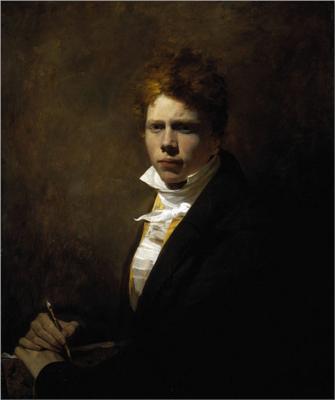
Scottish painter David Wilkie made morally charged domestic genre scenes before transforming his style after travels in Italy and Spain.
Where to see David Wilkie
Ranked by works you can see in person.
-
32 works
National Galleries Scotland
Edinburgh, United Kingdom
-
17 works
Royal Collection
London, United Kingdom


-
15 works
National Gallery
London, United Kingdom
-
8 works
Victoria and Albert Museum
London, United Kingdom
-
4 works
Dundee Art Galleries and Museums
Dundee, United Kingdom
-
4 works
Aberdeen Archives, Gallery and Museums collections
Aberdeen, United Kingdom
-
4 works
National Gallery of Ireland
Dublin, Ireland
Also here (6)
-
4 works
National Portrait Gallery
London, United Kingdom
-
3 works
Fine Arts Museums of San Francisco
San Francisco, United States
-
2 works
Wallace Collection
London, United Kingdom


View all 35 museums
-
2 works
National Trust
Swindon, United Kingdom
-
2 works
Auckland Art Gallery Toi o Tāmaki
Auckland, New Zealand
-
2 works
Nottingham Museums
Nottingham, United Kingdom
-
1 works
North Carolina Museum of Art
Raleigh, United States
-
1 works
Royal Academy of Arts
London, United Kingdom
-
1 works
Laing Art Gallery
Newcastle upon Tyne, United Kingdom
-
1 works
Gemäldegalerie Berlin
Berlin, Germany
-
1 works
Walker Art Gallery
Liverpool, United Kingdom
-
1 works
Hunterian Museum and Art Gallery
Glasgow, United Kingdom
-
1 works
Royal Scottish Academy
Edinburgh, United Kingdom
-
1 works
Brighton Museum & Art Gallery
Brighton and Hove, United Kingdom
-
1 works
Temple Newsam
Leeds, United Kingdom
-
 1 works
Paisley Museum
Paisley, United Kingdom
-
1 works
National Gallery of Art
Washington D.C., United States
-
1 works
Manchester Art Gallery
Manchester, United Kingdom
-
1 works
University of Strathclyde
Glasgow, United Kingdom
Also here (2)
-
1 works
Sudley House
Liverpool, United Kingdom
-
1 works
Palais des Beaux-Arts de Lille
Lille, France
-
1 works
Lady Lever Art Gallery
Port Sunlight, United Kingdom
-
1 works
RISD Museum
Providence, United States
-
1 works
Leicester Museum & Art Gallery
Leicester, United Kingdom
-
1 works
Cartwright Hall Art Gallery
Bradford, United Kingdom
-
1 works
Kelvingrove Art Gallery and Museum
Glasgow, United Kingdom
-
1 works
Metropolitan Museum of Art
New York City, United States
-
1 works
Fitzwilliam Museum
Cambridge, United Kingdom


Frequently Asked Questions
Where can I see David Wilkie's work?
Sir David Wilkie's paintings are held in many public collections. The National Gallery, London, holds several important examples; these include "The Village Politicians" (1806[3]), a work that established his early reputation. Another significant piece in their collection is "Chelsea Pensioners Reading the Waterloo Dispatch" (1822), commissioned by the Duke of Wellington. The Tate Britain also possesses a number of Wilkie's works. These provide a good overview of his artistic development. The National Galleries of Scotland hold a substantial collection, reflecting his Scottish background. Beyond the United Kingdom, Wilkie's paintings can be found in collections such as the Metropolitan Museum of Art in New York. These international holdings demonstrate the widespread appreciation of his art during and after his lifetime. Catalogues from these museums and galleries offer detailed information about specific works, their provenance, and exhibition history. Consulting these resources will help you locate and learn more about Wilkie's artistic output.What should I know about David Wilkie's prints?
David Wilkie was a Scottish painter, and prints of his work were popular during the 19th century. The prints available in the marketplace varied in quality and price. Prints were often purchased for their subject matter. According to some observers, the print-buying public had a Philistine attitude, but were willing to buy reproductions of paintings recommended to them. Publishers were keen to increase profits by producing prints of popular works. The size of prints was an important factor, as they were expected to be large enough to fill a wall. The dimensions were often governed by the original painting, but engravers sometimes reduced the size of the work. Editions of prints can be open or limited. A limited edition means the artist has chosen to restrict the number of prints made, not that the woodblock is worn out. For example, Thomas Bewick's wood engraving of Newcastle was printed 900,000 times. The decision to limit an edition is the choice of the artist.Why are David Wilkie's works important today?
David Wilkie (1785[3]-1841[3]) was a Scottish painter, especially known for his genre scenes. These paintings offer insights into early 19th-century British[3] life. He also produced portraits and history paintings. Wilkie's early work, such as "Pitlessie Fair" (1804[3]), showed his talent for depicting everyday life. He gained recognition for his ability to capture detail and character in crowded scenes. "The Village Politicians" (1806) and "The Blind Fiddler" (1806) established his reputation. These paintings appealed to a broad audience due to their relatable subjects and anecdotal style. Later, Wilkie travelled to Europe, including Spain and the Middle East. This travel influenced his artistic style. He began to incorporate more dramatic lighting and exotic subject matter. His later works, like "The Defence of Saragossa" (1828), reflect this shift. Wilkie's influence on British art is considerable. He paved the way for later genre painters. His attention to detail and narrative skill continue to be admired. His paintings provide valuable social commentary on the period in which he lived.What techniques or materials did David Wilkie use?
David Wilkie was a Scottish painter, especially known for his genre scenes. He worked primarily in oil paint, but also produced drawings, etchings, and some watercolours. Early in his career, Wilkie adopted a meticulous style, influenced by seventeenth-century Dutch and Flemish masters. He paid close attention to detail and used a smooth finish. Examples of this approach can be seen in paintings such as "Pitlessie Fair" (1804[3]) and "The Village Politicians" (1806). Later, after a trip to the Continent in the 1820s, Wilkie's technique changed. He began to employ a looser, more painterly style, with broader brushstrokes and a greater emphasis on colour. This shift is evident in works like "The Chelsea Pensioners Reading the Waterloo Dispatch" (1822), which displays a move towards a more dynamic composition and expressive handling of paint. His travels exposed him to different artistic traditions, which led to experimentation with his methods. He also explored historical and orientalist subjects in his late period, adapting his technique to suit these new themes.Who did David Wilkie influence?
David Wilkie, a Scottish artist born in Fife in 1785[3], is considered one of the great Scottish artists, alongside Henry Raeburn and Allan Ramsay. He began his career painting portraits, but he found success creating genre pictures. Wilkie's work, often reminiscent of 17th-century Dutch painters like Adriaen van Ostade and David Teniers, appealed to the new middle classes in Britain. His paintings often had an overtone of caricature. Wilkie's style, particularly his use of swinging lines to animate figures, had an impact on British[3] art. Painters from Fuseli and Blake to Turner adopted this style. Turner memorialised Wilkie in the painting 'Peace: Burial at Sea' after Wilkie's death at sea, off Gibraltar, in 1841[3]. Narrative painting became fashionable in Britain, and Wilkie's 'Reading the Will' influenced this trend. The painting was commissioned by the King of Bavaria, Max I Joseph, and this type of painting remained popular throughout the century in Europe.Who influenced David Wilkie?
David Wilkie's artistic development involved several influences. Early in his career, Wilkie studied the Analytic Cubist work of Braque and Picasso, as well as early Kandinsky and Miro. He analysed the structure of their paintings exhaustively. Wilkie also studied Matisse's Blue Window (1913), Miro's Person Throwing a Stone at a Bird (1926), Cezanne's Card Players (1890-92), and Mondrian's grid paintings. He also studied Leger, Renaissance and Quattrocento artists, Old Masters, American masters, and African art. Later, the New York School, including Pollock, de Kooning, and Rothko, became mentors. He saw Gorky's Agony (1947) and The Liver Is the Cock's Comb (1944) at the Whitney in 1951, which impressed him. He also saw many of Pollock's 1940s works. The size change in his work was due to Pollock, as well as Stills, Rothkos, and Newmans. The circle also included Gottlieb, Stamos, Reinhardt, and Baziotes. In the later 1950s and early 1960s, he was moved by Louis's Veils and Unfurleds and Noland's targets and chevrons.What is David Wilkie's most famous work?
Sir David Wilkie (1785[3]-1841[3]) was a Scottish painter known for genre scenes and portraits. He was born in Cults, Fife, and studied at the Trustees’ Drawing Academy of Edinburgh. Wilkie's paintings often promoted Scottish culture. One of his best-known works is *Visit of King George to Scotland* (1829[3]), which is held in the Royal Collection, London. It depicts King George IV's 1822 visit to Scotland, the first by a British[3] monarch since 1650. The visit aimed to ease social unrest after the French Revolution. Organised by Sir Walter Scott, it included a procession of men in kilts. Wilkie's portrait shows the King in a kilt, which improved his image in Scotland and promoted Scottish identity. Another famous painting by Wilkie is *Reading the Will* (1820), now in the Neue Pinakothek, Munich. Commissioned by King Maximilian Joseph of Bavaria, it depicts a family gathered to hear a lawyer read a will. The scene, with its theatrical lighting and arrangement, captures the varied emotions of the characters as they learn of their inheritance.What style or movement did David Wilkie belong to?
David Wilkie (1785[3]-1841[3]) was a Scottish painter, usually associated with the British[3] genre painting school. He is also sometimes connected to early realism because of his attention to detail and everyday subject matter. Wilkie gained fame for paintings depicting scenes of ordinary life, often with a narrative element. Early works, such as "Pitlessie Fair" (1804[3]) and "The Village Politicians" (1806), show his interest in village life in Fife. These paintings established his reputation for detailed observation and anecdotal storytelling. Later in his career, Wilkie moved towards history painting[3] and portraiture. He succeeded Sir Henry Raeburn as His Majesty’s Limner for Scotland in 1823. He became a Royal Academician in 1811 and later served as the Academy's librarian and keeper. Wilkie's style evolved over time, influenced by his travels in Europe and his study of Old Master paintings. He experimented with different techniques and subjects, but he remained rooted in a representational approach.
Sources
Where to See guide aggregates verified holdings of David Wilkie's works across the following collections.
- [1] museum Temple Newsam Used for: museum holdings.
- [2] museum Paisley Museum Used for: museum holdings.
- [3] wikipedia Wikipedia: David Wilkie Used for: biography.
- [4] book Beard, Lee, 1973- author, Butler, Adam, author; Van Cleave, Claire, author; Fortenberry, Diane, author; Stirling, Susan, author, Beard, Lee, 1973- author, Butler, Adam, author; Van Cleave, Claire, author; Fortenberry, Diane, author; Stirling, Susan, author - The Art Book_ New Edition, Mini Format Used for: biography.
- [5] book Allison Lee Palmer, Historical Dictionary of Neoclassical Art and Architecture Used for: biography.
- [6] book Milam, Jennifer Dawn, Historical Dictionary of Rococo Art Used for: biography.
- [7] book Masterpieces of western art : a history of art in 900 individual studies from the Gothic to the present day Used for: biography.
Editorial overseen by Solis Prints. Sources verified 2026-09-24. Click a source for details, or hover over [N] in the page above to preview.
Editorial standardsMethodologyCorrectionsAI disclosureAbout the editorial team