



About Abraham Mignon
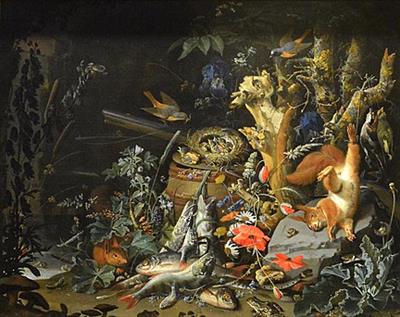
lush flower paintings that trained Maria Sibylla Merian and sold to Louis XIV, left undated and difficult to chronologise
Where to see Abraham Mignon
Ranked by works you can see in person.
-
 7 works
Louvre
Paris, France
-
 7 works
Rijksmuseum
Amsterdam, Netherlands
-
5 works
Munich Central Collecting Point
Munich, Germany
Also here (6)
-
 5 works
Staatliche Kunstsammlungen Dresden
Dresden, Germany
-
 4 works
Bavarian State Painting Collections
Munich, Germany
-
 4 works
Ashmolean Museum
Oxford, United Kingdom
-
3 works
Führermuseum
Linz, Austria
Also here (6)
-
 3 works
Mauritshuis
The Hague, Netherlands
-
 2 works
Gemäldegalerie Alte Meister
Dresden, Germany
-
 2 works
Städel Museum
Frankfurt, Germany
Own a piece of it
Abraham Mignon prints
Hand-finished archival prints from Abraham Mignon's body of work.
 Still Life with Fruit and a Nautilus Cup - Abraham Mignon
From £28.00
Still Life with Fruit and a Nautilus Cup - Abraham Mignon
From £28.00
 Stilleven met bloemen en een horloge - Abraham Mignon
From £28.00
Stilleven met bloemen en een horloge - Abraham Mignon
From £28.00
 Still Life with Fruit, Foliage, and Insects - Abraham Mignon
From £28.00
Still Life with Fruit, Foliage, and Insects - Abraham Mignon
From £28.00
 The Overturned Bouquet - Abraham Mignon
From £28.00
The Overturned Bouquet - Abraham Mignon
From £28.00
 Fruits and Lobster - Abraham Mignon
From £28.00
Fruits and Lobster - Abraham Mignon
From £28.00
 A Garland of Flowers - Abraham Mignon
From £28.00
A Garland of Flowers - Abraham Mignon
From £28.00
 Fruits - Abraham Mignon
From £28.00
Fruits - Abraham Mignon
From £28.00
 Fruits and Oysters - Abraham Mignon
From £28.00
Fruits and Oysters - Abraham Mignon
From £28.00
View all 40 museums
-
 2 works
Herzog Anton Ulrich Museum
Brunswick, Germany
-
 2 works
Museum Boijmans Van Beuningen
Rotterdam, Netherlands
-
 2 works
National Gallery of Art
Washington D.C., United States
-
 2 works
Staatliche Kunsthalle Karlsruhe
Karlsruhe, Germany
-
 2 works
Hermitage Museum
Saint Petersburg, Russia
-
2 works
Hessen Kassel Heritage
Kassel, Germany
-
 2 works
Fitzwilliam Museum
Cambridge, United Kingdom
-

-
2 works
Statens Museum for Kunst
Copenhagen, Denmark
-
1 works
Maidstone Museum and Bentlif Art Gallery
Maidstone, United Kingdom
-
 1 works
Royal Museum of Fine Arts Antwerp
Antwerp, Belgium
-
 1 works
Liechtenstein Museum
Vienna, Austria
-
1 works
National Gallery Prague
Prague, Czech Republic
-
1 works
Johann Wilhelm von der Pfalz collection
Düsseldorf, Germany
-
 1 works
Wallraf–Richartz Museum
Cologne, Germany
-
 1 works
Gemäldegalerie Berlin
Berlin, Germany
-
 1 works
Bilbao Fine Arts Museum
Bilbao, Spain
-
1 works
Amsterdam Museum
Amsterdam, Netherlands
-
1 works
Hermann Göring Collection
Carinhall, Germany
-
 1 works
Museum of Fine Arts, Budapest
Budapest, Hungary
-
1 works
Charles Sedelmeyer collection
Paris, France
-
1 works
Museum of Fine Arts of Lyon
Lyon, France
-
 1 works
Royal Museums of Fine Arts of Belgium
Brussels, Belgium
-
1 works
Galleria Sabauda
Turin, Italy
-
1 works
Noordbrabants Museum
s-Hertogenbosch, Netherlands
-
 1 works
Minneapolis Institute of Art
Minneapolis, United States
-
1 works
Metropolitan Museum of Art
New York City, United States
-
1 works
Centraal Museum
Utrecht, Netherlands
-
 1 works
Fine Arts Museums of San Francisco
San Francisco, United States
-
 1 works
National Museum in Warsaw
Warsaw, Poland


Can't travel? Bring Abraham Mignon home.
See all Abraham Mignon prints →Frequently Asked Questions
Where can I see Abraham Mignon's work?
It is difficult to say exactly where works by Abraham Mignon can be seen today, as many are in private collections. However, some works by artists of the same period are held by public art galleries. For example, the National Gallery of Victoria in Melbourne has Nicolas Poussin's The Crossing of the Red Sea. The Minneapolis Institute of Arts has Poussin's The Death of Germanicus. In Moscow, the Pushkin Museum of Fine Arts holds Poussin's The Continence of Scipio, as well as his work, Landscape with Hercules and Cacus. The Alte Pinakothek in Munich has Poussin's The Adoration of the Shepherds and Apollo and Daphne. The Musée des Beaux-Arts in Nancy has Poussin's The Entry of Christ into Jerusalem. The Metropolitan Museum of Art in New York has Poussin's Landscape with Orion, Midas Washing at the Source of the Pactolus, and The Rape of the Sabines.What should I know about Abraham Mignon's prints?
Abraham Mignon (1640-1679) was a still-life painter of the Dutch Golden Age, known for his detailed depictions of flowers, fruit, and woodland creatures. Although he is not as widely recognised as some of his contemporaries, his works were admired for their technical skill and decorative appeal. Mignon trained with Jan Davidsz de Heem in Utrecht, and his style closely resembles that of his teacher. Like de Heem, he often included insects and other small animals in his compositions, adding a sense of life and movement to his meticulously arranged displays. While Mignon is best known for his paintings, prints were made after his work. These prints allowed for wider circulation of his compositions, making them accessible to a broader audience. Many of these prints were produced by engravers who specialised in reproducing paintings, and they offer a valuable record of Mignon's artistic output. They capture the detail and colour of his original paintings, providing collectors with an opportunity to own versions of his celebrated still lifes.Why are Abraham Mignon's works important today?
Abraham Mignon (1640-1679) was a still-life painter of the Baroque period, active in what is now Germany and the Netherlands. He is remembered for his detailed depictions of flowers, fruit, and forest floor subjects. Mignon trained in Frankfurt under still-life painter Jacob Marrel, and later with Jan Davidsz de Heem in Utrecht. De Heem's influence is clear in Mignon's compositions and technique. He became a member of the Utrecht Guild of Saint Luke in 1669. His paintings are admired for their precise observation and careful arrangement. Mignon often included insects, dewdrops, and other small details to create a sense of realism and capture the beauty of nature. These elements add visual interest and complexity to his works. Mignon's works are found in major museum collections, such as the Louvre in Paris, the Rijksmuseum in Amsterdam, and the Ashmolean Museum in Oxford. Although he died relatively young, his output was significant, and his style was influential on other still-life painters of the period. His art provides insight into the 17th-century appreciation for the natural world and the development of still-life painting as a genre.Who was Abraham Mignon?
Abraham Mignon was a Dutch Golden Age painter born in Frankfurt in 1640 to a French-speaking family. He is known for training Maria Sibylla Merian, who became an important scientific illustrator.What techniques or materials did Abraham Mignon use?
Information about Abraham Mignon's specific techniques or materials is scarce. However, historical context provides some insight into the practices of seventeenth-century painters. During this period in France, painting techniques were often closely guarded secrets, passed down through guilds from master to apprentice. Manuals and "books of secrets" offered recipes and instructions on various artistic processes. These books covered a range of topics, including how to prepare pigments, copy drawings, imitate marble, and create varnishes. Oil painting was considered a relatively new method, and preparing the medium was a significant concern. Recipes often suggested using nut oil with lead white, thickened by sunlight. Turpentine was sometimes added to help layers dry faster. To prepare canvases, artists stretched the material, smoothed it with pumice, sized it with glue, and applied a double ground, typically using raw umber, red brown, lead white, and carbon black. For panels, multiple layers of chalk ground were common.Who did Abraham Mignon influence?
It is difficult to identify direct artistic influence, but some artists responded to the paintings of Frans Hals in the 1700s. Antoine Watteau (1684-1721) made drawings after Hals; one was a head of a boy, and another was a copy of a portrait located in St. Petersburg. Alexis Grimou (1678-1733) appropriated Hals's conception of large-scale single figures. Grimou's self-portrait of 1721 uses the pose and comportment seen in Hals's figures such as Jolly Toper and Jonker Ramp. Jean-Honoré Fragonard (1732-1806) also engaged with Hals's works. Fragonard emulated Hals's handling, especially in his series of fifteen fantasy portraits created between 1768 and 1772. Fragonard built forms from layers of paint, and left individual strokes unblended to create stark juxtapositions. The structure of working up the picture relates directly to Hals's example. Fragonard could have learned these elements either from the growing number of works by the Dutch painter in Paris or on his trip to the Netherlands that may have occurred in the early 1760s.Who influenced Abraham Mignon?
Abraham Mignon (1640-1679) was a still-life painter active in the Dutch Golden Age. He is known for his detailed depictions of fruit, flowers, and small animals. Mignon's primary influence was his teacher, Jan Davidsz de Heem (1606-1684). De Heem was a leading still-life painter, working first in Leiden, then in Antwerp, and finally in Utrecht. Mignon joined de Heem's workshop in Utrecht around 1660 and became his most important pupil. De Heem's style, which combined meticulous observation with a decorative flair, had a direct impact on Mignon's work. Other artists who may have influenced Mignon include Jacob Marrel (1614-1681), his stepfather, and Otto Marseus van Schrieck (c. 1619-1678). Marrel, a flower painter, likely provided early training and instilled an interest in botanical subjects. Van Schrieck, known for his paintings of forests with reptiles and insects, may have inspired Mignon's inclusion of similar creatures in his still lifes. However, de Heem's impact remained the most significant, shaping Mignon's artistic direction and contributing to his success in the genre.What is Abraham Mignon's most famous work?
Abraham Mignon (1640-1679) was a Frankfurt-born still-life painter. He is known for precise compositions that combine Baroque exuberance with naturalistic representation. Mignon trained in his hometown before moving to Utrecht in 1659 with the master Jacob Morel. There, he worked with Jan Davidszoon de Heem, a Dutch still-life painter. Mignon alternated between Frankfurt and Utrecht, becoming a member of the Guild of St Luke in 1669. His paintings often feature moist undergrowth with small animals, reptiles, insects, flowers, and deadly snares. These elements can be interpreted as an allegory of earthly vanity, fading beauty, and the passage of time. Mignon's art is distinguished by its clarity, meticulous drawing, and attention to detail. His still lifes have been interpreted allegorically, contrasting good and evil. For example, snails are juxtaposed with butterflies, which symbolise the soul freeing itself from sin. One of Mignon's well-known works is *Nature as a Symbol of Vanity*, dating from between 1665 and 1679. Another is *Still Life with Fish and Quail's Nest*, circa 1670. Mignon's paintings remained milestones in German taste and were imitated until the Biedermeier period in the late nineteenth century.
Sources
Where to See guide aggregates verified holdings of Abraham Mignon's works across the following collections.
- [1] museum Maidstone Museum and Bentlif Art Gallery Used for: museum holdings.
- [2] museum Royal Museum of Fine Arts Antwerp Used for: museum holdings.
- [3] museum Gemäldegalerie Alte Meister Used for: museum holdings.
- [4] museum Städel Museum Used for: museum holdings.
- [5] museum Herzog Anton Ulrich Museum Used for: museum holdings.
- [6] museum Liechtenstein Museum Used for: museum holdings.
- [7] academic Encyclopaedia Britannica Editors, Abraham Mignon | Biography & Art Used for: biography.
- [8] book Lilian H. Zirpolo, Historical Dictionary of Baroque Art and Architecture Used for: biography.
- [9] book Allison Lee Palmer, Historical Dictionary of Neoclassical Art and Architecture Used for: biography.
- [10] book Masterpieces of western art : a history of art in 900 individual studies from the Gothic to the present day Used for: biography.
- [11] museum Abraham Mignon | National Gallery of Art Used for: biography.
- [12] museum Still Life with Flowers and a Watch Used for: museum holdings.
- [13] museum Still Life with Fruit and Oysters Used for: museum holdings.
Editorial overseen by Solis Prints. Sources verified 2026-09-24. Click a source for details, or hover over [N] in the page above to preview.
Editorial standardsMethodologyCorrectionsAI disclosureAbout the editorial team