



About Eugene Carriere
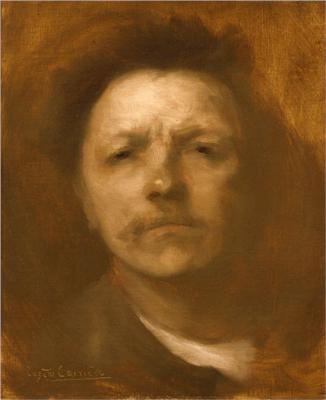
Where to see Eugene Carriere
Ranked by works you can see in person.
-
107 works
Musée d'Orsay
Paris, France
-
15 works
Kunsthalle Bremen
Bremen, Germany


-
15 works
Musée des Beaux-Arts de la ville de Paris
Paris, France
-
6 works
Amgueddfa Cymru – Museum Wales
Cardiff, United Kingdom
-
4 works
Munich Central Collecting Point
Munich, Germany
Also here (6)
-
3 works
Cleveland Museum of Art
Cleveland, United States
-
3 works
National Museum of Western Art
Tokyo, Japan
-
3 works
Musée d'Art moderne de Troyes
Troyes, France
-
3 works
Musée Toulouse-Lautrec
Albi, France
-
3 works
Hermitage Museum
Saint Petersburg, Russia


Own a piece of it
Eugene Carriere prints
Hand-finished archival prints from Eugene Carriere's body of work.
 Portrait of Pol Neveux - Eugène Carrière
From £28.00
Portrait of Pol Neveux - Eugène Carrière
From £28.00
 Portrait of Georges Clemenceau - Eugène Carrière
From £28.00
Portrait of Georges Clemenceau - Eugène Carrière
From £28.00
 Portrait of Paul Gauguin - Eugène Carrière
From £28.00
Portrait of Paul Gauguin - Eugène Carrière
From £28.00
 Woman Leaning on a Table - Eugène Carrière
From £28.00
Woman Leaning on a Table - Eugène Carrière
From £28.00
 Portrait d'Elisabeth, fille d'Elie Faure - Eugène Carrière
From £28.00
Portrait d'Elisabeth, fille d'Elie Faure - Eugène Carrière
From £28.00
 Portrait of Paul Verlaine - Eugène Carrière
From £28.00
Portrait of Paul Verlaine - Eugène Carrière
From £28.00
 Marguerite Carrière - Eugène Carrière
From £28.00
Marguerite Carrière - Eugène Carrière
From £28.00
 Madame Eugène Carrière - Eugène Carrière
From £28.00
Madame Eugène Carrière - Eugène Carrière
From £28.00
View all 73 museums
-
3 works
Art Institute of Chicago
Chicago, United States
-
3 works
Metropolitan Museum of Art
New York City, United States
-
3 works
Tate
London, United Kingdom
-
3 works
Musée Carnavalet
Paris, France
-
3 works
Museum of Fine Arts of Nancy
Nancy, France
-
2 works
Städel Museum
Frankfurt, Germany
-
2 works
Hill-Stead Museum
Farmington, United States
Also here (2)
-
2 works
Museum of Fine Arts Boston
Boston, United States
-
2 works
National Gallery
London, United Kingdom
-
2 works
Matsukata Collection
Tokyo, Japan
-
2 works
Musée des Beaux-Arts de Dijon
Dijon, France
-
2 works
Musée des Beaux-Arts de Bordeaux
Bordeaux, France
-
2 works
Museum of Art and History Geneva
Geneva, Switzerland
-
2 works
Palais des Beaux-Arts de Lille
Lille, France
-
2 works
RISD Museum
Providence, United States
-
2 works
Los Angeles County Museum of Art
Los Angeles, United States
-
2 works
Wadsworth Atheneum Museum of Art
Hartford, United States
-
2 works
Thiel Gallery
Stockholm, Sweden
-
2 works
Philadelphia Museum of Art
Philadelphia, United States
-
1 works
Milwaukee Art Museum
Milwaukee, United States
-
1 works
Musée d'Art et d'Histoire
Neuchâtel, Switzerland
-
1 works
Hungarian National Gallery
Budapest, Hungary
Also here (6)
Bertalan SzekelyVilmos Aba-NovakEndre BalintAladar Korosfoi-KrieschEgry JózsefAugust von Pettenkofen -
1 works
Clark Art Institute
Williamstown, United States
-
1 works
National Gallery Prague
Prague, Czech Republic
-
1 works
National Museum of Serbia
Belgrade, Serbia
-
1 works
National Museum of Fine Arts, Argentina
Buenos Aires, Argentina
Also here (6)
-
 1 works
Maison de Victor Hugo
Paris, France
Also here (6)
-
1 works
Musée des Beaux-Arts de Quimper
Quimper, France
-
1 works
Carnegie Museum of Art
Pittsburgh, United States
-
1 works
Hunterian Museum and Art Gallery
Glasgow, United Kingdom
-
1 works
Museum of Fine Arts Ghent (MSK)
Ghent, Belgium
-
1 works
Denver Art Museum
Denver, United States
-
1 works
Columbus Museum of Art
Columbus, United States
-
 1 works
Paisley Museum
Paisley, United Kingdom
-
1 works
National Gallery of Art
Washington D.C., United States
-
1 works
Bristol City Museum & Art Gallery
Bristol, United Kingdom
-
1 works
Clemens Sels Museum Neuss
Neuss, Germany
-
1 works
Aberdeen Archives, Gallery and Museums collections
Aberdeen, United Kingdom
-
1 works
Art Gallery of South Australia
Adelaide, Australia
-
1 works
Nationalmuseum
Stockholm, Sweden


23 more museums hold works by Eugene Carriere with smaller collections, not listed here.
Can't travel? Bring Eugene Carriere home.
See all Eugene Carriere prints →Frequently Asked Questions
Where can I see Eugene Carriere's work?
I am unable to provide specific museum locations for Eugène Carrière[7]'s work. My current knowledge base lacks detailed information regarding the present-day locations of his paintings and prints. Art-historical information and museum holdings are subject to change. For the most up-to-date details, it is best to consult museum websites and collection databases directly. Many major museums now have their catalogues available online, offering a convenient way to search for particular artists or artworks. These resources often include details about current exhibitions, loans, and the accessibility of specific pieces. You may also wish to consult art-historical indexes such as the Art Sales Catalogues Online, or the Witt Library at the Courtauld Institute in London.What should I know about Eugene Carriere's prints?
Eugène Carrière[7] (1849[2]-1906[2]) was a French Symbolist artist known for his lithographs and paintings. His prints often feature soft, hazy forms and a monochromatic palette, creating an atmospheric, dreamlike quality. During the late 19th century, there was a surge in interest in fine art etching, with specialist publications and societies dedicated to the medium. While reproductive etchings of paintings were popular, Carrière's prints were original works. Printmakers often limit the number of prints in an edition, not always due to technical limitations but as an artistic choice. Each print in a limited edition is typically numbered, titled, and signed in pencil by the artist. These conventions, though not legally binding, are widely respected and add value to the work. Original prints, such as those by Carrière, are produced by hand, with the artist creating the artwork directly on the plate or stone. They are distinct from offset reproductions or posters, which are produced by photochemical means, and from giclée prints, which are inkjet fine art prints.Why are Eugene Carriere's works important today?
Eugène Carrière[7] (1849[2]-1906[2]) trained as a lithographer before studying painting at the École des Beaux-Arts in Paris. He supplemented his income by working in Jules Cheret's poster studio. Initially painting in a naturalistic style, his work shifted in the 1880s toward a more mysterious, monochrome aesthetic with symbolic elements. Carrière's importance lies in his influence on later artists. His atmospheric, dreamlike paintings, achieved through a distinctive sfumato technique, appealed to a younger generation. He exchanged works with Gauguin and painted portraits of Verlaine and Edmond de Goncourt. In 1898[2], he opened an academy where Derain and Matisse trained. His paintings often depicted scenes of motherhood and family life. Critics praised his ability to convey emotion and ideals through his manipulation of light and shadow. Carrière's work invites comparison to the Symbolist concerns of Maeterlinck and Ibsen. In 1904, Rodin organised a banquet in Carrière's honour. The Musée d’Orsay marked the centenary of his death with an exhibition.What techniques or materials did Eugene Carriere use?
The choice of materials available to an artist affects the character of their work. Some painters have attempted to reproduce the techniques of earlier masters, such as Jan van Eyck, but without exact duplication of materials, it is impossible to recreate those works. Some painters have experimented with encaustic techniques, using hot plates to fuse coloured wax into a composition. Others have sought a permanent form of painting, such as eludoric painting, developed in 1775. When applying colour to canvas, some artists mix standard oil paint with a medium of wax and turpentine, using a brush; they then work the paint with a painting spatula or knife. Heating the medium can cause evaporation, which can make the paint gummy. Oil remains the primary binder, as opposed to encaustic, where wax is the binder.Who did Eugene Carriere influence?
Eugène Carrière[7] (1849[2]-1906[2]) began his art studies in Strasbourg, later entering the École des Beaux-Arts in Paris in 1869[2]. Initially a lithographer, he shifted to painting, inspired by Dutch art. Carrière's style evolved in the 1880s, moving away from academic influences towards a monochrome aesthetic. His works featured stylised details and a carefully chosen tonality, extracting portraits and intimate scenes from evanescent forms. Critics praised his ability to reveal ideals and states of mind through his manipulation of light. Carrière's approach, characterised by monochrome mists and vaguely transcribed forms, created a sense of mystery that appealed to younger artists. His symbolic use of light in domestic settings has drawn comparisons to the work of Maeterlinck and Ibsen, as well as artists like Vuillard and Bonnard. In 1898, he opened an academy where Derain and Matisse trained. Paul Gauguin mentioned Redon in letters, while Maurice Denis depicted him as a teacher with his Nabis group in the 1900 painting *Homage to Cézanne*.Who influenced Eugene Carriere?
Eugène Carrière[7] (1849[2]-1906[2]) studied under Alexandre Cabanel at the École des Beaux-Arts in Paris. He also supported himself with lithographic work in Jules Chéret’s studio. Although Carrière’s formal training was academic, his style evolved in the 1880s as he moved away from those influences. Dutch painting inspired him, particularly in his family interiors and his treatments of motherhood. A visit to London in 1876[2]-7 led him to admire the work of Turner. By the late 1880s, Carrière had developed a personal style, characterised by monochrome tones and stylised details. His technique of applying a misty effect to his canvases won him praise. Critics noted that his manipulation of light seemed to reveal states of mind. Carrière’s work also invites comparisons to the symbolic use of light by playwrights Maeterlinck and Ibsen, and painters such as Vuillard and Bonnard. Matisse and Derain trained in Carrière's studio.What is Eugene Carriere's most famous work?
It is difficult to name one single work as Eugène Carrière[7]'s 'most famous', but several paintings are well known. He produced a large number of works, mostly portraits and family scenes, during his career. Carrière is best known for his tonalist style, which often employed a limited colour palette, creating an atmospheric, dreamlike effect. His paintings frequently depict intimate, domestic settings. This can be seen in works such as *The Sick Child* (date unknown), which captures a tender moment between a mother and child. Similar themes appear in *Intimacy* (date unknown) and *Motherhood* (date unknown), which also explore the bonds of family. These paintings, with their soft, hazy quality, are typical of Carrière's style and contribute to his reputation as an artist of emotional depth.What style or movement did Eugene Carriere belong to?
Eugène Carrière[7], born in 1849[2], is associated with Symbolism. He began his artistic training in Strasbourg, then moved to Paris in 1869[2] to study at the École des Beaux-Arts. Carrière's style evolved during the 1880s as he moved away from academic naturalism. His mature work employed monochrome tones and stylised forms to create a sense of mystery. His paintings often depicted portraits and intimate scenes rendered with a soft, dreamlike quality, achieved through his signature sfumato technique. Critics of the time noted that Carrière's manipulation of light created an idealised atmosphere. His work explored themes of love, suffering, gentleness, and the complexities of human nature. Carrière's Symbolist approach extended beyond his paintings; he also produced lithographs and engaged with contemporary social issues, such as the Dreyfus Affair. He died in Paris in 1906[2], and a banquet was held in his honour by Rodin in 1904.
Sources
Where to See guide aggregates verified holdings of Eugene Carriere's works across the following collections.
- [1] academic The Editors of Encyclopaedia Britannica, Eugène Carrière | Symbolist, Realist, Impressionist Used for: biography.
- [2] wikipedia Wikipedia: Eugene Carriere Used for: biography.
- [3] book Brodskaya Nathalia, Brodskaya Nathalia - Symbolism Used for: biography.
- [4] book Post-impressionism : cross-currents in European painting Used for: biography.
- [5] book Post-impressionism : cross-currents in European painting Used for: biography.
- [6] museum Ashley Dunn, A Cross-Media Kinship: Auguste Rodin and Eugène Carrière Used for: influences.
- [7] museum Eugène Carrière Used for: museum holdings.
- [8] museum Eugène Carrière 1849–1906 Used for: biography.
- [9] museum Eugène Carrière - Self-Portrait - The Metropolitan Museum of Art Used for: notable works.
Editorial overseen by Solis Prints. Sources verified 2026-09-24. Click a source for details, or hover over [N] in the page above to preview.
Editorial standardsMethodologyCorrectionsAI disclosureAbout the editorial team