



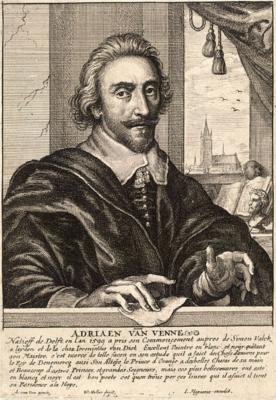
About Adriaen van de Venne
Dutch[7]","author":null,"year":null,"publisher":null,"type":"wikipedia","url":"https://en.wikipedia.org/wiki/Adriaen_van_de_Venne","used_for":"biography"}">[4] Golden Age satirist known for grisaille paintings of beggars and fools with proverb banners, and for the allegorical Fishing for Souls[9].
Where to see Adriaen van de Venne
Collection holdings are reported here; current display varies. Check with each museum before visiting.
-
21 recorded works
Rijksmuseum
Amsterdam, Netherlands
-
8 recorded works
Hermitage Museum
Saint Petersburg, Russia


-
5 recorded works
Nationalmuseum
Stockholm, Sweden
-
4 recorded works
Museum Boijmans Van Beuningen
Rotterdam, Netherlands
-
4 recorded works
Amsterdam Museum
Amsterdam, Netherlands
-
4 recorded works
National Museum in Warsaw
Warsaw, Poland
-
3 recorded works
Mauritshuis
The Hague, Netherlands
-
2 recorded works
Wallraf–Richartz Museum
Cologne, Germany
-
2 recorded works
Gemäldegalerie Berlin
Berlin, Germany
-
2 recorded works
Museum of Fine Arts Ghent (MSK)
Ghent, Belgium


Own a piece of it
Adriaen van de Venne prints
Hand-finished archival prints from Adriaen van de Venne's body of work.
 A Summer Village Landscape with Horse - Adriaen van de Venne
From £28.00
A Summer Village Landscape with Horse - Adriaen van de Venne
From £28.00
 Title Page for Hovwelick - Adriaen van de Venne
From £28.00
Title Page for Hovwelick - Adriaen van de Venne
From £28.00
 Altogether too stupid! - Adriaen van de Venne
From £28.00
Altogether too stupid! - Adriaen van de Venne
From £28.00
 Allegory of Poverty - Adriaen van de Venne
From £28.00
Allegory of Poverty - Adriaen van de Venne
From £28.00
 Dance of Death - Adriaen van de Venne
From £28.00
Dance of Death - Adriaen van de Venne
From £28.00
 Moses Striking the Rock - Adriaen van de Venne
From £28.00
Moses Striking the Rock - Adriaen van de Venne
From £28.00
 Allegory depicting the Pacification of Ghent - Adriaen van de Venne
From £28.00
Allegory depicting the Pacification of Ghent - Adriaen van de Venne
From £28.00
 Man with Telescope - Adriaen van de Venne
From £28.00
Man with Telescope - Adriaen van de Venne
From £28.00
View all 39 museums
-
2 recorded works
J. Paul Getty Museum
Los Angeles, United States
-
2 recorded works
Palais des Beaux-Arts de Lille
Lille, France
-
2 recorded works
Harvard Art Museums
Cambridge, United States
-
2 recorded works
Detroit Institute of Arts
Detroit, United States
-
2 recorded works
Statens Museum for Kunst
Copenhagen, Denmark
-
2 recorded works
Yale University Art Gallery
New Haven, United States
-
1 recorded work
Groeningemuseum
Bruges, Belgium
-
1 recorded work
Upton House
Ratley and Upton, United Kingdom
-
1 recorded work
Louvre
Paris, France
-
 1 recorded work
Weston Park
Weston-under-Lizard, United Kingdom
-
1 recorded work
Museum of Fine Arts Boston
Boston, United States
-
1 recorded work
Frans Hals Museum
Haarlem, Netherlands
-
1 recorded work
Museum Plantin-Moretus
Antwerp, Belgium
-
1 recorded work
Museo de Arte de Worcester
Worcester, United States
-
1 recorded work
Musée des Beaux-Arts de Caen
Caen, France
-
1 recorded work
KODE Art museums and composer homes
Bergen, Norway
Also here (2)
-
1 recorded work
Staatliche Kunsthalle Karlsruhe
Karlsruhe, Germany
-
1 recorded work
Hessen Kassel Heritage
Kassel, Germany
-
1 recorded work
National Trust
Swindon, United Kingdom
-
1 recorded work
Fitzwilliam Museum
Cambridge, United Kingdom
-
1 recorded work
Kunstmuseum Den Haag
The Hague, Netherlands
-
1 recorded work
Centraal Museum
Utrecht, Netherlands
-
1 recorded work
Gothenburg Museum of Art
Gothenburg, Sweden
-
1 recorded work
National Museum of Art, Architecture and Design
Oslo, Norway
-
1 recorded work
National Gallery of Canada
Ottawa, Canada
-
1 recorded work
Nottingham Museums
Nottingham, United Kingdom
-
1 recorded work
Philadelphia Museum of Art
Philadelphia, United States
-
0 recorded works
Museum of Fine Arts of Rennes
Rennes, France
-
0 recorded works
Musea Brugge
Bruges, Belgium


Can't travel? Bring Adriaen van de Venne home.
See all Adriaen van de Venne prints →Frequently Asked Questions
Where can I see Adriaen van de Venne's work?
Adriaen van de Venne[7]'s artworks can be found in numerous collections across Europe and North America. In the United Kingdom, his works are held by institutions such as the British Library, the British Museum, the National Gallery, the National Portrait Gallery, Tate, UCL Art Collections (University College), and the Victoria and Albert Museum, all in London; also the National Gallery of Scotland in Edinburgh; and the Walker Art Gallery in Liverpool. Elsewhere in Europe, you can view van de Venne's art in the Staatliche Museen in Berlin; the Herzog Anton Ulrich-Museum in Braunschweig; the Gemäldegalerie Alte Meister in Dresden; the Galleria degli Uffizi in Florence; the Städel Museum in Frankfurt am Main; the Niedersächsisches Landesmuseum in Hanover; the Museo Thyssen-Bornemisza in Madrid; the Staatliche Graphische Sammlung in Munich; the Musée du Louvre in Paris; the Royal Cabinet of Paintings Mauritshuis in The Hague; and the Kunsthistorisches Museum in Vienna. In the United States, notable locations include the Metropolitan Museum of Art in New York; the J. Paul Getty Museum in Los Angeles; and the National Gallery of Art in Washington.What should I know about Adriaen van de Venne's prints?
Adriaen van de Venne[7] (1589[4]-1662[4]) was a painter and draughtsman who briefly studied with Simon de Valck, a goldsmith and painter in Leiden. After 1625[4], van de Venne moved to The Hague and produced small-scale monochrome paintings known as *grouwetjes* (little greys). These paintings, admired for their novelty and skill, often included witty sayings. His audience included Constantijn Huygens, Jacob Cats, and Johan de Brune. Van de Venne's prints often depict peasants and the urban poor. Despite the low social class of his subjects, the paintings were exquisitely executed. The grisaille medium allowed van de Venne to display his mastery by eliminating colour variation, which allowed viewers to appreciate the brushwork. In 1626, van de Venne was commissioned by the King and Queen of Bohemia to create an album of watercolours. These showed the royal family playing tennis, ball, and billiards. He also provided illustrations for Gilles Jacobs Quintijn's *De Hollandsche-Lijs, met de Brabandsche-Bely* in 1629, and for Jacob Cats' *Spiegel van den Ouden ende Niewen Tijd* in 1632.Why are Adriaen van de Venne's works important today?
Adriaen van de Venne[7] (1589[4]-1662[4]) is notable for his contributions to Dutch[4] Golden Age painting, particularly his witty grisailles. These small-scale, largely monochrome works, sometimes called 'little grays', often depicted peasants or the urban poor. Despite the humble subject matter and rugged earth-tone palette, the paintings display refined artistic skill. The limited colour range allowed viewers to appreciate van de Venne's brushwork and manual dexterity. Van de Venne's grisailles appealed to sophisticated audiences, including figures such as Constantijn Huygens and Jacob Cats. These paintings were seen as displays of 'refined artifice and poetic wit'. Van de Venne cultivated this style after moving to The Hague in 1625[4], catering to the social and political elite. He also produced other works, such as an album of watercolours commissioned by the King and Queen of Bohemia in 1626, showing the royal family at play. His paintings offer insights into the art market and cultural values of the Dutch Golden Age.Who did Adriaen van de Venne influence?
Adriaen van de Venne[7] (1589[4]-1662[4]) was a Dutch[4] Golden Age painter, draughtsman, and versifier. He is associated with grisaille painting, book illustration, and satirical political subjects. Van de Venne's influence is most apparent in the work of his pupils. These included Jan van de Velde the Younger (1593[4]-1641[4]), who became a printmaker, and Antonie Jansz. van der Croos (circa 1606-1662), a painter of townscapes and winter scenes. His style also affected lesser-known artists working in the Netherlands during the period. His impact is particularly noticeable in the development of Dutch genre painting. Van de Venne's paintings of peasants, soldiers, and everyday life prefigured the work of later, more celebrated artists in that field. These included Adriaen Brouwer (1605-1638) and David Teniers the Younger (1610-1690), who further popularised scenes of lower-class life. Van de Venne's influence can also be seen in the work of Pieter van Laer (1599-1642), especially his paintings of Italian peasant life. These artists built upon Van de Venne's foundations, developing their own individual styles, but his early contributions to genre painting are clear.Who influenced Adriaen van de Venne?
Adriaen van de Venne[7] (1589[4]-1662[4]) developed his artistic style through exposure to several artists and movements. He began his career studying with the goldsmith Simon de Valck in Leiden. Subsequently, he apprenticed with the painter Jeronymus van Diest in The Hague. Van Diest was a specialist in seascapes. Later, van de Venne studied with Gillis van den Valckert in Middelburg. Van den Valckert's influence is apparent in van de Venne's early paintings. These display a muted palette and subjects drawn from everyday life. His contact with Flemish art and artists in Middelburg was also important. Artists like Jan Brueghel the Elder, Pieter Bruegel the Elder, and Frans Francken the Younger helped shape his artistic vision. Their influence is visible in van de Venne's crowded compositions and attention to detail. The work of these artists provided van de Venne with a foundation in both style and subject matter. He synthesised these influences into his own distinctive approach to painting and printmaking.What style or movement did Adriaen van de Venne belong to?
Adriaen van de Venne[7] was a Dutch[4] Golden Age painter, active during the Baroque[4] period. Dutch Baroque painting saw specialisation within genres; artists focused on still life, history painting, portraiture, and what was called genre painting: scenes of everyday life. Van de Venne's subject matter included portraits and genre scenes. Common to Baroque art was the use of allegory; this period saw a love of coded statements, which were regarded as evidence of potential significance inherent in all things as bearers of messages. Van de Venne's paintings often contained symbolic or moralising elements, in line with this Baroque characteristic. His skill in conveying an underlying message was typical of Dutch Baroque painting.What was Adriaen van de Venne known for?
Adriaen van de Venne[7] (1589[4]-1662[4]) was a painter and draughtsman active in the Dutch[4] Republic. He is known for his small monochrome paintings called "grouwetjes" (little grays). These paintings, often featuring peasants and the urban poor, were admired for their novelty, cleverness, and skill. Van de Venne moved to The Hague in 1625[4], where he catered to a sophisticated audience that included Constantijn Huygens, Jacob Cats, and Johan de Brune. His grisailles, executed almost entirely in monochrome, became his trademark. The lack of colour variation allowed viewers to focus on the brushwork and manual skill evident in each stroke. In 1626, van de Venne received a commission from the King and Queen of Bohemia for an album of watercolours. These depicted the royal family at The Hague enjoying activities such as tennis, ball games, and billiards, capturing a sense of movement. He also provided illustrations for books, such as Gilles Jacobs Quintijn's "De Hollandsche-Lijs, met de Brabandsche-Bely" (1629).What is Adriaen van de Venne known for?
Adriaen van de Venne[7] is best known for developing the grisaille technique from 1620[4] onward. His grisailles were monochrome paintings in grey and brown, often depicting peasants, beggars, thieves, and fools accompanied by motto bands taken from proverbs and sayings; these paintings made him famous during his lifetime and maintained that reputation well into the eighteenth century.
Sources
Where to See guide aggregates verified holdings of Adriaen van de Venne's works across the following collections.
- [1] museum Weston Park Used for: museum holdings.
- [2] museum Royal Pump Rooms Used for: museum holdings.
- [3] museum Cultural Heritage Agency of the Netherlands Art Collection Used for: museum holdings.
- [4] wikipedia Wikipedia: Adriaen van de Venne Used for: biography.
- [5] book DiFuria, ArthurJ.; Levy, Dr. Allison; , Genre Imagery in Early Modern Northern Europe Used for: biography.
- [6] book Atkins, Christopher D. M., The Signature Style of Frans Hals: Painting, Subjectivity, and the Market in Early Modernity Used for: biography.
- [7] museum Adriaen van de Venne Used for: biography.
- [8] museum Adriaen van de Venne (The J. Paul Getty Museum Collection) Used for: museum holdings.
- [9] museum Fishing for Souls Used for: notable works.
- [10] museum To Each His Own Pastime (Elck Sijn Tijt-Verdrijff) Used for: notable works.
Editorial overseen by Solis Prints. Sources verified 2026-09-30. Click a source for details, or hover over [N] in the page above to preview.
Editorial standardsMethodologyCorrectionsAI disclosureAbout the editorial team