



About Ferdinand Bol
Dutch Golden Age painter and Rembrandt's most stylistically proximate pupil, known for civic group portraits and works long misattributed to his master.
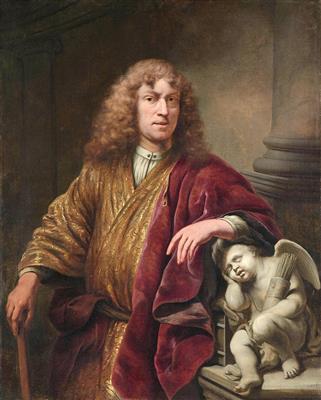
Where to see Ferdinand Bol
Ranked by works you can see in person.
-
25 works
Rijksmuseum
Amsterdam, Netherlands
-
15 works
Hermitage Museum
Saint Petersburg, Russia


-
14 works
Munich Central Collecting Point
Munich, Germany
Also here (6)
-
13 works
Amsterdam Museum
Amsterdam, Netherlands
-
9 works
Führermuseum
Linz, Austria
Also here (6)
-
8 works
Louvre
Paris, France
-
6 works
Hermann Göring Collection
Carinhall, Germany
-
6 works
National Museum in Warsaw
Warsaw, Poland
-
5 works
Mauritshuis
The Hague, Netherlands
-
5 works
Leiden Collection
New York City, United States


Own a piece of it
Ferdinand Bol prints
Hand-finished archival prints from Ferdinand Bol's body of work.
 Oude man met baard - Ferdinand Bol
From £37.00
Oude man met baard - Ferdinand Bol
From £37.00
 Michiel de Ruyter als luitenant-admiraal - Ferdinand Bol
From £37.00
Michiel de Ruyter als luitenant-admiraal - Ferdinand Bol
From £37.00
 Margarita Trip as Minerva Instructing her Sister Anna Maria Trip - Ferdinand Bol
From £37.00
Margarita Trip as Minerva Instructing her Sister Anna Maria Trip - Ferdinand Bol
From £37.00
 Man with Two Plumes in His Cap - Ferdinand Bol
From £37.00
Man with Two Plumes in His Cap - Ferdinand Bol
From £37.00
 Saint Jerome in the Cave - Ferdinand Bol
From £37.00
Saint Jerome in the Cave - Ferdinand Bol
From £37.00
 The Holy Family in an Interior - Ferdinand Bol
From £37.00
The Holy Family in an Interior - Ferdinand Bol
From £37.00
 The Woman with the Pear - Ferdinand Bol
From £28.00
The Woman with the Pear - Ferdinand Bol
From £28.00
 Hagar and the Angel by the Spring on the Way to Shur - Ferdinand Bol
From £28.00
Hagar and the Angel by the Spring on the Way to Shur - Ferdinand Bol
From £28.00
View all 52 museums
-
4 works
Gemäldegalerie Berlin
Berlin, Germany
-
3 works
National Gallery
London, United Kingdom
-
3 works
Metropolitan Museum of Art
New York City, United States
-
2 works
Toledo Museum of Art
Toledo, United States
-
2 works
Pushkin Museum of Fine Arts
Moscow, Russia
-
2 works
Städel Museum
Frankfurt, Germany
-
2 works
Johann Wilhelm von der Pfalz collection
Düsseldorf, Germany
-
2 works
Museum Boijmans Van Beuningen
Rotterdam, Netherlands
-
2 works
Museum of Fine Arts Boston
Boston, United States
-
2 works
Groninger Museum
Groningen, Netherlands
-
2 works
Nationalmuseum
Stockholm, Sweden
-
2 works
Indianapolis Museum of Art
Indianapolis, United States
-
2 works
Royal Museums of Fine Arts of Belgium
Brussels, Belgium
-
2 works
Los Angeles County Museum of Art
Los Angeles, United States
-
2 works
National Gallery of Ireland
Dublin, Ireland
Also here (6)
-
2 works
Royal Collection
London, United Kingdom
-
2 works
Museum of Fine Arts, Houston
Houston, United States
-
1 works
Royal Museum of Fine Arts Antwerp
Antwerp, Belgium
-
1 works
Gemäldegalerie Alte Meister
Dresden, Germany
-
1 works
Musée des Beaux-Arts de Quimper
Quimper, France
-
 1 works
Bolton Museum
Bolton, United Kingdom
-
1 works
Museum of John Paul II Collection
Warsaw, Poland
-
1 works
Museo de Arte de Worcester
Worcester, United States
-
1 works
Kunsthistorisches Museum
Vienna, Austria
-
1 works
Wallace Collection
London, United Kingdom
-
1 works
Iveagh Bequest, 1929
London, United Kingdom
-
1 works
Hessen Kassel Heritage
Kassel, Germany
-
1 works
Art Institute of Chicago
Chicago, United States
-
1 works
Israel Museum
Jerusalem, Israel
-
1 works
Landesmuseum Hannover
Hanover, Germany
-
1 works
Cincinnati Art Museum
Cincinnati, United States
-
1 works
National Trust
Swindon, United Kingdom
-
 1 works
Chequers
Wycombe, United Kingdom
-
1 works
Thyssen-Bornemisza Museum
Madrid, Spain
-
1 works
Museum der bildenden Künste
Leipzig, Germany
-
1 works
Centraal Museum
Utrecht, Netherlands
-
1 works
Fine Arts Museums of San Francisco
San Francisco, United States
-
1 works
National Museum of Art, Architecture and Design
Oslo, Norway
-
0 works
Groeningemuseum
Bruges, Belgium


2 more museums hold works by Ferdinand Bol with smaller collections, not listed here.
Can't travel? Bring Ferdinand Bol home.
See all Ferdinand Bol prints →Frequently Asked Questions
Where can I see Ferdinand Bol's work?
Ferdinand Bol's paintings and drawings can be found in numerous public collections. In Germany, his work is held by the Staatliche Museen zu Berlin; the Kupferstichkabinett, Berlin; the Herzog Anton Ulrich-Museum, Braunschweig; the Gemäldegalerie Alte Meister, Dresden; the Städelsches Kunstinstitut, Frankfurt am Main; the Niedersächsisches Landesmuseum, Hanover; and the Staatliche Graphische Sammlung, Munich. In the UK, Bol's work can be viewed at the National Gallery of Scotland, Edinburgh; the National Museums Liverpool, Walker Art Gallery; the British Library, London; the British Museum, London; the National Gallery, London; the National Portrait Gallery, London; Tate, London; UCL Art Collections, University College, London; the Victoria and Albert Museum, London; and the Ashmolean Museum, Oxford. Elsewhere in Europe, Bol's art is located in the Galleria degli Uffizi, Florence; the Museo Thyssen-Bornemisza, Madrid; the Musée du Louvre, Paris; the Royal Cabinet of Paintings, Mauritshuis, The Hague; and the Kunsthistorisches Museum, Vienna. In the United States, examples can be seen at the J. Paul Getty Museum, Los Angeles; the Metropolitan Museum of Art, New York; and the National Gallery of Art, Washington, D.C.What should I know about Ferdinand Bol's prints?
Ferdinand Bol (1616[5]-1680[5]) was a Dutch painter and draughtsman, and his prints reflect the influence of his training with Rembrandt. Bol was born in Dordrecht, and he later moved to Amsterdam, where he studied with Rembrandt. Bol's artistic style was initially similar to Rembrandt's, but he later developed his own style, which was influenced by Flemish masters such as Peter Paul Rubens and Anthony van Dyck. However, Rembrandt's influence remained with him. A drawing by Bol, Study for the Figure of a High Priest, shows a figure that appears monumental, despite the sheet's small size. The drawing may have been a study for a print or painting. The subject, a dignified elder, is set inside a temple, with the background only indicated in outline. The figure's robe and staff are rendered with simple, precise strokes of the pen, and the effect of shadows and depth is achieved through light washing.Why are Ferdinand Bol's works important today?
Ferdinand Bol (1616[5]-1680[5]) was a Dutch painter and etcher. He produced portraits, history paintings, and a few genre scenes. Bol's importance stems from his connections to Rembrandt van Rijn. He was one of Rembrandt's most able students, working in his studio during the late 1630s. Bol's early paintings closely resemble Rembrandt's style. He adopted Rembrandt's use of chiaroscuro and his interest in dramatic lighting. Works such as "Isaac Blessing Jacob" (c. 1643[5], Rijksmuseum, Amsterdam) demonstrate this influence. Later, Bol developed a more individual style. He moved toward a more classical approach, with brighter colours and more elegant figures. This shift reflected broader changes in Dutch art during the mid-17th century. Bol obtained significant commissions in Amsterdam. He contributed paintings to the Amsterdam Town Hall (now the Royal Palace). These paintings, completed in the 1650s, show his mature, classicising style. Bol's success illustrates the changing tastes of the Dutch elite, who increasingly favoured a more refined aesthetic. His works provide insight into the artistic trends of the Dutch Golden Age, and into the operation of Rembrandt's studio.What techniques or materials did Ferdinand Bol use?
Ferdinand Bol's painting technique involved specific choices of materials and application. He typically worked on canvas, prepared with a yellowish-grey ground. Examination of his paintings reveals the use of bold strokes, with translucent grey and brown paint for darker areas. Lighter areas were achieved using more opaque paint. In areas such as the face, Bol applied paint quite thickly, using a variety of flesh tints. He used small lines and patches of greyish and reddish paint to suggest folds and wrinkles. For highlights, he employed yellowish-white paint, with pinkish-white touches on areas like the nose. Like other Baroque painters, Bol likely used a limited range of colours on his palette, appropriate for the specific stage of the painting process. Some areas show fluid and animated strokes in a light yellow. Chains were rendered with slightly squiggly strokes of ochre yellow, light yellow, and white, sometimes with impasto.Who did Ferdinand Bol influence?
Ferdinand Bol was a student of Rembrandt between 1632[5] and 1635. Echoes of Rembrandt's drawing style from the 1630s can be observed in Bol's drawings from the 1640s, and in his painting proposals created for Amsterdam's city hall (now the Royal Palace) during the 1650s. Jan Victors was also associated with Rembrandt's studio. In 1722, it was claimed that Victors was active in Rembrandt's studio, with both Bol and Victors cited as two of Rembrandt's most gifted students. Most scholars consider that Victors' tuition under Rembrandt is based on the 'distinctly Rembrandtesque style of his early drawings'. Notable parallels in rendition, energetic drawing technique, and composition explain why *Lot and His Family Departing from Sodom* was long attributed to Rembrandt himself. Other artists influenced by Rembrandt include Govert Flinck, Nicolaes Maes, Adriaen van Ostade and Gabriel Metsu.Who influenced Ferdinand Bol?
Ferdinand Bol, a painter from Dordrecht (born in 1616[5]), became a pupil of Rembrandt around 1635[5] in Amsterdam. His works from 1640 to 1644 show such a strong similarity to Rembrandt's that they have often been mistaken for the master's paintings. After 1650, Bol adapted his style to more official tastes. Rembrandt ran a large workshop in Amsterdam, which attracted Dutch artists seeking greater success than their home towns could offer. Amsterdam was the fastest-growing city in the Netherlands and its largest centre of trade. Artistic exchange and competition were common in Amsterdam. Artists would incorporate another's invention to improve upon it; this approach reflected the philosophical and practical techniques of Rembrandt's workshop. Artists learned technique and invention from their predecessors, either working after the creations of others or observing from nature.What is Ferdinand Bol's most famous work?
It is difficult to identify one single "most famous" work by Ferdinand Bol, as fame and recognition can shift over time and among different audiences. Bol was a prolific painter, draughtsman, and etcher whose subject matter included portraits, history paintings, and biblical scenes. He is known to have been influenced by Rembrandt, under whom he studied in the early 1630s. Some of Bol's most notable works include paintings such as "Joseph Explaining the Dreams" and portraits of Michiel de Ruyter. His paintings can be found in major museum collections, such as the Rijksmuseum in Amsterdam. Without more passages to draw from, it is difficult to assess which work is the best known.What style or movement did Ferdinand Bol belong to?
Ferdinand Bol (1616[5]-1680[5]) was a Dutch artist who is generally associated with the Dutch Golden Age and, more specifically, with the circle of Rembrandt van Rijn. Bol was one of Rembrandt's most prominent and successful students. He is best known for history paintings and portraits. Bol's early work closely resembled Rembrandt's style, characterised by dramatic lighting, rich colours, and loose brushwork. He adopted Rembrandt's use of chiaroscuro, a technique that employs strong contrasts between light and dark to create a sense of depth and drama. Over time, Bol developed his own distinctive style, moving away from Rembrandt's more intense emotionalism toward a more classical and elegant aesthetic. His later works are characterised by smoother brushwork, lighter colours, and a greater emphasis on decorative elements. Bol's artistic development reflects the broader shift in Dutch art during the mid-17th century, as artists moved away from the dramatic baroque style toward a more refined and classical approach. He received many commissions, and he worked for Nicolaes Tulp among others.
Sources
Where to See guide aggregates verified holdings of Ferdinand Bol's works across the following collections.
- [1] museum Leiden Collection Used for: museum holdings.
- [2] museum Bolton Museum Used for: museum holdings.
- [3] museum Musées Nationaux Récupération Used for: museum holdings.
- [4] academic The Editors of Encyclopaedia Britannica, Ferdinand Bol | Dutch painter | Britannica Used for: biography.
- [5] wikipedia Wikipedia: Ferdinand Bol Used for: biography.
- [6] book Getty, Getty - Group Portraiture of Holland Used for: biography.
- [7] book Metropolitan Museum Of Art, Metropolitan Museum Of Art - Dutch Painting, the Golden Age_ an Exhibition of Dutch Pictures of the Seventeenth Century, under the High Patronage of Her Majesty the Queen of the Netherlands - Metropolitan Museum of Art, Toledo Museum of Art, Art Used for: biography.
- [8] book National Gallery of Art, National Gallery of Art - Painting in the Dutch Golden Age - A Profile of the Seventeenth Century Used for: biography.
- [9] museum Ferdinand Bol (1616 - 1680) | National Gallery, London Used for: stylistic analysis.
- [10] museum Ferdinand Bol - Rijksmuseum Used for: biography.
- [11] museum Giovanni Boldini - Gossip - The Metropolitan Museum of Art Used for: notable works.
Editorial overseen by Solis Prints. Sources verified 2026-09-24. Click a source for details, or hover over [N] in the page above to preview.
Editorial standardsMethodologyCorrectionsAI disclosureAbout the editorial team