



About Bernhard Strigel
- portrait
- religious painting
Swabian court painter to Emperor Maximilian I, known for imperial portraits and religious panels in the Flemish-inflected Swabian colourist tradition.
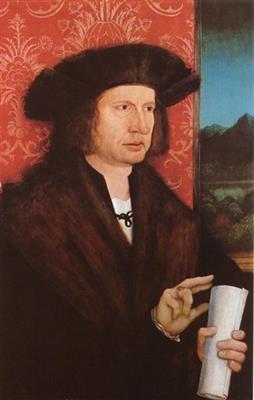
Where to see Bernhard Strigel
Ranked by works you can see in person.
-
17 works
Gemäldegalerie Berlin
Berlin, Germany
-
6 works
National Gallery of Art
Washington D.C., United States


-
6 works
Kunsthistorisches Museum
Vienna, Austria
-
4 works
Walters Art Museum
Baltimore, United States
-
4 works
Thyssen-Bornemisza Museum
Madrid, Spain
-
2 works
Führermuseum
Linz, Austria
Also here (6)
-
2 works
Munich Central Collecting Point
Munich, Germany
Also here (6)
-
2 works
Staatsgalerie Stuttgart
Stuttgart, Germany
-
1 works
Städel Museum
Frankfurt, Germany
-
1 works
Upton House
Ratley and Upton, United Kingdom


View all 19 museums
-
1 works
National Gallery Prague
Prague, Czech Republic
-
1 works
Unterlinden Museum
Colmar, France
-
1 works
Tokyo Fuji Art Museum
Hachiōji, Japan
-
1 works
Kunstmuseum Basel
Basel, Switzerland
-
1 works
Dumbarton Oaks
Washington D.C., United States
-
1 works
National Trust
Swindon, United Kingdom
-
1 works
Metropolitan Museum of Art
New York City, United States
-
1 works
National Gallery of Ireland
Dublin, Ireland
Also here (6)
-
1 works
National Museum in Warsaw
Warsaw, Poland


Frequently Asked Questions
Where can I see Bernhard Strigel's work?
Bernhard Strigel (circa 1460-1528[2]) was a German[2] painter of the late Gothic and early Renaissance. He worked primarily in Memmingen, Swabia, an Imperial Free City now located in Bavaria. Many of Strigel's paintings are in German collections. The Kunsthistorisches Museum, Vienna, owns several portraits, including those of Emperor Maximilian I. The Alte Pinakothek in Munich holds Strigel's most famous work, the large-scale altarpiece commissioned for the church of St. Martin in Memmingen. This altarpiece, created circa 1520[2], depicts scenes from the Life of the Virgin Mary and the Passion of Christ. Other works by Strigel can be found in the Germanisches Nationalmuseum in Nuremberg and in the Staatsgalerie in Stuttgart. Some examples are also held in international collections. For example, the National Gallery in London possesses a portrait[2] of a man attributed to Strigel. These various locations offer opportunities to view the range of Strigel's artistic output, especially his portraits and religious paintings.What should I know about Bernhard Strigel's prints?
Bernhard Strigel (1460/61-1528[2]) was a German[2] painter of the late Gothic and early Renaissance periods. While he is best known for his paintings, particularly portraits and religious scenes, information specifically about his prints is scarce. The printmaking boom occurred during Strigel's career. Print production and distribution saw great expansion during the Renaissance. Woodcuts and engravings became increasingly common, and artists like Dürer achieved considerable wealth through print sales. However, Strigel's primary focus appears to have been painting for aristocratic patrons. He worked for Emperor Maximilian I, producing devotional panels and portraits of the imperial family. This suggests that printmaking may not have been a central part of his artistic output. Research resources focus on Strigel's drawings and paintings. It is possible that Strigel created designs that were then executed as prints by others, but further investigation would be required to confirm this aspect of his work.Why are Bernhard Strigel's works important today?
Bernhard Strigel (circa 1460-1528[2]) was a Swabian painter of the transition between the Gothic and Renaissance periods. He is important for his contributions to portraiture and religious art in southern Germany. Strigel's significance lies in his ability to blend traditional German[2] artistic styles with new Italian Renaissance influences. He is known for his portraits of members of the Habsburg imperial family and other prominent figures, which offer insights into the appearance and fashion of the time. His portraits are characterised by their attention to detail and realistic depiction of the sitters. Beyond portraiture, Strigel produced religious works, including altarpieces and panel paintings. These pieces often display a sensitivity to colour and composition. His work provides valuable information about the artistic and cultural environment of southern Germany during a period of change. Strigel's legacy rests on his skill as a portraitist and his role in introducing Renaissance ideas into German art.What techniques or materials did Bernhard Strigel use?
Bernhard Strigel created small-scale stained-glass panels using techniques derived from monumental church windows. These panels often took the form of roundels, trefoils, and quatrefoils. Strigel employed leaded or pot-metal panels, combining clear glass, pot glass (antique glass of one colour), and flashed glass (clear glass overlaid with a thin layer of deep colour). The coloured layer could be abraded or acid-etched to reveal the clear glass underneath, which was helpful for depicting coats of arms or clothing patterns. The glass pieces were painted on the front with vitreous paint in black and browns, applied as washes and lines. A badger brush could be used to create stippling effects. From the late fifteenth century, a wire brush was used to scratch points of light out of the washes. Highlights could be created using a needle, stick, or the end of a brush. The reverse side was articulated with silver stain or yellow stain to produce translucent yellows, often used for halos, hair, and clothing. Sanguine, a reddish-brown enamel, was sometimes applied to the reverse to indicate flesh tones. After firing, the glass pieces were held together by lead strips. He also worked in grisaille, painting on a single piece of clear glass using black, grey, and brown vitreous paint on the front, and yellow stain, and often sanguine, on the reverse.Who did Bernhard Strigel influence?
Bernhard Strigel's influence is most apparent in the work of artists in the Danube school. These artists, active in the early 16th century, include Wolf Huber and Albrecht Altdorfer. However, a drawing at the University Library in Erlangen is sometimes attributed to Strigel, based on comparisons with the backgrounds of his panels. Other scholars have compared it to work by the Master of the Housebook. During this period, Albrecht Dürer also exerted a strong influence on other artists. Hans Baldung Grien, Hans von Kulmbach, and Georg Pencz all emulated Dürer's graphic style. Erhard Schon, who produced over 1,200 book illustrations, was also influenced by Dürer. Other artists who came under Dürer's influence include Hans Leu, Hans Dürer, Nicholas Glockendon, Hans Plattner, Hans Springinklee, and Wolf Traut.Who influenced Bernhard Strigel?
Bernhard Strigel's artistic development occurred in a milieu influenced by several artists. The Master WB, active in Frankfurt, and a master from Lake Constance, who created *Bishop Hugo van Landenberg* in Karlsruhe (dated 1502[2]), represent examples of artistic figures whose work bears comparison to Strigel's. Gertrud Otto's 1964 monograph, however, accepted the attribution without question. Ludwig Baldass, writing in *Oberrheinische Kunst* (1926/7), drew comparisons between Strigel and the Housebook Master, specifically referencing the mining scene on folio 35a of the Housebook. Alan Shestack complicated matters further in a 1966 *Master Drawings* article, mentioning panels by the Master LCz in relation to Strigel's influences. These references suggest a complex web of artistic interactions and influences during Strigel's time.What is Bernhard Strigel's most famous work?
It is difficult to name one single work as Bernhard Strigel's most famous. He was active as a painter in Memmingen, Swabia, from about 1490 until 1520[2], and he worked for the Holy Roman Emperor Maximilian I. Strigel came from a family of artists; his father was a painter, and his son and nephew also became painters. His work moved from the late Gothic style toward the Renaissance style. Among his important works are several portraits of members of Maximilian's Habsburg imperial family. These include portraits of Maximilian I, his son Emperor Maximilian, and his grandson the future Emperor Charles V. Strigel also produced religious paintings, such as the high altar at Memmingen.What style or movement did Bernhard Strigel belong to?
Bernhard Strigel (circa 1460-1528[2]) was a German[2] painter of the late Gothic and early Renaissance periods. He is associated with the Danube School, a circle of artists working in the regions of Bavaria and Austria. Strigel's early work shows the influence of Netherlandish painting, particularly in his attention to detail and realistic depiction of textures. He later incorporated Italian Renaissance elements into his style, such as classical motifs and a greater emphasis on perspective. This is evident in his portraits and religious paintings, which often feature elegant figures and harmonious compositions. Strigel's patrons included Emperor Maximilian I, for whom he painted portraits and genealogical works. He also produced altarpieces and other religious works for churches and monasteries in southern Germany. His art represents a transition from the late Gothic style to the Renaissance, blending traditional German elements with new Italian influences. He is considered one of the most important artists of his time in the region.
Sources
Where to See guide aggregates verified holdings of Bernhard Strigel's works across the following collections.
- [1] museum Samuel H. Kress Collection Used for: museum holdings.
- [2] wikipedia Wikipedia: Bernhard Strigel Used for: biography.
- [3] book Yvonne Owens, Abject Eroticism in Northern Renaissance Art Used for: stylistic analysis.
- [4] book Christopher S. Wood, Albrecht Altdorfer and the Origins of Landscape Used for: stylistic analysis.
- [5] book Cuttler, Charles D, Northern painting from Pucelle to Bruegel: fourteenth, fifteenth, and sixteenth centuries Used for: biography.
- [6] book Charles D. Cuttler, Northern Painting From Pucelle to Bruegel Fourteenth, Fifteenth, and Sixteenth Centuries Used for: biography.
- [7] book Barbara Butts, Lee Hendrix, John Walsh, Brent Benjamin, Barbara Giesicke, Timothy B. Husband, Mylène Ruoss, Hartmut Scholz and Peter van Treeck, Painting on Light: Drawings and Stained Glass in the Age of Dürer and Holbein Used for: biography, stylistic analysis.
Editorial overseen by Solis Prints. Sources verified 2026-09-24. Click a source for details, or hover over [N] in the page above to preview.
Editorial standardsMethodologyCorrectionsAI disclosureAbout the editorial team