

About Anna Katarina Boberg
Swedish · 1864–1935
- landscape painting
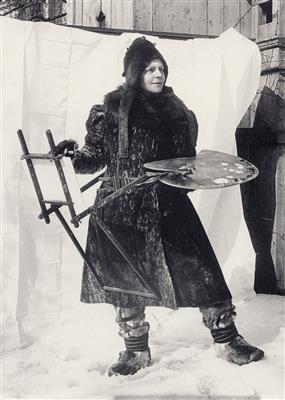
Self-taught Swedish[1] painter who devoted 33 years to the Arctic light and ice of Norway's Lofoten archipelago.
Museums3
Countries3
Most worksNationalmuseum, Stockholm · 238 works
Loading map…
Where to see Anna Katarina Boberg
Ranked by works you can see in person.
-
238 works
Nationalmuseum
Stockholm, Sweden
-
2 works
Musée d'Orsay
Paris, France


-
1 works
National Museum of Art, Architecture and Design
Oslo, Norway

Frequently Asked Questions
Where can I see Anna Katarina Boberg's work?
Anna Katarina Boberg's work can be found in numerous museums and public collections internationally. These include institutions in her native Sweden, such as the Nationalmuseum and Malmö Museum in Stockholm. In the United States, her art is held by the Art Institute of Chicago, the Metropolitan Museum of Art, and the Museum of Modern Art (both in New York), as well as the Carnegie Institute Museum of Art in Pittsburgh. Other locations include the Busch-Reisinger Museum at Harvard University and the Cincinnati Art Museum. In Europe, Boberg's pieces are in the collection of the Musée des Arts Décoratifs in Paris, the Graphische Sammlung Albertina in Vienna, the Kunstmuseum in Bern, the Louisiana Museum of Modern Art in Humlebaek, Denmark, and the National Gallery in Oslo. Her art is also held in the Amos Anderson Art Museum in Helsinki.What should I know about Anna Katarina Boberg's prints?
Anna Katarina Boberg's prints, like those of many artists, exist in a range of types and values. 'Original prints' are produced by hand, with the artist creating the artwork directly on a plate, woodblock, stone, or screen. These include woodcuts, engravings, etchings, lithographs and serigraphs. These are often called 'hand-pulled prints'. Because the plates for original prints are made by hand, the number of prints is limited by how many impressions can be made before the plate wears out. Some publishers limit the number of impressions to increase a print’s value. The prints are numbered, for example 35/100, with the largest number representing the total prints in the edition, and the smaller number the sequential number of that particular print. Some artists also hold out a percentage as artist's proofs. Original prints are sold through print galleries, frame shops, and fine art galleries. Offset reproductions, also known as posters, are reproduced by photochemical means. Plates used in offset reproductions do not wear out, so there are no physical limits on the number of prints made. Giclée prints are inkjet fine art prints and canvas transfers are images printed onto canvas to resemble paintings.Why are Anna Katarina Boberg's works important today?
Anna Katarina Boberg (1864[1]-1935[1]) was a Swedish[1] artist, best known for her decorative art and Arctic paintings. Her importance today stems from her diverse artistic output and her unique perspective on the northern regions of Sweden and Norway. Boberg's early career focused on decorative arts. She designed ceramics, textiles, and glass for Svenskt Tenn, a Stockholm design company. These designs, often inspired by nature, contributed to the Swedish Arts and Crafts movement. Her work in this area demonstrates her skill in translating natural forms into stylised patterns. Later in life, Boberg turned to painting, particularly scenes of the Lofoten Islands in Norway. She spent considerable time in the Arctic, capturing the dramatic light and imposing forms of the mountains and sea. These paintings offer a visual record of a remote environment and reflect Boberg's fascination with the sublime aspects of nature. Her Arctic paintings are significant for their atmospheric qualities and their depiction of a landscape largely untouched by human development at the time. They provide a historical viewpoint on a region undergoing significant environmental change.What techniques or materials did Anna Katarina Boberg use?
Anna Katarina Boberg (1864[1]-1935[1]) was a Swedish[1] artist, active as a painter and textile designer. She is known for her varied artistic output, including work with different media and techniques. Boberg is particularly well known for her Art Nouveau ceramics produced at the Rörstrand porcelain factory. These pieces often featured stylised natural motifs and unusual glazes. She also designed textiles, including rugs and decorative fabrics, often incorporating similar Art Nouveau-inspired designs. In addition to her decorative arts, Boberg was a painter. She worked in watercolour and oil paint, creating pictures of coastal scenes from northern Norway. These paintings capture the dramatic light and atmosphere of the Arctic region. Her work demonstrates a versatility in both subject matter and technique, moving from decorative design to fine art painting.Who did Anna Katarina Boberg influence?
It is difficult to identify specific individuals who were directly influenced by Anna Katarina Boberg. Information about Swedish[1] art from the period suggests a complex interplay of influences and trends. Sweden, during Boberg's active period, maintained an openness to international artistic movements. Some observers felt that new trends were adopted too rapidly, potentially hindering individual artistic development. The art scene was largely centred in Stockholm, although regional centres such as Gothenburg and Malmo provided some counterbalance. Young Swedish artists were described as being in an experimental phase, with German neo-expressionism making a considerable impact. Jörg Immendorff's guest teaching position at the College of Art in 1981 is cited as an example of this influence. At the time, some teachers observed that young artists lacked historical awareness, which affected their work.Who influenced Anna Katarina Boberg?
It is difficult to identify specific influences on Anna Katarina Boberg from the passages provided. However, the texts do discuss the influences on Anni Albers, a Bauhaus artist. Albers was taught by a Miss Violet, who instructed her in naturalistic watercolours. Later, she studied with Toni Mayer, who introduced her to figure drawing. Albers also studied with Postimpressionist Martin Brandenburg, from whom she felt she benefited, despite disagreeing with some of his techniques. Albers was also taught by Paul Klee at the Bauhaus. Klee's transcendentalist philosophy, which valued independence and saw the visual world as only one of several realities, impacted Albers. Klee aimed to create his own style devoid of preconceptions. Albers considered Klee a genius because of his ability to combine abstract and geometric forms with natural and organic ones. Klee's Bauhaus colleague, Wassily Kandinsky, was also a close friend.What is Anna Katarina Boberg's most famous work?
Anna Katarina Boberg was a Finnish artist who worked in diverse media. Watercolours, often combined with India ink or pastel, appear frequently in lists of her works. Many of these date from the 1970s and 1980s. Examples include *Sven Duva in Hades* (1975), *The Queen Threatened* (1976), *Midsummer Night's Dream* (1977), and *Grasshopper by a Rainbow* (1981). Several of her watercolours are in the collections of major museums, such as the Ateneum Art Museum in Helsinki, and the Amos Anderson Art Museum, also in Helsinki. Her watercolours often have an element of fantasy or the surreal. For example, *Bunny Plays Bach on an Electric Piano* dates to 1979. *The Sphinx's Dream* was completed in 1981.What style or movement did Anna Katarina Boberg belong to?
Anna Katarina Boberg (1864[1]-1935[1]) was a Swedish[1] artist whose work encompassed several styles, making her difficult to categorise neatly. Initially, Boberg's artistic approach aligned with naturalism. This is evident in her detailed depictions and objective studies of nature. However, her style evolved over time. Like many artists of the late 19th and early 20th centuries, she was exposed to, and influenced by, impressionism. This is reflected in a lighter palette and a more dynamic brushstroke in some of her later pieces. Some art historians connect Boberg's work with romanticism, citing the way she conveyed a view of nature with a numinous tinge. Her paintings often featured tranquil, secluded scenes, far from urban centres, aligning with the escapist sentiments prevalent at the time. Other Austrian artists, such as Emil Jakob Schindler, also explored similar themes. Boberg's output resists easy classification, containing elements of naturalism, impressionism, and romanticism.
Sources
Where to See guide aggregates verified holdings of Anna Katarina Boberg's works across the following collections.
- [1] wikipedia Wikipedia: Anna Katarina Boberg Used for: biography.
- [2] book Beard, Lee, 1973- author, Butler, Adam, author; Van Cleave, Claire, author; Fortenberry, Diane, author; Stirling, Susan, author, Beard, Lee, 1973- author, Butler, Adam, author; Van Cleave, Claire, author; Fortenberry, Diane, author; Stirling, Susan, author - The Art Book_ New Edition, Mini Format Used for: biography.
- [3] book Landauer, Susan, The not-so-still life : a century of California painting and sculpture Used for: biography.
- [4] book John Gribbin, The Scientists Used for: biography, stylistic analysis.
- [5] book Hodge, Susie, 1960- author, The short story of women artists : a pocket guide to movements, works, breakthroughs, & themes Used for: biography.
Editorial overseen by Solis Prints. Sources verified 2026-09-24. Click a source for details, or hover over [N] in the page above to preview.
Editorial standardsMethodologyCorrectionsAI disclosureAbout the editorial team