



About Agostino Carracci
- history painting
- portrait
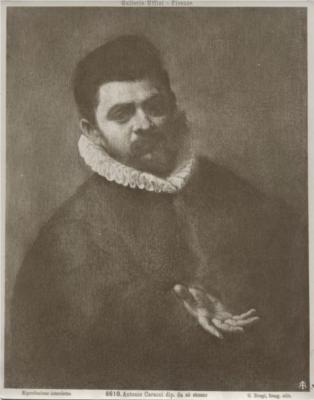
Bolognese painter, printmaker and co-founder of the Accademia degli Incamminati whose engravings influenced Matisse three centuries after his death.
Where to see Agostino Carracci
Ranked by works you can see in person.
-
5 works
Museo di Capodimonte
Naples, Italy
-
 0 works
National Gallery of Art
Washington D.C., United States

-
4 works
Statens Museum for Kunst
Copenhagen, Denmark
-
3 works
Hermitage Museum
Saint Petersburg, Russia
-
2 works
National Galleries Scotland
Edinburgh, United Kingdom
-
2 works
Pinacoteca Nazionale di Bologna
Bologna, Italy
-
2 works
National Gallery
London, United Kingdom
-
2 works
Kunsthistorisches Museum
Vienna, Austria
-
1 works
Gemäldegalerie Alte Meister
Dresden, Germany
-
1 works
Louvre
Paris, France


Own a piece of it
Agostino Carracci prints
Hand-finished archival prints from Agostino Carracci's body of work.
 Portrait of Titian - Agostino Carracci
From £28.00
Portrait of Titian - Agostino Carracci
From £28.00
 Great Crucifixion (right panel) - Agostino Carracci
From £28.00
Great Crucifixion (right panel) - Agostino Carracci
From £28.00
 The Great Crucifixion (left panel) - Agostino Carracci
From £28.00
The Great Crucifixion (left panel) - Agostino Carracci
From £28.00
 The Virgin Appearing to Saint Jerome - Agostino Carracci
From £28.00
The Virgin Appearing to Saint Jerome - Agostino Carracci
From £28.00
 Saint James Minor, Saint James Major and Saint Matthias - Agostino Carracci
From £28.00
Saint James Minor, Saint James Major and Saint Matthias - Agostino Carracci
From £28.00
 Saint Jerome Surrounded by Mourners - Agostino Carracci
From £28.00
Saint Jerome Surrounded by Mourners - Agostino Carracci
From £28.00
 Mercury and the Three Graces - Agostino Carracci
From £28.00
Mercury and the Three Graces - Agostino Carracci
From £28.00
 Saint Jerome - Agostino Carracci
From £28.00
Saint Jerome - Agostino Carracci
From £28.00
View all 25 museums
-
 1 works
Weston Park
Weston-under-Lizard, United Kingdom
-
1 works
Gemäldegalerie Berlin
Berlin, Germany
-
1 works
Staatliche Kunstsammlungen Dresden
Dresden, Germany
-
1 works
Musée des beaux-arts de Marseille
Marseille, France
-
1 works
Museo del Prado
Madrid, Spain
-
1 works
Accademia Carrara
Bergamo, Italy
-
1 works
Victoria and Albert Museum
London, United Kingdom
-
1 works
National Gallery of Ireland
Dublin, Ireland
Also here (6)
-
1 works
Royal Collection
London, United Kingdom
-
0 works
Museum of Fine Arts of Rennes
Rennes, France
-
0 works
Groeningemuseum
Bruges, Belgium
-
0 works
Museum Boijmans Van Beuningen
Rotterdam, Netherlands
-
0 works
Museum of Fine Arts Ghent (MSK)
Ghent, Belgium
-
0 works
Nationalmuseum
Stockholm, Sweden
-
0 works
Vanderbilt Museum of Art
Nashville, United States


Can't travel? Bring Agostino Carracci home.
See all Agostino Carracci prints →Frequently Asked Questions
Where can I see Agostino Carracci's work?
Agostino Carracci's paintings and engravings can be viewed in several locations. In Bologna, where he completed several important fresco cycles with his brother Annibale and cousin Ludovico, look to the Fava Palace, the Palazzo Magnani, and the Palazzo Sampieri. The Pinacoteca Nazionale in Bologna holds his celebrated painting, *The Last Communion of St Jerome*. Outside Italy, Carracci's *Allegory of Truth and Time* is in the Royal Collection at Hampton Court. In Oxford, the Christ Church Gallery has both his *Butcher's Shop* and *Madonna above Bologna*. The Matthiesen Gallery, London, holds his *Portrait of a Woman as Judith*. Other works can be found on the continent. The Dresden Gallery possesses Carracci's *Assumption of the Virgin*, *Madonna of St Matthew*, and *St Roch Distributing Alms*. The Louvre in Paris has his *Resurrection of Christ* and *St Luke*. The National Museum in Capodimonte, Naples, has his *Choice of Hercules* and a *Pietà*. The Parma Gallery holds his *Pietà with Saints*.Who was Agostino Carracci?
Agostino Carracci was a painter and engraver from Bologna, Italy, who, along with his brother Annibale and cousin Ludovico, co-founded the Accademia degli Incamminati in 1582[2]. He trained as a goldsmith before becoming a painter, and he also studied engraving under Domenico Tibaldi.Who did Agostino Carracci influence?
Agostino Carracci, along with his brother Annibale and cousin Ludovico, sought to reform painting away from Mannerist excesses. They wanted to combine Raphael's classicism, Correggio's soft forms, and Venetian colourism. Agostino's travels to Venice in 1580[2] and 1582 to engrave works by Venetian masters exposed his circle to Venetian art. The Carracci established the Accademia dei Desiderosi (later the Accademia degli Incamminati) in Bologna in 1582. It was intended as a progressive learning environment, offering instruction in both artistic theory and practice. Agostino's detailed anatomical drawings became teaching tools at the academy for two centuries. His lectures covered philosophy, geometry, architecture, perspective and cosmography. The academy attracted not only artists but also scholars and aristocrats, who participated in discussions. Around 1615, Giovanni Battista Agucchi noted that many Italian[2] gentlemen and foreigners studied at the Carracci academy, producing work of merit. Annibale Carracci's frescoes in the Palazzo Farnese, begun in 1597, were also enormously influential.Who influenced Agostino Carracci?
Agostino Carracci, along with his brother Annibale and cousin Ludovico, felt that art in Bologna needed reform. They sought to revive painting by studying past masters such as Raphael, Correggio, and Titian. Agostino travelled to Venice in 1580[2] and again in 1582 to engrave works by Venetian artists such as Veronese and Tintoretto. This exposure to Venetian art brought a new artistic vocabulary back to Bologna. The Carracci aimed to combine Raphael's classicism and emphasis on drawing, Correggio's softer forms, and the colourism of Venetian painting. In 1582, Agostino, Annibale, and Ludovico established the Accademia dei Desiderosi, later known as the Accademia degli Incamminati, in Bologna. Agostino provided intellectual leadership, and his detailed anatomical drawings became teaching tools. He lectured on philosophy, geometry, architecture, perspective, and cosmography. The academy fostered discussion among artists, scholars, and aristocrats.What style or movement did Agostino Carracci belong to?
Agostino Carracci, along with his brother Annibale and cousin Ludovico, is associated with the Carracci Reform. This movement arose from their dissatisfaction with the state of art in Bologna. They aimed to revive painting by drawing upon the strengths of past masters such as Raphael, Correggio, and Titian. Agostino's travels to Venice in 1580[2] and 1582 exposed him to the works of Venetian artists. Annibale also visited Venice in 1588. Their study of these masters led to a synthesis of Raphael's classicism and emphasis on draftsmanship, Correggio's softened forms, and the Venetian school's colourism. Together, the Carracci founded the Accademia dei Desiderosi in 1582, later called the Accademia degli Incamminati. This academy promoted progressive art education, combining theoretical study with practical training. Agostino's detailed anatomical drawings became teaching aids at the academy for two centuries. The Carracci's reform rejected Mannerism, instead advocating for a combination of classicism, naturalism, and Venetian colour.What is Agostino Carracci known for?
Agostino Carracci is known for his engravings, which reproduced works by artists such as Tintoretto, Titian, and Veronese. These prints helped to spread knowledge of Venetian colour across Italy. He is also known for co-founding the Accademia degli Incamminati with his brother and cousin.What was Agostino Carracci's art style?
Agostino Carracci's painting style was influenced by Correggio, as seen in his use of soft light in The Last Communion of Saint Jerome. He also worked on fresco cycles at Palazzo Fava and Palazzo Magnani.
Sources
Where to See guide aggregates verified holdings of Agostino Carracci's works across the following collections.
- [1] museum Weston Park Used for: museum holdings.
- [2] wikipedia Wikipedia: Agostino Carracci Used for: biography.
- [3] book Elizabeth Gilmore Holt; Project Muse, A Documentary History of Art, Volume 2 _ Michelangelo and the Mannerists, The Baroque and the Eighteenth Century Used for: biography.
- [4] book Elizabeth Gilmore Holt; Project Muse, A Documentary History of Art, Volume 2 _ Michelangelo and the Mannerists, The Baroque and the Eighteenth Century Used for: biography.
- [5] book Lilian H. Zirpolo, Historical Dictionary of Baroque Art and Architecture Used for: biography.
Editorial overseen by Solis Prints. Sources verified 2026-09-24. Click a source for details, or hover over [N] in the page above to preview.
Editorial standardsMethodologyCorrectionsAI disclosureAbout the editorial team