



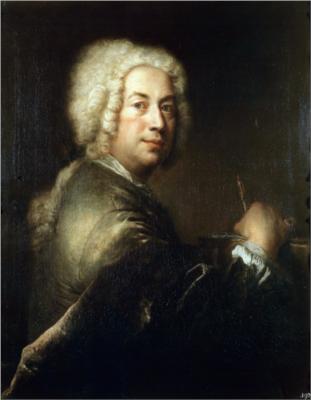
About Antoine Pesne
Where to see Antoine Pesne
Ranked by works you can see in person.
-
29 works
Nationalmuseum
Stockholm, Sweden
-
21 works
Gemäldegalerie Berlin
Berlin, Germany


-
13 works
Hermitage Museum
Saint Petersburg, Russia
-
11 works
National Portrait Gallery of Sweden
Mariefred, Sweden
-
8 works
National Museum in Warsaw
Warsaw, Poland
-
7 works
Munich Central Collecting Point
Munich, Germany
Also here (6)
-
6 works
Führermuseum
Linz, Austria
Also here (6)
-
4 works
Royal Collection
London, United Kingdom
-
2 works
Germanisches Nationalmuseum
Nuremberg, Germany
-
2 works
Louvre
Paris, France


Own a piece of it
Antoine Pesne prints
Hand-finished archival prints from Antoine Pesne's body of work.
 Louise Eleonore von Wreech - Antoine Pesne
From £37.00
Louise Eleonore von Wreech - Antoine Pesne
From £37.00
 Portrait of Mary Susanne Dinglinger, born Gutermann - Antoine Pesne
From £28.00
Portrait of Mary Susanne Dinglinger, born Gutermann - Antoine Pesne
From £28.00
 Portrait of the Crown Prince Friedrich Ludwig of Württemberg and his wife Henriette Marie of Brandenburg-Schwedt - Antoine Pesne
From £28.00
Portrait of the Crown Prince Friedrich Ludwig of Württemberg and his wife Henriette Marie of Brandenburg-Schwedt - Antoine Pesne
From £28.00
 Friedrich Hoffmann, German physician - Antoine Pesne
From £28.00
Friedrich Hoffmann, German physician - Antoine Pesne
From £28.00
 Portrait of the dancer Barbara Campanini, known as La Barbarina - Antoine Pesne
From £28.00
Portrait of the dancer Barbara Campanini, known as La Barbarina - Antoine Pesne
From £28.00
 Princess Amalia of Prussia as an Amazon - Antoine Pesne
From £28.00
Princess Amalia of Prussia as an Amazon - Antoine Pesne
From £28.00
 Elisabeth Christine of Brunswick-Wolfenbüttel-Bevern - Antoine Pesne
From £28.00
Elisabeth Christine of Brunswick-Wolfenbüttel-Bevern - Antoine Pesne
From £28.00
 Marianne Cochois - Antoine Pesne
From £28.00
Marianne Cochois - Antoine Pesne
From £28.00
View all 25 museums
-
1 works
Gemäldegalerie Alte Meister
Dresden, Germany
-
1 works
National Galleries Scotland
Edinburgh, United Kingdom
-
1 works
National Museum in Kraków
Kraków, Poland
-
1 works
Liechtenstein Museum
Vienna, Austria
-
1 works
Westphalian State Museum of Art and Cultural History
Münster, Germany
-
1 works
Finnish National Gallery
Helsinki, Finland
Also here (6)
-
1 works
Hermann Göring Collection
Carinhall, Germany
-
1 works
Hessen Kassel Heritage
Kassel, Germany
-
1 works
Harvard Art Museums
Cambridge, United States
-
1 works
Bode Museum
Berlin, Germany
-
1 works
National Art Museum of Azerbaijan
Baku, Azerbaijan
-
1 works
Busch–Reisinger Museum
Cambridge, United States
-
1 works
Minneapolis Institute of Art
Minneapolis, United States
-
1 works
Saint Louis Art Museum
St. Louis, United States
-
1 works
Musée Carnavalet
Paris, France


Can't travel? Bring Antoine Pesne home.
See all Antoine Pesne prints →Frequently Asked Questions
Where can I see Antoine Pesne's work?
Antoine Pesne's work can be seen in various locations, particularly in Germany and France. As a painter who served at the Prussian court of Frederick the Great, Pesne's art provides a link between French[1] and Frederican Rococo[1] styles. One can view the collaborative painting of Schloss Rheinsberg (1737[1]) at Schloss Charlottenburg, Berlin, which he created with Georg Wenzeslaus von Knobelsdorff. Also at Schloss Charlottenburg, Berlin, is The Dancer Barbara Campanini (circa 1745). Pesne's decorative work at Rheinsberg, Berlin and Potsdam often featured allegorical and mythological themes. His ceiling at Sanssouci, titled Zephyr Crowns Flora (1747), remains in situ. In Paris, the Musée Carnavalet holds his portrait of Pierre-Jean Mariette (1723).What should I know about Antoine Pesne's prints?
Antoine Pesne was primarily a painter, rather than a printmaker. Born in Paris in 1683[1], he is better known for his portraits of European royalty and aristocracy. Pesne trained with his father, the painter Thomas Pesne, and his uncle, the engraver Charles Pesne. He received a stipend to study in Italy from 1705[1] to 1710. In 1711, he was appointed court painter to Frederick I of Prussia; he later became director of the Berlin Academy. Pesne remained in this role for much of his career, although he travelled to Paris and London. He died in Berlin in 1757[1]. Prints related to Pesne fall into a few categories. Some are reproductive engravings of his paintings, made by other artists. These prints circulated his compositions to a wider audience. Other prints are portraits of Pesne himself. One example is a 1737 engraving by Johann Martin Bernigeroth, after a painting by Georg Lisiewski. Finally, Pesne is known to have produced a small number of etchings. These include a self-portrait and studies of heads. These etchings display a painterly style; they translate his skill with colour and tone into a monochrome medium.Why are Antoine Pesne's works important today?
Antoine Pesne (1683[1]-1757[1]) was a court painter, primarily active in Berlin. While not as universally known as some of his contemporaries, his artistic contributions remain relevant for several reasons. Pesne's career trajectory avoids the extremes of some artists. Nicolas Poussin, for example, maintained steady acclaim, while others, such as Fragonard, experienced periods of obscurity before rediscovery. Pesne's work, while not always at the forefront of art historical discussion, has not suffered total neglect. His importance also stems from his role in bridging artistic styles. Poussin combined the study of nature and classical antiquity. Similarly, Pesne integrated French[1], Italian, and Dutch influences into his portraits and history paintings, creating a distinctive style that appealed to the Prussian court. Studying Pesne allows historians to examine the transmission and adaptation of artistic ideas across Europe during the 18th century. His portraits offer insights into the social and cultural milieu of the Prussian elite.Who did Antoine Pesne influence?
Nicolas Poussin, a French[1] painter whose work greatly influenced artists for centuries, can be seen as an influence on Antoine Pesne. Poussin's impact extended to painters, intellectuals, iconographers, and art historians. His work appealed to an elite audience, and he is often called "the philosopher-painter". Poussin's classical ideals, which include reason, harmony, balance, moderation, clarity, and concentration, have been viewed as the source of great art. Jacques-Louis David, a French painter of the late 1700s, brought Poussin's style back to prominence in France. Jean-Auguste-Dominique Ingres continued this tradition. Paul Cézanne also admired Poussin greatly. Even Pablo Picasso drew inspiration from Poussin's classical style, particularly during his return to naturalism after the First World War. Poussin's influence has been felt most strongly during periods when an intellectual approach to painting prevailed. His example demonstrates that classicism can produce works that appeal to both the mind and the heart.Who influenced Antoine Pesne?
It is difficult to assess Antoine Pesne's influences based on the passages provided. They do not contain specific information about Pesne or his artistic development. However, the passages do discuss the general transmission of artistic ideas and techniques. For instance, the text mentions that artists like Ingres followed the example of their masters by teaching and collaborating with students. This suggests that artistic influence can occur through direct instruction and studio practice. The passages also note the broader influence of artists such as Watteau, Poussin, and David, whose work affected various aspects of culture, including theatre, fashion, literature, and historical interpretation. These examples suggest that an artist's impact can extend beyond the art world and into other intellectual and professional spheres. Without more specific information, it is impossible to determine which artists or movements had a direct impact on Antoine Pesne's work.What is Antoine Pesne's most famous work?
It is difficult to identify one single work as Antoine Pesne's most famous. He was a prolific portraitist, and many of his paintings are well known. Pesne's broader artistic output included many engravings; for example, Jean Pesne (died 1700[1]) created engravings of Nicolas Poussin's Virgin and Child and Virgin and Child with St. John. Similarly, Antoine Trouvain (died 1708) made an engraving of Poussin's Moses and the Daughters of Jethro, while Louis de Chatillon (died 1734) engraved Poussin's Landscape with a Storm. Gerard Audran (died 1703) engraved The Vision of Sta. Francesca Romano, and Benoit Audran the Elder (died 1721) engraved The Flight into Egypt. These engravings after Poussin's works demonstrate the artistic milieu in which Pesne and his contemporaries operated.What is Antoine Pesne known for?
Antoine Pesne is known for portraits, allegorical ceilings, and mythological panels. He is also known for adapting to the fête galante style of Antoine Watteau and Nicolas Lancret, and for figure painting in the Schloss Rheinsberg scene with architect Georg Wenzeslaus von Knobelsdorff.
Sources
Where to See guide aggregates verified holdings of Antoine Pesne's works across the following collections.
- [1] wikipedia Wikipedia: Antoine Pesne Used for: biography.
- [2] book Milam, Jennifer Dawn, Historical Dictionary of Rococo Art Used for: biography, stylistic analysis.
Editorial overseen by Solis Prints. Sources verified 2026-09-24. Click a source for details, or hover over [N] in the page above to preview.
Editorial standardsMethodologyCorrectionsAI disclosureAbout the editorial team