



About August Ahlborn
Kingdom of Hanover · 1796–1857
- Romantic painting
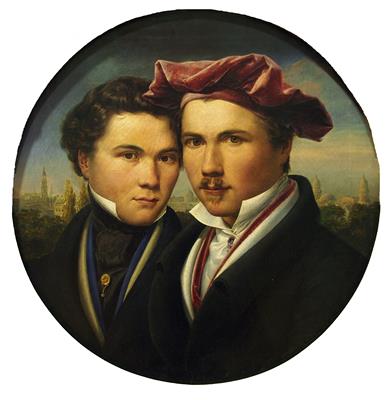
Prussian landscape painter whose 1836[1] copy of Schinkel's lost panorama is the sole surviving record of German Romanticism's most ambitious political painting.
Museums6
Countries3
Largest reported holdingAlte Nationalgalerie, Berlin · 5 recorded works
Loading map…
Where to see August Ahlborn
Collection holdings are reported here; current display varies. Check with each museum before visiting.
-
5 recorded works
Alte Nationalgalerie
Berlin, Germany
-
4 recorded works
Landesmuseum Hannover
Hanover, Germany


-
1 recorded work
Pushkin Museum of Fine Arts
Moscow, Russia
-
1 recorded work
Kunstmuseum Basel
Basel, Switzerland
-
1 recorded work
Pomeranian State Museum
Greifswald, Germany
-
1 recorded work
Hamburger Kunsthalle
Hamburg, Germany


Frequently Asked Questions
Where can I see August Ahlborn's work?
August Ahlborn (1796[1]-1857[1]) was a German painter known for Italianate scenes. During his career, he spent long periods in Italy, particularly in Rome. Viewing Ahlborn's paintings today requires consulting museum collections, as his work is not widely available in public spaces. The National Gallery in Berlin holds some of his pieces. Other German museums, such as those in his native Hanover, may also possess examples of his work. Beyond Germany, it is possible that some of Ahlborn's paintings are held in private collections internationally. Auction houses that specialise in 19th-century European painting occasionally offer works attributed to him. These sales provide opportunities for collectors and institutions to acquire his art. Consulting auction records and contacting art dealers who specialise in 19th-century German painting may yield further information about the current locations of his works. Researching museum catalogues is also helpful.What should I know about August Ahlborn's prints?
August Ahlborn (1796[1]-1857[1]) was a German painter, best known for Italianate subjects. He was born in Hanover. He became one of the most important figures in a group of German artists working in Rome. Ahlborn studied painting at the Berlin Academy from 1817[1]. In 1823, he travelled to Italy, where he remained for much of his career. He converted from Judaism to Christianity in 1824. In Rome, he became associated with a circle of German artists, including Johann Christian Reinhart and Joseph Anton Koch, who favoured classical and Italian themes. Ahlborn's work often depicts Italian scenes, such as views of Rome and the surrounding countryside. He became known for his detailed and realistic style. His paintings often feature bright colours and careful attention to light and shadow. These elements create a sense of atmosphere. In 1831, Ahlborn was appointed court painter to the King of Hanover. He continued to live and work in Italy, sending paintings back to Hanover for the royal collection. Although primarily a painter, prints of Ahlborn's work circulated, helping to broaden his audience beyond aristocratic circles. These prints offer accessible ways to appreciate his Italian views.Why are August Ahlborn's works important today?
August Ahlborn (1796[1]-1857[1]) was a German painter, known for his Italianate pictures. He is important today because his paintings document the 19th-century German artistic vision of Italy. Ahlborn's career began with studies at the Berlin Academy. He joined the Prussian military in 1815[1], and afterwards worked in lithography. His artistic breakthrough came after travelling to Italy in 1824. He stayed in Rome for many years, becoming a central figure in the German artistic community there. Ahlborn's paintings typically depict Italian scenery and peasant life. These works appealed to a northern European audience interested in the romanticised vision of Italy. His style is characterised by detailed realism and clear light. He became the court painter to the Duke Bernhard of Saxe-Weimar-Eisenach in 1833. He later became a professor at the Berlin Academy in 1855. His paintings are held in collections such as the National Gallery in Berlin. They provide insight into the artistic exchange between Germany and Italy during the 19th century. Ahlborn's influence can be seen in the work of later German artists who also travelled to Italy for inspiration.What techniques or materials did August Ahlborn use?
August Ahlborn (1796[1]-1857[1]) was a German painter, known primarily for Italianate paintings. He worked mainly in oils. Ahlborn's early training was at the Berlin Academy. He then travelled in 1824[1] to Italy, where he remained for much of his career. He became a member of the German artists' colony in Rome. The Italian countryside and classical ruins provided inspiration for his output. His method involved careful observation and detailed preparatory sketches. He aimed for realistic depictions of light and atmosphere. This approach aligned with the artistic goals of his contemporaries, who moved away from Romanticism towards a more naturalistic style. Ahlborn's paintings often feature precise brushwork and a smooth finish. His colour palette tended towards earth tones, reflecting the Italian landscape. He sometimes incorporated figures into his compositions, often in traditional dress. These elements added a sense of scale and narrative to the scenes. His paintings found an audience among European collectors interested in views of Italy.Who did August Ahlborn influence?
August Ahlborn's impact is most evident in the work of his students. He became a professor at the Academy of Fine Arts in Rome. There, he taught a number of artists who adopted his approach to realistic depictions of nature and architecture. Carl Blechen was one artist who may have been influenced by Ahlborn. Although never formally his student, Blechen's Italian period coincided with Ahlborn's presence in Rome. Blechen's work from this time shows a similar interest in light and atmosphere. Ahlborn's emphasis on plein-air painting and detailed observation had a direct effect on his pupils. These included Friedrich Preller the Younger, who adopted Ahlborn's style in his Italian-themed paintings. Other students who absorbed aspects of his style include Carl Heinrich Arnold, Albert Flamm, and Adolph Northen. These artists continued to promote his ideas about naturalism in their own work and teaching.Who influenced August Ahlborn?
It is difficult to say with certainty who influenced August Ahlborn. More research would be needed to provide a detailed answer. However, it is known that intellectual circles in Vienna were affected by arguments for and against ornamentation around the same time that poets and intellectuals became conscious of the limitations of language. Hugo von Hofmannsthal (1874-1924[1]) and Fritz Mauthner (1894-1923) were skeptical about the range of thoughts and feelings susceptible to communication by words. Eduard Hanslick (1825[1]-1904), a professor of music at the University of Vienna, argued that beauty was self-contained and rejected literary ideas as subjects for musical composition. According to Hanslick, music was "logic of sound in motion". It is possible that Ahlborn was affected by these intellectual trends.What is August Ahlborn's most famous work?
It is difficult to identify August Ahlborn's single "most famous work" definitively. He was a German historical painter, portraitist, and professor of art, active mainly in Rome. While no specific work eclipses all others in terms of fame, Ahlborn is well regarded for his Italian-themed paintings. He is known for depictions of the Roman Campagna, painted with attention to detail and atmospheric effects. His work often included classical ruins and pastoral scenes, reflecting the Romantic movement's interest in history and nature. Without a specific, singularly famous work to point to, Ahlborn's broader contribution lies in his detailed and evocative paintings of the Italian countryside, which captured the imagination of his contemporaries and contributed to the Romantic vision of Italy.What style or movement did August Ahlborn belong to?
August Ahlborn (1796[1]-1857[1]) was a German painter associated with the Nazarene movement. This group of artists aimed to revive spiritual and honest Christian art, rejecting what they viewed as the empty classicism of academic painting. Formed in the early 19th century, the Nazarenes, including Ahlborn, sought inspiration from late medieval and early Renaissance masters. They admired artists such as Perugino, Raphael, and Dürer. Many of them, like Ahlborn, moved to Rome; there, they lived communally and influenced one another's artistic development. Ahlborn's Italian paintings reflect the Nazarene aesthetic through their clear, linear style, precise detail, and moralising subjects. He is known for depictions of the Italian countryside and its people. His work displays a blend of realism and idealisation, characteristic of the Nazarene painters' approach. Other members included Johann Friedrich Overbeck, Peter von Cornelius, and Julius Schnorr von Carolsfeld.
Sources
Where to See guide aggregates verified holdings of August Ahlborn's works across the following collections.
- [1] wikipedia Wikipedia: August Ahlborn Used for: biography.
- [2] book guggenheim-expger00neug Used for: biography.
- [3] book Masterpieces of western art : a history of art in 900 individual studies from the Gothic to the present day Used for: biography.
- [4] book Neoclassicism and romanticism : architecture, sculpture, painting, drawings, 1750-1848 Used for: biography.
Editorial overseen by Solis Prints. Sources verified 2026-09-30. Click a source for details, or hover over [N] in the page above to preview.
Editorial standardsMethodologyCorrectionsAI disclosureAbout the editorial team