



About Charles Cottet
French[3] Post-Impressionist who led the Bande noire group and devoted his career to painting the sombre fishing communities of Brittany.
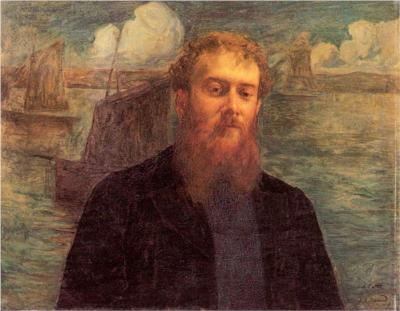
Where to see Charles Cottet
Ranked by works you can see in person.
-
26 works
Musée d'Orsay
Paris, France
-
22 works
National Museum of Western Art
Tokyo, Japan


-
 14 works
Musée des Beaux-Arts de Quimper
Quimper, France
-
5 works
Matsukata Collection
Tokyo, Japan
-
5 works
Museum of Fine Arts of Reims
Reims, France
-
4 works
MuMa Museum of modern art André Malraux
Le Havre, France
-
3 works
Museum of Fine Arts of Rennes
Rennes, France
-
3 works
Centre national des arts plastiques
Paris, France
-
3 works
Musée des Beaux-Arts de la ville de Paris
Paris, France
-
2 works
Museum of Fine Arts Ghent (MSK)
Ghent, Belgium


Own a piece of it
Charles Cottet prints
Hand-finished archival prints from Charles Cottet's body of work.

View all 26 museums
-
2 works
Nantes Museum of Arts
Nantes, France
-
2 works
Hermitage Museum
Saint Petersburg, Russia
-
1 works
Royal Museum of Fine Arts Antwerp
Antwerp, Belgium
-
1 works
Munich Central Collecting Point
Munich, Germany
Also here (6)
-
1 works
Odesa Museum of Western and Eastern Art
Odesa, Ukraine
Also here (2)
-
1 works
Musée des Beaux-Arts de Dijon
Dijon, France
-
1 works
Finnish National Gallery
Helsinki, Finland
Also here (6)
-
1 works
Musée des Beaux-Arts de Bordeaux
Bordeaux, France
-
1 works
Musée des beaux-arts de Marseille
Marseille, France
-
1 works
Art Institute of Chicago
Chicago, United States
-
1 works
Cincinnati Art Museum
Cincinnati, United States
-
1 works
Detroit Institute of Arts
Detroit, United States
-
1 works
Museu Nacional d'Art de Catalunya
Barcelona, Spain
-
1 works
Musée d'art moderne (Saint-Étienne)
Saint-Étienne, France
-
1 works
National Gallery of Canada
Ottawa, Canada
-
1 works
Musée Fabre
Montpellier, France


Can't travel? Bring Charles Cottet home.
See all Charles Cottet prints →Frequently Asked Questions
What should I know about Charles Cottet's prints?
Charles Cottet (1863[3]-1925[3]) was a French[3] painter, printmaker, and photographer, associated with the Symbolist movement and the Bande Noire. Cottet's prints often share themes and subjects with his paintings. He is known for his depictions of Breton peasants, religious scenes, and maritime subjects. His style is characterised by a sombre mood, muted colours, and a concern with the lives of ordinary people. Cottet's work often shows the influence of his travels in Brittany and Egypt. His prints include lithographs and etchings. These prints were often produced in small editions. They are not as widely known as his paintings. However, they offer a more intimate view into his artistic vision. Cottet's prints are collected by major museums and private collectors interested in late 19th- and early 20th-century French art. They provide insight into the artistic and cultural context of his time.Why are Charles Cottet's works important today?
Charles Cottet (1863[3]-1925[3]) was a French[3] painter, printmaker and photographer associated with the post-Impressionist movement. He is remembered for his depictions of rural life, particularly in Brittany. Cottet's importance stems from his role in bridging academic painting and more modern styles. He received traditional training at the École des Beaux-Arts, but moved toward a personal style influenced by symbolism and realism. His work provides insight into the artistic transition at the end of the 19th century. His Breton scenes offer valuable documentation of the region's culture during that period. Cottet's paintings capture the atmosphere and daily routines of Breton fishing communities. Works such as "The Land of the Sea" (1898[3]) illustrate his ability to convey the solemnity and hardship of their lives. Cottet also founded "La Bande Noire" or "The Black Gang", a group of artists who favoured dark palettes and realistic depictions of contemporary life. This group challenged the dominance of Impressionism and contributed to the development of later artistic movements. His leadership within this group marks his contribution to French art history.What techniques or materials did Charles Cottet use?
Charles Cottet was a painter, and therefore used pigments diluted in liquid, applied with a brush. The two main classes of painting are oils and watercolours; the same colour differs depending on whether it is watercolour or oil. Even the touch of the painter changes the colour effect. The choice an artist makes of a certain material is conditioned by the effect the artist intends to achieve. The formal vocation of a painting material has both its possibilities and its limits. Some painters have tried to rediscover the techniques of past masters; even if modern painters could rediscover the lost secrets of the ancient painters, they still could not duplicate their works in our own times. Renaissance artists exploited their material and tool values in the interest of the complete illusion of a plastic realism. The impressionists rediscovered colour and light as essential components in painting. The crux of the technical problem of the impressionists was to bring colours to their elementary intensity, to the point of fusing into light. This can be done either through the juxtaposition of homogeneous pure-colour values (yellow, red, blue) or through breaking (shading) of the tones.Who did Charles Cottet influence?
Charles Cottet's art and teaching impacted several artists, particularly those interested in Symbolism[3] and the changing approaches to painting at the turn of the century. Cottet's focus on emotional expression, seen in his depictions of Breton life and his Symbolist works, resonated with artists seeking alternatives to Impressionism's emphasis on fleeting visual impressions. His sombre colour palettes and treatment of light also set him apart. Émile Jourdan, a painter of Breton subjects, is considered to be among Cottet's students. Although he was older than Cottet, he adopted a similar interest in scenes of Breton life. Beyond direct students, Cottet's influence can be seen in the broader movement towards more subjective and emotionally charged art. His work contributed to the development of modern painting by exploring themes of human experience and spirituality.Who influenced Charles Cottet?
Charles Cottet (1863[3]-1925[3]) developed a style that combined academic training with Symbolist and Post-Impressionist influences. Early in his career, Cottet studied at the École des Beaux-Arts, and under painters Puvis de Chavannes and Alfred Roll. These studies provided him with a strong foundation in traditional techniques. His exposure to Symbolism is evident in his use of evocative imagery and themes exploring human emotion and spirituality. Cottet's connection with Post-Impressionism[3] appears in his approach to colour and form. He moved away from strict realism, favouring instead a more subjective interpretation of his subjects. This is seen in his use of simplified forms and non-naturalistic colour, which owes something to artists like Gauguin. Cottet formed Les Nabis with Pierre Bonnard and Édouard Vuillard, among others. This group of young artists were influenced by Japanese prints and Synthetism, and they explored decorative and symbolic qualities in painting. Cottet’s association with Les Nabis further encouraged his move toward a more stylised and expressive aesthetic.What is Charles Cottet's most famous work?
It is difficult to identify Charles Cottet's single "most famous work" definitively. He produced a varied body of work throughout his career, encompassing paintings, drawings, and prints. Without specific examples of his paintings, it is challenging to determine which piece has received the most critical attention or popular recognition. A comprehensive catalogue of his works would be needed to assess his output and identify any particularly well-known pieces. Lists of paintings by other artists, such as Jean-Honoré Fragonard and Pierre-Auguste Renoir, do not include any works by Cottet. This absence makes it impossible to compare the notability or recognition of Cottet's works with those of other artists. Further research into Cottet's biography and critical reception would be necessary to answer the question more thoroughly.What style or movement did Charles Cottet belong to?
Charles Cottet is associated with Symbolism, a movement that appeared in France and Europe between the 1880s and the early twentieth century. Symbolism is anti-Realism and anti-Impressionism. As a style, it reflected a literary-intellectual movement. The ideas of Symbolism were influential during the Post-Impressionism[3] era, impacting artists with diverse creative approaches. Symbolists were fascinated by ancient mythology and sought to escape rational thought. They aimed to go beyond the visible and rational world, exploring pure thought and the unconscious. The symbolist poet Albert Aurier published an article in March 1891[3], outlining the core principles of symbolist art. These included idealism, symbolism, subjectivity, synthesism, and a decorative aspect. Aurier emphasised the simplification of symbols and the subjectivity of art. Symbolism acted as a backdrop for the varied art of the Post-Impressionism Era.What was Charles Cottet known for?
Charles Cottet is associated with the Symbolist movement, which gained traction in the late 19th century. Symbolism permeated various art forms, including literature and painting. Albert Aurier, a symbolist poet and critic, articulated the core principles of symbolist art in his article "Paul Gauguin: Symbolism in painting", published in March 1891[3] in the *Mercure de France*. Aurier identified five key elements, applicable to both literature and painting. Three of these elements, idealism, symbolic nature, and subjectivity, shaped the symbolist worldview. The remaining two, synthesism and decorative aspect, pertained to direct modes of expression. Aurier emphasised the importance of simplifying the depiction of symbols for symbolist painters. Symbolists championed the subjective nature of art. Artists of the time interpreted these principles in their own ways, incorporating them into their creations. Symbolism provided a backdrop for the diverse and sometimes contradictory art of the Post-Impressionism[3] era.
Sources
Where to See guide aggregates verified holdings of Charles Cottet's works across the following collections.
- [1] museum Musée des Beaux-Arts de Quimper Used for: museum holdings.
- [2] museum Centre national des arts plastiques Used for: museum holdings.
- [3] wikipedia Wikipedia: Charles Cottet Used for: biography.
- [4] book Masterpieces of western art : a history of art in 900 individual studies from the Gothic to the present day Used for: biography.
- [5] book Post-impressionism : cross-currents in European painting Used for: biography.
- [6] book Post-impressionism : cross-currents in European painting Used for: biography.
- [7] book 1892-1968, Panofsky, Erwin,, Tomb sculpture: four lectures on its changing aspects from ancient Egypt to Bernini Used for: biography, stylistic analysis.
Editorial overseen by Solis Prints. Sources verified 2026-09-24. Click a source for details, or hover over [N] in the page above to preview.
Editorial standardsMethodologyCorrectionsAI disclosureAbout the editorial team