



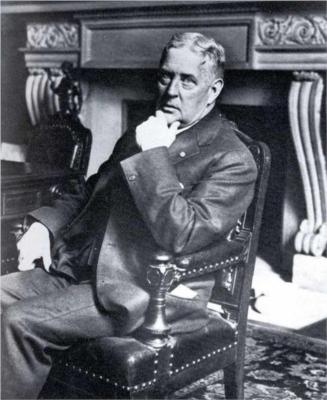
About Edmund Charles Tarbell
A founding member of The Ten and central figure in the Boston School, Tarbell blended French Impressionism[1] with Old Master discipline in luminous domestic interiors.
Where to see Edmund Charles Tarbell
Ranked by works you can see in person.
-
4 works
Museo de Arte de Worcester
Worcester, United States
-
4 works
Smithsonian American Art Museum
Washington D.C., United States


-
3 works
National Gallery of Art
Washington D.C., United States
-
2 works
Pennsylvania Academy of the Fine Arts
Philadelphia, United States
-
2 works
Metropolitan Museum of Art
New York City, United States
-
2 works
Fine Arts Museums of San Francisco
San Francisco, United States
-
1 works
Buffalo AKG Art Museum
Buffalo, United States
-
1 works
New Britain Museum of American Art
New Britain, United States
-
1 works
Carnegie Museum of Art
Pittsburgh, United States
-
1 works
Indianapolis Museum of Art
Indianapolis, United States


Own a piece of it
Edmund Charles Tarbell prints
Hand-finished archival prints from Edmund Charles Tarbell's body of work.

View all 12 museums
-
1 works
Cincinnati Art Museum
Cincinnati, United States
-
1 works
Yale University Art Gallery
New Haven, United States


Can't travel? Bring Edmund Charles Tarbell home.
See all Edmund Charles Tarbell prints →Frequently Asked Questions
Where can I see Edmund Charles Tarbell's work?
Edmund Charles Tarbell's paintings can be viewed in numerous public collections in the United States. The Smithsonian American[1] Art Museum in Washington, D.C., holds several examples, including "My Family" (1888[1]) and "Reverie" (1913). The Museum of Fine Arts in Boston, where Tarbell taught for many years, also has a substantial collection of his work; these holdings include paintings such as "In the Orchard" (1891) and "Girl Crocheting" (1905). Other museums with works by Tarbell include the Metropolitan Museum of Art in New York, which holds "Girl with a Dog" (1890). The National Academy of Design, also in New York, possesses his self-portrait from 1930. Further examples can be found at the Pennsylvania Academy of the Fine Arts in Philadelphia and the Corcoran Gallery of Art (now part of the National Gallery of Art) in Washington, D.C. These institutions offer opportunities to study Tarbell's development and his contribution to American Impressionism[1].What should I know about Edmund Charles Tarbell's prints?
Edmund Charles Tarbell (1862[1]-1938[1]) was an American[1] Impressionist painter. While he is better known for his paintings, particularly his domestic interior scenes, he also produced prints, including etchings. When considering Tarbell's prints, it is important to understand the context of printmaking at the time. In the late 19th and early 20th centuries, there was a growing interest in fine art etching, with specialist publications and societies dedicated to the medium. An "original print" is conceived as a print, executed solely as a print, and usually in a numbered edition, signed by the artist. Each print in the edition is an original, printed individually from a plate or other matrix created for that purpose. There is no single "original" from which copies are made. The number of prints in an edition is decided by the artist, and each print is numbered sequentially (for example, 12/25, meaning the 12th print in an edition of 25). However, early prints were not always numbered or signed. The edition claim is usually written on the bottom left margin of the print, the title in the middle, and the signature on the right.Why are Edmund Charles Tarbell's works important today?
It is difficult to assess Edmund Charles Tarbell's importance today based on the passages provided. The passages discuss the collecting of Baroque paintings in America, the activities of the Heim Gallery in promoting Italian Baroque art, and the work of William Harnett, a still-life painter. None of these passages directly address Tarbell or his artistic output. Without specific information, one can only speculate on Tarbell's current relevance. If his work challenged or influenced artistic conventions, or if it provides insight into a particular historical period or social context, it might hold significance for contemporary audiences. If his paintings are well-regarded for their technical skill, aesthetic qualities, or emotional impact, they could continue to be appreciated by art enthusiasts and scholars. However, a more thorough examination of Tarbell's artistic contributions is necessary to determine his true importance today.What techniques or materials did Edmund Charles Tarbell use?
Edmund Charles Tarbell was an American[1] Impressionist painter known for his handling of light and his scenes of domestic life. He favoured oil paint, and his technique involved layering and glazing to create luminous effects. Tarbell's artistic education at the School of the Museum of Fine Arts, Boston, provided him with a strong foundation in drawing and academic painting methods. He further refined his skills during studies in Paris, where he was exposed to Impressionism[1]. His paintings often depict figures in sunlit interiors, demonstrating his mastery of light and shadow. Tarbell's brushwork is characterised by soft, broken strokes, a technique influenced by Impressionist principles. He also paid close attention to colour relationships, using subtle variations to create a sense of atmosphere. His work frequently shows women and children in comfortable settings, pursuing everyday activities. These paintings display his skill in capturing the textures of fabrics, the play of light on surfaces, and the overall ambience of domesticity.Who did Edmund Charles Tarbell influence?
It is difficult to say exactly who Edmund Charles Tarbell influenced, but we can look at the influences of some of his contemporaries. John Singleton Copley and Gilbert Stuart, two early American[1] portraitists, emulated their British counterparts. Benjamin West, a contemporary, painted American historical scenes in the style of French historical painters such as Jacques-Louis David and Jean-Auguste-Dominique Ingres. This style may have been acquired secondhand through British imitators. Fuller and Morse reveal influences from the Munich school or Britain. These influences are further expressed in the work of Thomas Eakins, Frank Duveneck, and William Merritt Chase. Winslow Homer was seemingly influenced by Eakins; George Bellows is considered a descendent of Chase. These artists, along with others, contributed to an American tradition.Who influenced Edmund Charles Tarbell?
Edmund Charles Tarbell, as an American[1] painter, was part of a developing artistic tradition that drew on European sources. Earlier American portraitists like John Singleton Copley and Gilbert Stuart emulated their British counterparts. Later, painters such as Fuller and Morse showed influences from the Munich school or from Britain. These influences found further expression in the work of Thomas Eakins, Frank Duveneck, and William Merritt Chase. Chase can be seen as one of the great mediators of modern European painting in the USA. After a visit to Paris in 1881[1], he abandoned his brown-toned Munich style and turned to open-air painting, showing the influence of Impressionism[1] in his lighter colours and more fluid brushwork. George Bellows, a little later, is a descendent again of Chase.What is Edmund Charles Tarbell's most famous work?
While Edmund Charles Tarbell produced a number of notable works, it is difficult to single out one as his undisputed most famous. He is best known for his paintings of domestic scenes, often featuring women and children in light-filled interiors. One of his popular paintings is "Girl Crocheting" (1905[1]), which depicts a young woman absorbed in her needlework. Another well-regarded work is "My Family" (1908), a portrait of his wife and children in a comfortable setting. These paintings are typical of his impressionistic style, with its emphasis on light and colour to create a sense of atmosphere and intimacy. Tarbell's skill as a portrait painter also brought him recognition. He painted portraits of prominent individuals, further establishing his reputation as a leading American[1] artist of his time. His contributions to American Impressionism[1] and his ability to capture the nuances of everyday life have secured his place in art history.What style or movement did Edmund Charles Tarbell belong to?
Edmund Charles Tarbell is associated with the American[1] Impressionist movement. This artistic style gained traction in the United States during the late 19th and early 20th centuries. American Impressionism[1] was influenced by French Impressionism; however, it developed its own distinct characteristics. Tarbell, along with artists like Childe Hassam and John Henry Twachtman, adopted Impressionistic techniques. These included broken brushstrokes and a focus on capturing light and atmosphere. However, American Impressionists often retained a stronger emphasis on realism and figuration than their French counterparts. Tarbell is particularly known for his paintings of domestic scenes, often featuring women and children in sunlit interiors. These works often convey a sense of quiet elegance and reflect the values of upper-middle-class American society during the period. He was a member of the Ten American Painters, a group of artists who seceded from the Society of American Artists in 1897[1] to exhibit their work more independently.
Sources
Where to See guide aggregates verified holdings of Edmund Charles Tarbell's works across the following collections.
- [1] wikipedia Wikipedia: Edmund Charles Tarbell Used for: biography.
- [2] book Alfred Frankenstein, After the Hunt _ William Harnett and Other American Still Life Painters, 1870-1900 Used for: biography, stylistic analysis.
- [3] book Titian, Delphi Complete Works of Titian Used for: biography.
- [4] book Titian, Masters of Art - Titian Used for: biography.
- [5] book test, test Used for: biography, stylistic analysis.
Editorial overseen by Solis Prints. Sources verified 2026-09-24. Click a source for details, or hover over [N] in the page above to preview.
Editorial standardsMethodologyCorrectionsAI disclosureAbout the editorial team