

About David Park
American · 1911–1960
- Abstract Expressionism
- Bay Area Figurative Movement
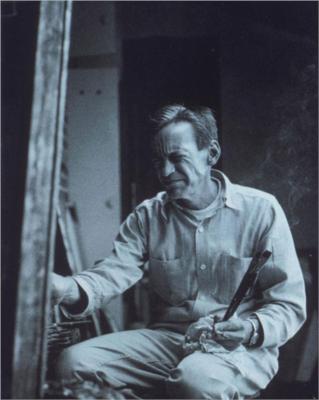
Boston-born painter who abandoned Abstract Expressionism[1] in 1949[1] to co-found the Bay Area Figurative movement with Bischoff and Diebenkorn.
Museums6
Countries1
Most worksFine Arts Museums of San Francisco, San Francisco · 12 works
Loading map…
Where to see David Park
Ranked by works you can see in person.
-
12 works
Fine Arts Museums of San Francisco
San Francisco, United States
-
5 works
Smithsonian American Art Museum
Washington D.C., United States


-
4 works
National Gallery of Art
Washington D.C., United States
-
3 works
Yale University Art Gallery
New Haven, United States
-
1 works
Metropolitan Museum of Art
New York City, United States
-
1 works
Los Angeles County Museum of Art
Los Angeles, United States


Frequently Asked Questions
Where can I see David Park's work?
To view the work of David Park, you could visit several museums. In the United States, these include the Los Angeles County Museum of Art (LACMA) at 5905 Wilshire Boulevard, Los Angeles, and the Metropolitan Museum of Art at 1000 Fifth Avenue, New York. Other options are the Minneapolis Institute of Arts, located at 2400 Third Avenue South, Minneapolis, and the Museum of Modern Art, at 11 West 53rd Street in New York City. You could also try the Virginia Museum of Fine Arts, 200 N. Boulevard, Richmond. Outside the United States, the Royal Ontario Museum in Toronto may hold relevant works. It is located at 100 Queens Park, Toronto. These museums all hold significant collections and may include pieces by Park.What should I know about David Park's prints?
When considering David Park's prints, bear in mind some basic facts about the medium. A print is an image conceived by the artist as a print and executed solely as a print, usually in a numbered edition, and signed. Each print in the edition is an original, printed individually from a plate, stone, screen or block created for that purpose. There is no single original print from which copies are made. The artist decides the number of prints in the edition. The numbering provides an accounting for the number of prints in the edition; each has a specific number (for example, 12/25 means the edition is 25, and the print is number 12). The edition claim is written as a pair of numbers on the left bottom margin of the print; it consists of a print number and an edition number written as a group with a short separating line between them. The title of the print is written in the middle of the bottom margin, and the signature is on the right. Edition descriptions are always signed in pencil.Why are David Park's works important today?
David Park (1911[1]-1960[1]) is important for his role in the Bay Area Figurative Movement. This group of artists, including Elmer Bischoff and Richard Diebenkorn, rejected Abstract Expressionism[1]'s dominance in the 1950s. They moved away from its "book of rules", seeking a more humble and accessible art. Park famously stated that "concepts of progress in painting are rather foolish". Park was among the first to return to figurative work. His still lifes, with their ordinary subjects, defied Abstract Expressionism's lofty aims. Table with Fruit (1951[1]-52) has the intimacy of a Bonnard, but without the stylistic excess. Park used idiosyncratic techniques, such as echoing stripes and exaggerated perspective, reminiscent of Grant Wood. By the mid-1950s, Park softened his stance toward Abstract Expressionism, reincorporating aspects of gesture painting. His still lifes showed a pleasure in spontaneous paint handling. Brush and Comb (1956) has a sculptural presence. Park also designed sets for theatrical productions in 1958. He was diagnosed with cancer in 1960.What techniques or materials did David Park use?
David Park's techniques involved a varied approach to materials. He had factory experience with metalwork, and he applied this knowledge to sculpture. Smith stated, 'My method of shaping material or arriving at form has been as functional as making a motor car or a locomotive'. Before turning to sculpture, Smith worked with lead, brass, and aluminium, combining these with stone and coral. He arc-welded his first piece in 1939[1], and his method involved using equipment and materials similar to those used in locomotive production. Smith aimed for functional form, without aesthetic interest in tool marks or surface decoration. Smith had no fixed method, and he stated that 'I cannot conceive a work and buy material for it. I can find or discover a part'. He often used found parts, allowing them to cure and develop a fluidity before incorporating them into his work. Smith also used steel, which he considered highly versatile. He also experimented with bronze casting, often using parts in a different order than initially intended.Who did David Park influence?
David Park is known for his association with the Bay Area Figurative Movement. This group of artists, including Elmer Bischoff and Richard Diebenkorn, reacted against Abstract Expressionism[1] in the 1950s. Diebenkorn stated that Abstract Expressionism was becoming too formulaic. Park famously said that "concepts of progress in painting are rather foolish". The Bay Area Figuratives sought a more approachable art, in contrast to the New York School's monumental abstractions. Bischoff wanted an expression that was "more humble, more down to earth, more every day, more accessible". Park's initial figurative works included still lifes with ordinary subjects. His painting, *Table with Fruit* (1951[1]-52), has the intimacy of a late-nineteenth-century Bonnard or Vuillard, but without their stylistic virtuosity. Park's exaggerated perspective reads like caricature, reminiscent of Grant Wood or Thomas Hart Benton. Bischoff's first figurative works had a straightforward naturalism, sharing Park's desire to return to perceptual reality. By the mid-1950s, Park and Bischoff began reincorporating aspects of gesture painting into their work.Who influenced David Park?
David Park is associated with the Bay Area Figurative movement. However, information about his direct influences is scarce. One can infer influences by examining the artists that his contemporaries admired. For example, one artist mentioned Analytic Cubism, particularly the work of Braque and Picasso, as formative during their college years. Early Kandinsky and Miró were also important, with Matisse and Mondrian on the periphery. This artist exhaustively analysed the structure of paintings by these figures. Matisse's work was influential to some artists in the 1940s. By 1950[1]-51, Pollock, de Kooning and Rothko had become mentors to some. Gorky's work was also very important; one artist saw *Agony* (1947) and *The Liver Is the Cock's Comb* (1944) at his 1951 Whitney exhibition. The New York School artists had emerged from various influences and developed their own statements.What is David Park's most famous work?
David Park is best known for his figurative paintings from the 1950s. He turned away from pure abstraction, joining artists such as Elmer Bischoff and Richard Diebenkorn in what became known as the Bay Area Figurative Movement[1]. While Park produced many notable works, 'Rehearsal' (1950[1]) is often cited as his most famous. This oil on canvas painting depicts a group of musicians, rendered in a simplified, almost blocky style. The composition is fairly dense, with the figures closely packed together. The colours are muted, dominated by browns, blues, and greys. 'Rehearsal' marks a clear departure from Park's earlier abstract expressionist works. It signals his move towards a more representational style. Another important painting is 'Four Men' (1958), which shows four figures seated together. Similar to 'Rehearsal', the figures are simplified and somewhat abstracted, yet clearly recognisable. These paintings established Park as a leading figure in the Bay Area art scene and helped to redefine figurative painting in the post-war period.What style or movement did David Park belong to?
David Park is associated with the Bay Area Figurative Movement. This group of artists, active in Northern California during the 1950s, turned away from Abstract Expressionism[1]. Park, along with Elmer Bischoff and Richard Diebenkorn, felt that Abstract Expressionism had become formulaic. Diebenkorn said it was becoming "a book of rules". The Bay Area Figuratives rejected avant-gardism, seeking an art that was approachable. Park stated that "concepts of progress in painting are rather foolish". Their aim was to be "more humble, more down to earth, more every day, more accessible" than the New York School. Many of the Bay Area Figuratives, including Park, gravitated towards still life and subjects from their immediate surroundings. Park's still life paintings, such as "Table with Fruit" (1951[1]-52), presented ordinary domestic scenes. These works contrasted with the lofty aspirations of Abstract Expressionism. By the mid-1950s, Park and Bischoff began to incorporate elements of gesture painting into their work. Park's still lifes showed a pleasure in the spontaneous handling of paint.
Sources
Where to See guide aggregates verified holdings of David Park's works across the following collections.
- [1] wikipedia Wikipedia: David Park Used for: biography.
- [2] book guggenheim-emergingartists100wald Used for: biography.
- [3] book guggenheim-guggenheimintern1964allo Used for: biography.
- [4] book guggenheim-guhe00solo Used for: biography, stylistic analysis.
- [5] book Masterpieces of western art : a history of art in 900 individual studies from the Gothic to the present day Used for: biography, stylistic analysis.
- [6] book Landauer, Susan, The not-so-still life : a century of California painting and sculpture Used for: biography, stylistic analysis.
Editorial overseen by Solis Prints. Sources verified 2026-09-24. Click a source for details, or hover over [N] in the page above to preview.
Editorial standardsMethodologyCorrectionsAI disclosureAbout the editorial team