



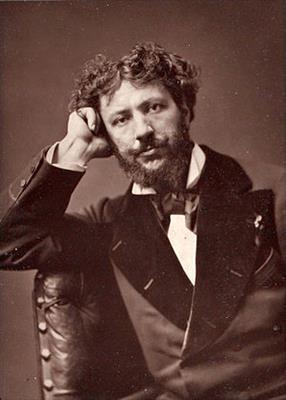
About Carolus-Duran
Where to see Carolus-Duran
Ranked by works you can see in person.
-
25 works
Musée d'Orsay
Paris, France
-
22 works
Palais des Beaux-Arts de Lille
Lille, France


-
7 works
Musée des Beaux-Arts de la ville de Paris
Paris, France
-
4 works
Hermitage Museum
Saint Petersburg, Russia
-
4 works
Smithsonian American Art Museum
Washington D.C., United States
-
4 works
National Gallery of Athens
Athens, Greece
-
4 works
Musée Carnavalet
Paris, France
-
3 works
Clark Art Institute
Williamstown, United States
-
3 works
Library-museum of the Comédie-Française
Paris, France
-
3 works
Metropolitan Museum of Art
New York City, United States


View all 40 museums
-
2 works
New York Historical
New York City, United States
-
2 works
Louvre
Paris, France
-
2 works
Matsukata Collection
Tokyo, Japan
-
2 works
National Museum of Western Art
Tokyo, Japan
-
2 works
Museo del Prado
Madrid, Spain
-
2 works
Indianapolis Museum of Art
Indianapolis, United States
-
2 works
Kröller-Müller Museum
Otterlo, Netherlands
-
2 works
National Museum in Warsaw
Warsaw, Poland
-
1 works
Museum of Fine Arts of Rennes
Rennes, France
-
1 works
Royal Museum of Fine Arts Antwerp
Antwerp, Belgium
-
1 works
North Carolina Museum of Art
Raleigh, United States
-
1 works
National Museum of Fine Arts, Argentina
Buenos Aires, Argentina
Also here (6)
-
1 works
Musée Marmottan Monet
Paris, France
-
1 works
Museum of Fine Arts Ghent (MSK)
Ghent, Belgium
-
1 works
Musée des Beaux-Arts de Bordeaux
Bordeaux, France
-
1 works
National Gallery of Art
Washington D.C., United States
-
1 works
Musée des Beaux-Arts de Caen
Caen, France
-
 1 works
Musée des beaux-arts de Marseille
Marseille, France
-
1 works
RISD Museum
Providence, United States
-
1 works
National Trust
Swindon, United Kingdom
-
1 works
Centre national des arts plastiques
Paris, France
-
1 works
Detroit Institute of Arts
Detroit, United States
-
1 works
McManus Gallery
Dundee, United Kingdom
-
1 works
Kunsthalle Bremen
Bremen, Germany
-
1 works
National Gallery of Ireland
Dublin, Ireland
Also here (6)
-
1 works
Musée des Augustins
Toulouse, France
-
1 works
Fine Arts Museums of San Francisco
San Francisco, United States
-
1 works
Museum of Fine Arts, Houston
Houston, United States
-
1 works
Ny Carlsberg Glyptotek
Copenhagen, Denmark
-
1 works
National Gallery of Canada
Ottawa, Canada


Frequently Asked Questions
Where can I see Carolus-Duran's work?
Carolus-Duran's paintings are held in collections across Europe and North America. In France, his work can be viewed in several museums in Paris: the Musée d’Orsay, the Musée du Louvre, the Musée du Petit Palais, and the Musée des Arts Decoratifs. Outside Paris, his paintings are held in the Musée des Beaux-Arts (Nantes), Musée des Beaux-Arts Jules Cheret (Nice), Musée des Beaux-Arts (Rouen), Musée des Beaux-Arts (Orleans), Musée des Beaux-Arts (Lille), Musée des Beaux-Arts (Dijon), Musée de Peinture et de Sculpture (Grenoble), Musée des Augustins (Toulouse), and Musée Crozatier (Le Puy). Outside France, museums that hold his paintings include the Musées Royaux des Beaux-Arts de Belgique (Brussels) and the Art Gallery of New South Wales (Sydney, Australia). In the United States, museums include the Metropolitan Museum of Art (New York City), the Los Angeles County Museum of Art, the Minneapolis Institute of Arts, the Virginia Museum of Fine Arts (Richmond), and the Charles Hosmer Morse Museum of American Art (Winter Park, Florida).What should I know about Carolus-Duran's prints?
Carolus-Duran (1837[7]-1917[7]) was a French[7] painter, especially known for his portraits. Information specifically about his prints is scarce; however, contextual details about print collecting in his era may be helpful. In letters, Vincent van Gogh discussed collecting prints and mentioned several artists whose work was available as prints. These included Herkomer, Menzel, Renouard, Frère, Heilbuth, Lançon, Caton Woodville, and Monthard. Van Gogh also discussed the logistics of printmaking, mentioning lithographic paper, crayon, autographic ink, and engraving ink. He noted the sometimes unreliable nature of autographic ink in transfer printing, as it could run and ruin the image. Furthermore, Van Gogh talked about acquiring duplicate prints from magazines such as L'Illustration, Le Monde illustré and Univers Illustré, suggesting that magazine illustration was a common source for print collectors. He also mentions specific prints, such as Régamey's “Gypsies” and Fildes's “Charles Dickens Empty Chair”, which he hoped to acquire.Why are Carolus-Duran's works important today?
Carolus-Duran, born Charles Auguste Émile Durand (1837[7]-1917[7]), was a French[7] painter known primarily for his portraits. He also produced genre scenes and history paintings. His influence on portraiture, and on painting technique, makes his work important for art historians and artists. Duran's loose, painterly style was influential. He advocated direct painting, "premier coup", in which the artist attempts to complete a work in a single sitting. John Singer Sargent was among his pupils, and adopted this approach. Sargent's portraits owe a clear debt to Duran's example. His portraits offer insights into the social and cultural elite of late 19th-century France and beyond. He portrayed many notable figures, including Émile Zola and Princess Mathilde. These works provide a visual record of the period, and demonstrate Duran's skill in capturing likeness and character. His emphasis on colour and tone, rather than line, also had an impact. Duran's approach encouraged a move away from academic precision toward a more modern aesthetic. He received many awards and honours during his lifetime, including election to the Académie des Beaux-Arts in 1904[7]. His paintings can be found in museums worldwide.What techniques or materials did Carolus-Duran use?
Carolus-Duran's artistic training involved a progression from drawing sculptures to working with live models. Students typically began by rendering white plaster casts of antique statues, learning to represent form through monochrome tonal gradations. This instilled a conventional style before they worked with live figures. When students were proficient in drawing, they were introduced to colour. Instruction included the materials, tools, and their maintenance. Students copied painted heads, often Venetian or Flemish examples, for their lively handling and colour. The first stage in painting was the ébauche: a thinly painted laying-in of lines, masses, and halftones. This base layer had to be 'leaner' (containing less oil) than subsequent layers, adhering to the 'fat over lean' rule to prevent cracking. Palettes were prepared with earth colours, Prussian blue, black, and lead white. Diluted red-brown mixtures of turpentine and earth colours were used to rework charcoal contours and lay in shadows. Backgrounds were roughed in early to mitigate the glare of the priming colour. Thicker paint was then applied, building up halftones between lights and darks. Hog's hair brushes were often used, with flat, square, and rounded ends of varying sizes.Who did Carolus-Duran influence?
Carolus-Duran's influence can be traced through the lineage of modern painters, particularly those aligned with Realism and Naturalism. Édouard Manet found his aesthetic through engagement with the style of Frans Hals. Later, Vincent van Gogh also ascended to the ranks of modern painters, partly through his study of Hals and Manet. These artists built upon each other's accomplishments. This lineage was defined through stylistic associations. Many contemporary painters with realist or anti-academic inclinations studied Hals's paintings. After the opening of the Haarlem Municipal Museum in 1862[7], numerous artists from across Europe and America travelled to Haarlem. French[7] painters such as François Bonvin (1868), Claude Monet (1871), Manet (1872), Léon Bonnat (1872), Jean-Léon Gérôme (1874), and Henri Fantin-Latour (1875) visited. Several German artists, including Wilhelm Busch (1873), Franz von Lenbach (1873, 1888, and 1898), and Max Liebermann (1872 and 1879) also made the voyage. Ilya Repin and others from eastern Europe, and the American painters Mary Cassat (1873), J. Alden Weir (1875 and 1881), William Merrit Chase (1878), and James Abbott McNeill Whistler (1882) followed.Who influenced Carolus-Duran?
Carolus-Duran, like many artists, drew inspiration from a variety of sources. The Louvre museum acted as an important resource for artists; there, they could study the techniques of past masters. The 18th-century Venetian painters and Peter Paul Rubens, for example, offered lessons in the use of colour. Independent artists and movements consciously adopted a new concept of originality, which set them in opposition to the ideals of the Academy. Some atelier masters, such as Charles Gleyre (1806-1874[7]) and Thomas Couture (1815-1879[7]), remained unconvinced that directing students exclusively towards the Rome Prize was the best way to produce good artists. Couture's most famous pupil was Edouard Manet (1832-1883), who remained with his master from 1850 to 1856, absorbing his unconventional attitudes to light and shade, handling, and immediacy.What is Carolus-Duran's most famous work?
It is difficult to name Carolus-Duran's single 'most famous work' using the reference passages provided. However, several portraits and figure studies are listed. These include portraits of Richard Wagner; Charles and Georges Durand-Ruel; Lucien Daudet; Claude Monet; Victor Chocquet; and a self-portrait[7]. Other works include studies of the children of Paul Berard; Marie Therese Durand-Ruel sewing; Mademoiselle Demarsy; Madame Hériot; Madame Hagen; Madame Leon Clapisson; and Madame Alphonse Daudet. There are also paintings titled 'Algerian Woman'; 'Woman in a Park'; 'Woman in a Red Blouse'; 'Woman in a Straw Hat'; 'Woman in Blue'; 'Woman in White'; and 'Woman with a Black Dog'. Without further information, it is impossible to determine which of these, if any, is considered his most well-known piece.
Sources
Where to See guide aggregates verified holdings of Carolus-Duran's works across the following collections.
- [1] museum Library-museum of the Comédie-Française Used for: museum holdings.
- [2] museum Musée des Beaux-Arts de Bordeaux Used for: museum holdings.
- [3] museum Musée des beaux-arts de Marseille Used for: museum holdings.
- [4] academic Carolus Duran Used for: biography.
- [5] academic The Editors of Encyclopaedia Britannica, Carolus-Duran Used for: biography.
- [6] academic Gabriel P. Weisberg, Carolus-Duran Used for: biography.
- [7] wikipedia Wikipedia: Carolus-Duran Used for: biography.
- [8] book Harding, James, Artistes pompiers : French academic art in the 19th century Used for: biography.
- [9] book Kalba, Laura Anne, Color in the Age of Impressionism Used for: stylistic analysis.
- [10] book Masterpieces of western art : a history of art in 900 individual studies from the Gothic to the present day Used for: biography, stylistic analysis.
- [11] book Post-impressionism : cross-currents in European painting Used for: biography.
- [12] book Post-impressionism : cross-currents in European painting Used for: biography.
Editorial overseen by Solis Prints. Sources verified 2026-09-24. Click a source for details, or hover over [N] in the page above to preview.
Editorial standardsMethodologyCorrectionsAI disclosureAbout the editorial team