



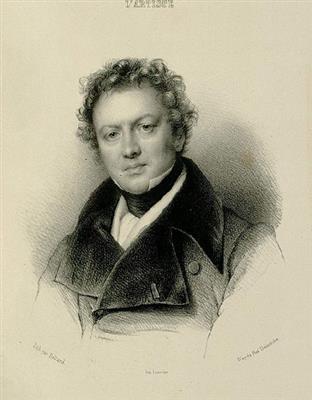
About Charles de Steuben
French · 1788–1856
- history painting
German-born painter trained under David and Prud'hon who rose to royal patronage under Louis Philippe and created monumental works for Saint Isaac's Cathedral.
Museums10
Countries3
Most worksHermitage Museum, Saint Petersburg · 9 works
Loading map…
Where to see Charles de Steuben
Ranked by works you can see in person.
-
9 works
Hermitage Museum
Saint Petersburg, Russia
-
5 works
Museum of the History of France
Versailles, France


-
4 works
Louvre
Paris, France
-
3 works
Palace of Versailles
Versailles, France
-
2 works
Musée des Beaux-Arts de Quimper
Quimper, France
-
2 works
Russian Museum
Saint Petersburg, Russia
-
2 works
Palais des Beaux-Arts de Lille
Lille, France
-
1 works
Führermuseum
Linz, Austria
Also here (6)
-
 1 works
Maison de Victor Hugo
Paris, France
Also here (6)
-
1 works
Musée Carnavalet
Paris, France


Frequently Asked Questions
Where can I see Charles de Steuben's work?
Charles de Steuben's paintings are held in several public collections, primarily in Europe. In France, his work can be found at the Palace of Versailles; examples include paintings of Napoleon. Other French[2] museums holding his paintings are the Musée des Beaux-Arts in Rouen and the Musée des Beaux-Arts in Bordeaux. Elsewhere in Europe, Steuben's art is represented in the collection of the Hermitage Museum in St Petersburg. The National Portrait Gallery in London possesses a portrait of Sarah Siddons, the celebrated actress, painted by Steuben. Some works are also held in American collections. These include the Metropolitan Museum of Art in New York, which owns his painting *The Arrival of the Steamboat Clermont on the Hudson*. The Smithsonian American Art Museum in Washington, D.C., also holds examples of his art. These public collections offer opportunities to view Steuben's history paintings and portraits.What should I know about Charles de Steuben's prints?
Charles de Steuben (1788[2]-1856[2]) was a French[2]-German Romantic painter, also known as Karl von Steuben. He is best known for historical and military subjects, and for paintings such as "The Battle of Poitiers, 732" (1837[2]). Prints relating to Steuben's art fall into two general categories: original prints (made by the artist as prints) and reproductions (copies of works conceived in another medium, such as paintings). The Professional Art Dealers Association of Canada defines an original print as an image conceived by the artist as a print and executed solely as a print, usually in a numbered edition and signed by the artist. Each print in the edition is an original, printed individually. A reproduction is a copy of a work of art conceived in another medium (painting, watercolour). It is usually made by photo-mechanical means. Numbering and signing a reproduction does not change its essence; it is still a reproduction of a painting. When considering Steuben's prints, determine whether they are original prints or reproductions. The intent of the artist is important. If the intent is to replicate an image best created as a painting, it is a reproduction, regardless of the technique used. The context of a print is also important. The subject matter, purpose, and social group at which it is directed all have a great deal to do with how it is made.Why are Charles de Steuben's works important today?
Charles de Steuben (1788[2]-1856[2]) was a painter active in France during the first half of the 19th century. Although not as well known as some of his contemporaries, his work provides insight into the artistic and political climate of the period following the French[2] Revolution and the Napoleonic era. Steuben's paintings often depicted historical or military subjects, reflecting the interest in national identity and heroic narratives that prevailed at the time. His connections to prominent figures and institutions of the time, such as the French Academy, also make his career a useful case study for understanding the art world of his era. While tastes and artistic values have shifted over time, studying artists like Steuben helps to give a fuller understanding of 19th-century European art.Who was Charles de Steuben?
Charles de Steuben was a painter born in Bauerbach, Saxe-Meiningen, who later became a French[2] citizen. He studied at the Imperial Academy of Arts in Saint Petersburg and the École nationale supérieure des Beaux-Arts in Paris, eventually establishing himself as a versatile painter in France.What techniques or materials did Charles de Steuben use?
Charles de Steuben (1788[2]-1856[2]) was a painter who worked in several genres. These included historical subjects, battle scenes, and portraits. He studied under Robert Lefèvre and also at the École des Beaux-Arts. His painting technique is characterised by dramatic compositions and attention to detail. He employed a style that aligned with the Romantic movement. This is visible in his use of colour and his efforts to capture emotional intensity. De Steuben's paintings often feature large-scale canvases. These allowed him to depict complex scenes with numerous figures. He was skilled in rendering textures and fabrics, which added realism to his works. His training in the academic tradition is evident in his precise drawing and modelling of forms. Among his notable works are "The Battle of Poitiers in 732" and "Peter the Great in Holland". These paintings demonstrate his ability to combine historical accuracy with artistic flair. He aimed to create visually striking and emotionally engaging images.Who did Charles de Steuben influence?
Charles de Steuben's artistic impact is difficult to assess because there is little scholarship about his life and career. However, other artists' influences are well documented. Nicolas Poussin's paintings and designs for the Grand Gallery in the Louvre provided examples from which French[2] Neoclassical style took its point of departure. Similarly, Jacob de Wit, a Dutch painter known for ceiling and room decoration, was strongly influenced by Peter Paul Rubens. De Wit studied at the Koninklijke Academie in Antwerp from 1708 and, between 1709 and 1712, with the history painter Jacob van Hal. He became a member of the Antwerp Guild of Saint Luke in 1713, before moving to Amsterdam. Watteau's influence on French art cannot be overestimated, despite the fact that he seems to have closely guarded his style and approach to art-making. During his career, he took only one student, Jean-Baptiste Pater, no doubt out of a sense of duty to Pater’s father.Who influenced Charles de Steuben?
It is difficult to summarise the influences on Charles de Steuben. Some sources point to the Bauhaus school and its instructors. Josef Albers, who taught at the Bauhaus, distinguished between material studies (Materialstudien) and matter studies (Materienstudien). The former focused on the structural nature of materials, while the latter emphasised the appearance and feeling of texture. Albers also felt strongly about colour and form. Other influences may have come from the world of dance. Rudolf Laban developed a system of movement analysis called Choreutics. Oskar Schlemmer, associated with the Bauhaus, explored abstract dance and the relationship between the human form and abstract space. These references suggest possible, but not definite, influences. More research would be needed to establish direct links between these figures and de Steuben's artistic development.What is Charles de Steuben's most famous work?
Charles de Steuben, a painter of historical scenes, is best known for his large-scale depictions of significant events. One of his most recognised works is "The Retreat from Moscow", painted in 1829[2]. This piece portrays the disastrous retreat of Napoleon's Grande Armée during the winter of 1812. De Steuben's painting captures the suffering and chaos endured by the French[2] soldiers as they struggled to escape Russia. The composition emphasises the sheer scale of the catastrophe, with masses of figures overwhelmed by the harsh winter conditions. The painting is admired for its dramatic intensity and its representation of a key moment in European history. De Steuben also created other notable historical paintings, including depictions of the Battle of Poitiers and scenes from the life of Joan of Arc. However, "The Retreat from Moscow" remains his most famous and widely reproduced work, securing his reputation as a painter of grand historical narratives. His ability to convey both the drama and the human cost of war made this painting particularly memorable.
Sources
Where to See guide aggregates verified holdings of Charles de Steuben's works across the following collections.
- [1] museum Maison de Victor Hugo Used for: museum holdings.
- [2] wikipedia Wikipedia: Charles de Steuben Used for: biography.
- [3] book Milam, Jennifer Dawn, Historical Dictionary of Rococo Art Used for: biography.
Editorial overseen by Solis Prints. Sources verified 2026-09-24. Click a source for details, or hover over [N] in the page above to preview.
Editorial standardsMethodologyCorrectionsAI disclosureAbout the editorial team