



About Charles Le Brun
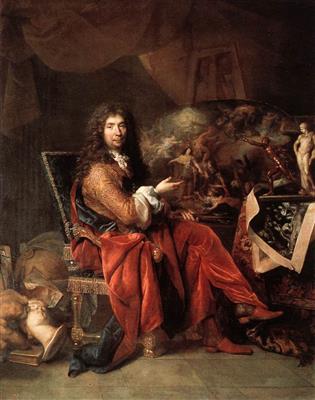
Where to see Charles Le Brun
Ranked by works you can see in person.
-
 48 works
Louvre
Paris, France
-
6 works
Hermitage Museum
Saint Petersburg, Russia

-
6 works
Museum of the History of France
Versailles, France
-
4 works
Museum of Fine Arts of Rennes
Rennes, France
-
3 works
Palace of Versailles
Versailles, France
-
3 works
Nantes Museum of Arts
Nantes, France
-
3 works
Musée des beaux-arts de Marseille
Marseille, France
-
2 works
Dulwich Picture Gallery
London, United Kingdom
-
2 works
Metropolitan Museum of Art
New York City, United States
-
1 works
Führermuseum
Linz, Austria
Also here (6)


View all 48 museums
-
1 works
Groeningemuseum
Bruges, Belgium
-
1 works
Munich Central Collecting Point
Munich, Germany
Also here (6)
-
1 works
Liechtenstein Museum
Vienna, Austria
-
1 works
Musée des Beaux-Arts et d'Archéologie de Besançon
Besançon, France
-
1 works
National Gallery Prague
Prague, Czech Republic
-
1 works
Musée des Beaux-Arts de Rouen
Rouen, France
-
1 works
Gemäldegalerie Berlin
Berlin, Germany
-
1 works
Walker Art Gallery
Liverpool, United Kingdom
-
1 works
J. Paul Getty Museum
Los Angeles, United States
-
1 works
Musée des Beaux-Arts de Dijon
Dijon, France
-
 1 works
Museum of Fine Arts of Reims
Reims, France
-
1 works
Temple Newsam
Leeds, United Kingdom
-
1 works
Nottingham Castle Ducal Mansion
Nottingham, United Kingdom
Also here (3)
-
1 works
Musée Bonnat-Helleu
Bayonne, France
-
1 works
Musée des Beaux-Arts de Caen
Caen, France
-
1 works
Hermann Göring Collection
Carinhall, Germany
-
1 works
Museo del Prado
Madrid, Spain
-
1 works
Museo de Arte de Ponce
Ponce, United States
-
1 works
Victoria and Albert Museum
London, United Kingdom
-
1 works
Detroit Institute of Arts
Detroit, United States
-
1 works
Minneapolis Institute of Art
Minneapolis, United States
-
1 works
Musée Thomas-Henry
Cherbourg-Octeville, France
-
1 works
Los Angeles County Museum of Art
Los Angeles, United States
-
1 works
Fitzwilliam Museum
Cambridge, United Kingdom
-
1 works
Musée d'art moderne (Saint-Étienne)
Saint-Étienne, France
-
1 works
National Gallery of Ireland
Dublin, Ireland
Also here (6)
-
1 works
National Museum of Fine Arts of Cuba
Havana, Cuba
-
1 works
Musée des Beaux-Arts d'Angers
Angers, France
-
1 works
Museum of Fine Arts, Houston
Houston, United States
-
1 works
National Gallery of Canada
Ottawa, Canada
-
1 works
Musée Fabre
Montpellier, France
-
0 works
National Museum of Western Art
Tokyo, Japan
-
0 works
National Gallery of Art
Washington D.C., United States
-
0 works
Nationalmuseum
Stockholm, Sweden
-
0 works
Kunsthistorisches Museum
Vienna, Austria
-
0 works
Skokloster Castle
Skokloster, Sweden
Also here (2)
-
0 works
Art Institute of Chicago
Chicago, United States
-
0 works
Vanderbilt Museum of Art
Nashville, United States


Frequently Asked Questions
Where can I see Charles Le Brun's work?
Charles Le Brun (1619[5]-1690[5]) was a dominant figure in French[5] art during the reign of Louis XIV. As such, many of his works are still located in France, particularly at the Palace of Versailles. Le Brun served as First Painter to the King, and he directed the decoration of Versailles. Visitors to the palace can view his large-scale paintings and ceiling frescoes, including the *Apotheosis of Hercules* ceiling in the Hercules Salon and much of the decoration in the Hall of Mirrors. Beyond Versailles, Le Brun's paintings can be found in the Louvre Museum in Paris. This includes works such as *Chancellor Séguier on Horseback* (1660[5]-1661[5]), a portrait of the king's chancellor, and *The Family of Darius Before Alexander* (1664), a history painting depicting Alexander the Great. Other museums with holdings of Le Brun's work include the National Gallery in London, which possesses his painting *The Magdalen Repentant*, and the Metropolitan Museum of Art in New York. These collections offer further opportunities to study Le Brun's artistic output.What should I know about Charles Le Brun's prints?
Charles Le Brun (1619[5]-1690[5]) was a dominant figure in French[5] art during the reign of Louis XIV. He is best known as a painter and decorator, particularly for his work at the Palace of Versailles. While Le Brun himself was not a printmaker, his designs were widely disseminated through engravings. Many prints after Le Brun's paintings and drawings were produced during his lifetime and after his death. These prints served several purposes. They allowed for the wider distribution of his artistic ideas, making his compositions accessible to a larger audience beyond the court. Print series after Le Brun also functioned as educational tools for artists and students. They provided models for drawing, composition, and the representation of emotions. Some of the most well-known prints after Le Brun are those reproducing his series of paintings on the life of Alexander the Great. These were engraved by Gérard Edelinck, among others. His influence extended to decorative arts, and prints were made after his designs for furniture, metalwork, and other objects. These prints offer valuable insight into the artistic tastes and decorative schemes of the French court during the Baroque[5] period.Why are Charles Le Brun's works important today?
Charles Le Brun (1619[5]-1690[5]) was a dominant figure in French[5] art during the reign of Louis XIV. His importance stems from his role in shaping the artistic style of the era and his influence on the development of the French Academy. As First Painter to the King, Le Brun directed the decoration of the Palace of Versailles. He oversaw a vast team of artists and craftsmen, ensuring a unified and grandiose aesthetic that became synonymous with Louis XIV's power. His designs permeated every aspect of the palace, from paintings and sculptures to furniture and gardens. Le Brun's artistic theories, disseminated through his teachings at the Academy, established a hierarchy of genres and promoted the idea of "le grand goût" (the great taste). This aesthetic emphasised classical principles, order, and decorum. His emphasis on history painting as the highest form of art influenced generations of artists. Although tastes have changed, Le Brun's impact on French art and the visual culture of the court remains significant. His work offers insights into the political and cultural ambitions of Louis XIV, and his theoretical writings continue to be studied by art historians.What techniques or materials did Charles Le Brun use?
Charles Le Brun (1619[5]-1690[5]) began his art studies in Paris with Simon Vouet. By 1638[5], he was named Peintre du Roi (Painter to the King). From 1642 to 1646, Le Brun sojourned in Rome, where he studied Raphael, the Bolognese School, and Nicolas Poussin. He was also exposed to the work of Pietro da Cortona, whose influence is evident in Le Brun's paintings. After his return to Paris, he co-founded the Royal Academy in 1648. Le Brun did not receive his first royal commission until 1661, but it brought him such success that he was appointed chief painter to King Louis XIV of France. Jean-Baptiste Colbert, Louis's minister, also appointed him chancellor of the French[5] Academy of Painting and Sculpture. In this role, Le Brun dictated artistic taste in France. Colbert also made Le Brun director of the Gobelins and Savonnerie factories, which produced furnishings and carpeting for the royal residences. At these factories, Le Brun provided all the designs to be executed by the approximately 250 labourers who worked there.Who influenced Charles Le Brun?
Charles Le Brun (1619[5]-1690[5]) began his artistic training in Paris with the painter Simon Vouet. He gained royal attention early in his career, becoming Peintre du Roi (Painter to the King) by 1638[5]. Between 1642 and 1646, Le Brun spent time in Rome. This period exposed him to the work of Raphael, the Bolognese School, and Nicolas Poussin. These artists had a considerable impact on his artistic development. Upon his return to Paris, Le Brun co-founded the Royal Academy in 1648. He exerted considerable influence over the Academy for many years. He also gave lectures on art, which suggests a theoretical, as well as a practical, engagement with artistic ideas.What is Charles Le Brun's most famous work?
Charles Le Brun (1619[5]-1690[5]) was a French[5] painter, architect, and art theorist. He studied in Paris with Simon Vouet, and later in Rome with Nicolas Poussin. Le Brun co-founded the Royal Academy in 1648[5], where he delivered discourses and exerted considerable influence. Although many of his works are lost or destroyed, some of his most noted pieces survive. The Portrait of Chancellor Pierre Séguier (1660-1661[5]) depicts Le Brun's patron, who financed his trip to Rome. The artist included himself as the page holding a parasol. The Tent of Darius (1661) secured Le Brun's appointment as chief painter to King Louis XIV. It shows the mother of Darius begging Alexander the Great to spare her family. This alludes to Louis XIV's benevolence. For two centuries, the French Academy of Painting and Sculpture used this work as an example for history scenes. In 1665, the king commissioned Le Brun to paint four works depicting Alexander's conquests. One of these, The Entry of Alexander to Babylon (Louvre), shows Alexander entering the city in triumph.What style or movement did Charles Le Brun belong to?
Charles Le Brun (1619[5]-1690[5]) is associated with the French[5] Baroque[5] style. He was a dominant figure in the artistic establishment of his time, particularly under the rule of Louis XIV. Le Brun's career began with training in the studio of Simon Vouet. Vouet's influence helped to shape Le Brun's early artistic development. Later, Le Brun went to Rome, where he studied classical antiquity and the works of Italian masters. This Roman sojourn further solidified his artistic foundations. Upon his return to France, Le Brun's career advanced rapidly. He became the First Painter to the King, director of the Académie Royale de Peinture et de Sculpture, and director of the Gobelins Manufactory. These positions gave him immense control over artistic production and taste in France. He supervised the decoration of the Palace of Versailles, where his grand, classical style became the visual representation of Louis XIV's power and glory. His work at Versailles established a template for Baroque art in France, characterised by its scale, opulence, and theatricality.What was Charles Le Brun known for?
Charles Le Brun (1619[5]-1690[5]) was a dominant figure in French[5] art during the reign of Louis XIV. He is best known for his role as director of the Académie Royale de Peinture et de Sculpture and, later, as director of the Gobelins manufactory. Le Brun's artistic style is associated with French Baroque[5] classicism. He was a skilled painter and designer, producing many works for the French court. His influence extended to all aspects of artistic production, from painting and sculpture to interior decoration and garden design. As director of the Académie, Le Brun established strict rules and standards for artistic training. He promoted the idea of a hierarchy of genres, with history painting at the top. His own paintings often depicted historical or allegorical subjects, intended to glorify the king and the French nation. Examples of his work can be seen at the Palace of Versailles, where he oversaw the decoration of the Galerie des Glaces (Hall of Mirrors) and other important spaces. Le Brun's theories about facial expression, published in books such as "Conférence sur l'expression générale et particulière" (1668[5]), had considerable influence on subsequent generations of artists.
Sources
Where to See guide aggregates verified holdings of Charles Le Brun's works across the following collections.
- [1] museum Department of Prints and Drawings of the Louvre Used for: museum holdings.
- [2] museum Museum of Fine Arts of Reims Used for: museum holdings.
- [3] academic The Editors of Encyclopaedia Britannica, Charles Le Brun | French Baroque Painter, Royal Artist & Art Theorist Used for: biography.
- [4] academic Charles le Brun - Smarthistory Used for: biography.
- [5] wikipedia Wikipedia: Charles Le Brun Used for: biography.
- [6] book Elizabeth Gilmore Holt; Project Muse, A Documentary History of Art, Volume 2 _ Michelangelo and the Mannerists, The Baroque and the Eighteenth Century Used for: biography, stylistic analysis.
- [7] book Elizabeth Gilmore Holt; Project Muse, A Documentary History of Art, Volume 2 _ Michelangelo and the Mannerists, The Baroque and the Eighteenth Century Used for: biography, stylistic analysis.
- [8] book Lilian H. Zirpolo, Historical Dictionary of Baroque Art and Architecture Used for: biography, stylistic analysis.
- [9] museum Charles Le Brun | British Museum Used for: biography.
- [10] museum Charles Le Brun | National Gallery of Art Used for: museum holdings.
- [11] museum Charles Le Brun - The Jabach Family - The Metropolitan Museum of Art Used for: museum holdings.
Editorial overseen by Solis Prints. Sources verified 2026-09-24. Click a source for details, or hover over [N] in the page above to preview.
Editorial standardsMethodologyCorrectionsAI disclosureAbout the editorial team