



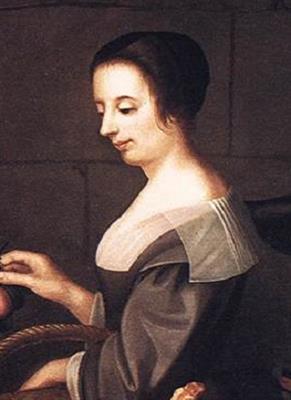
About Louise Moillon
French · 1610–1696
luminous fruit still lifes that stopped abruptly at thirty, possibly silenced by the persecution of Huguenots
Museums7
Countries3
Most worksLouvre, Paris · 3 works
Loading map…
Where to see Louise Moillon
Ranked by works you can see in person.
-
3 works
Louvre
Paris, France
-
3 works
Musée des Augustins
Toulouse, France


-
2 works
Norton Simon Museum
Pasadena, United States
-
1 works
Toledo Museum of Art
Toledo, United States
-
1 works
Art Institute of Chicago
Chicago, United States
-
1 works
Los Angeles County Museum of Art
Los Angeles, United States
-
1 works
Thyssen-Bornemisza Museum
Madrid, Spain


Frequently Asked Questions
Where can I see Louise Moillon's work?
Louise Moillon's still-life paintings can be viewed in several museums. In France, her works are held at the Musée des Beaux-Arts in Rouen, the Musée des Beaux-Arts in Nantes, and the Musée des Beaux-Arts in Orléans. Additionally, examples can be found at the Musée du Louvre, Musée d’Orsay, Musée des Arts Décoratifs, and Musée National d’Art Moderne, Centre Georges Pompidou, all located in Paris. Other French museums that hold her paintings include the Musée des Beaux-Arts in Dijon, the Musée de la Chartreuse in Douai, the Musée des Beaux-Arts in Lille, the Musée Crozatier in Le Puy, the Musée des Beaux-Arts Jules Chéret in Nice, the Musée des Beaux-Arts in Reims, the Musée des Beaux-Arts in Rennes, the Musée d’Art et d’Industrie in Saint-Étienne, the Musée du Prieuré in Saint-Germain-en-Laye, the Musée de l’Annonciade in Saint-Tropez, the Musée du Haubergier in Senlis, the Musée d’Art Moderne in Strasbourg, and the Musée des Augustins in Toulouse. Outside France, museums that hold Moillon's works include the Metropolitan Museum of Art in New York, the Los Angeles County Museum of Art, and the Minneapolis Institute of Arts.What should I know about Louise Moillon's prints?
There is little information available regarding prints made by Louise Moillon. However, it is important to note the popularity of printmaking during Moillon's lifetime; the print market was well-established in France, and prints were commonly used for reproducing paintings and drawings. For example, after the death of painter Antoine Watteau, Jean de Jullienne oversaw the printing of his entire drawn and painted works. The resulting *Recueil Jullienne* is considered one of the oldest illustrated catalogues in art history. Similarly, Jean-Honoré Fragonard made etchings of his drawings after the masters, which were then copied as aquatints by the abbé de Saint-Non. These examples demonstrate the popularity and importance of printmaking as a means of reproduction and documentation during the period in which Moillon was active.Why are Louise Moillon's works important today?
Louise Moillon's works are important because they offer insight into the experiences of female artists during a time of social and political change. Unlike some of her contemporaries, Moillon was not born into an artistic family and had to forge her own path. By examining her career, we can better understand the support networks, influences, and competitions that shaped her work. Her choices regarding artistic practices, training, and display sites were, in part, driven by necessity, as opportunities for women were limited. Moillon's story also provides a unique perspective on the French Revolution. While some artists fled the country, Moillon stayed and adapted her work to reflect the new political climate. However, her earlier association with the royal family led to a period of silence surrounding her career. Studying Moillon's art, career, and reception helps us understand how she navigated a constantly changing cultural environment. Her portraits, for example, demonstrate an interest in capturing likeness and varied textures. By considering the historical and political context of her work, we gain a deeper appreciation for her achievements and the challenges she faced as a female artist.What techniques or materials did Louise Moillon use?
Louise Moillon's still lifes demonstrate considerable skill with oil paint. The 18th century saw renewed interest in older painting methods, and also the invention of new ones. Experimentation was common. Some artists looked to classical Greece and Rome for encaustic techniques using hot plates to fuse wax-based colours. Others sought a painting medium that would not discolour or flake. Eludoric painting, using both oil and water, was invented in 1775 by Vincent de Montpetit. The support was placed under a thin film of water, and the painting was done in oil under water. Excess oil floated away, and the artist could rework the painting without leaving a thick, shiny surface. This method was popular in the French court during the 18th century. Other methods included painting on glass, and even painting in cheese, according to a satirical brochure.Who did Louise Moillon influence?
Louise Moillon's direct influence is difficult to trace, as many women artists of her era were overlooked in historical records. However, her still lifes contributed to the broader development of the genre in France. Moillon's detailed realism and balanced compositions likely resonated with other artists who were part of the burgeoning still-life movement. While specific names are not definitively linked to her tutelage, her paintings set a high standard for subsequent generations. Artists who focused on similar subject matter, such as fruit, vegetables, and market scenes, may have drawn inspiration from her work. The popularity of still-life painting increased during the 17th century, and Moillon's success helped to pave the way for other women artists to gain recognition in this field. Her ability to capture the textures and colours of everyday objects with precision and artistry was admired by collectors and fellow painters alike. Further research into the artistic networks of 17th-century Paris may reveal more specific connections between Moillon and her contemporaries or successors.Who influenced Louise Moillon?
Louise Moillon's artistic origins are connected with her family. Her father, Jean Moillon, was a painter and art dealer. He is considered her first instructor. After Jean Moillon's death in 1619, Louise's mother married François Garnier, a still-life painter. Garnier likely contributed to Moillon's artistic education. Moillon's style shows the influence of several artists. Specialists often note the impact of the painter Fede Galizia on her work. Galizia was an Italian still-life painter whose compositions share traits with Moillon's. Some scholars suggest links to the Flemish painter Clara Peeters; however, direct connections are less clear. The influence of Parisian painters such as Jean Chalette and Jacques Linard is also considered relevant to Moillon's artistic development. These artists helped shape Moillon's approach to realism and composition.What is Louise Moillon's most famous work?
While it is difficult to identify one single "most famous" work, Louise Moillon is well known for her still-life paintings, particularly those featuring fruit. She excelled in this genre during the 17th century. Moillon often depicted arrangements of fruits such as plums, peaches, grapes, and melons. These were presented with remarkable realism and attention to detail. Her paintings often included a limited number of objects, carefully arranged to create a sense of balance and harmony. Paintings such as "Still Life with Cherries, Strawberries and Gooseberries" (1630) and "Still Life with Peaches" (1646) are among her most recognised pieces. These works demonstrate her skill in capturing the textures, colours, and forms of various fruits. Moillon's paintings are appreciated for their naturalism and their contribution to the development of still-life painting in France. Her work can be found in major museum collections, including the Louvre in Paris.What style or movement did Louise Moillon belong to?
Louise Moillon painted in the Baroque style, which broadly dates from 1600 to 1700. The Baroque followed Mannerism, and the term likely came from the Portuguese word for a misshapen pearl: "barocco". It was later used to describe art that used emotion, dynamism, and drama, alongside strong tonal contrasts. The style developed from religious tensions in Europe, and it was intended to strengthen Catholicism. Following the rejection of Catholic doctrines by the Protestant movement, the Council of Trent (1545-1563) decided that religious art should encourage piety through realism and accuracy. The Baroque style emerged in Italy, later spreading through Europe. The art was intended to be visually appealing and to focus on Catholic doctrine in order to educate. In northern Europe, the Baroque style emphasised realism in daily life, moving away from the emotional impact preferred by Catholic countries. During the 18th century, the Baroque became increasingly ornate, before receding in favour of the lighter Rococo style.
Sources
Where to See guide aggregates verified holdings of Louise Moillon's works across the following collections.
- [1] book Allison Lee Palmer, Historical Dictionary of Neoclassical Art and Architecture Used for: biography.
- [2] book Milam, Jennifer Dawn, Historical Dictionary of Rococo Art Used for: biography.
- [3] book Hodge, Susie, 1960- author, The short story of women artists : a pocket guide to movements, works, breakthroughs, & themes Used for: biography.
Editorial overseen by Solis Prints. Sources verified 2026-09-24. Click a source for details, or hover over [N] in the page above to preview.
Editorial standardsMethodologyCorrectionsAI disclosureAbout the editorial team