



About Anne-Louis Girodet
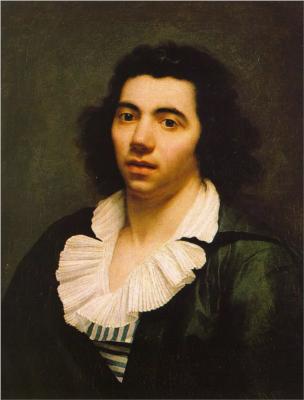
Where to see Anne-Louis Girodet
Collection holdings are reported here; current display varies. Check with each museum before visiting.
-
 40 recorded works
Louvre
Paris, France
-
6 recorded works
Musée Fabre
Montpellier, France

-
4 recorded works
Musée Magnin
Dijon, France
-
4 recorded works
Museum of the History of France
Versailles, France
-
3 recorded works
Hermitage Museum
Saint Petersburg, Russia
-
2 recorded works
Clark Art Institute
Williamstown, United States
-
2 recorded works
Cleveland Museum of Art
Cleveland, United States
-
2 recorded works
Smith College Museum of Art
Northampton, United States
-
2 recorded works
Palace of Versailles
Versailles, France
-
2 recorded works
Metropolitan Museum of Art
New York City, United States


Own a piece of it
Anne-Louis Girodet prints
Hand-finished archival prints from Anne-Louis Girodet's body of work.
 The Ghosts of Malvina and Oscar - Anne-Louis Girodet-Trioson
From £28.00
The Ghosts of Malvina and Oscar - Anne-Louis Girodet-Trioson
From £28.00
 Madame Jacques-Louis-Étienne Reizet - Anne-Louis Girodet-Trioson
From £28.00
Madame Jacques-Louis-Étienne Reizet - Anne-Louis Girodet-Trioson
From £28.00
 Portrait of Hortense de Beauharnais - Anne-Louis Girodet-Trioson
From £28.00
Portrait of Hortense de Beauharnais - Anne-Louis Girodet-Trioson
From £28.00
 Ossian receiving the Ghosts of the French Heroes - Anne-Louis Girodet
From £37.00
Ossian receiving the Ghosts of the French Heroes - Anne-Louis Girodet
From £37.00
 Portrait of the Katchef Dahouth, Christian Mameluke - Anne-Louis Girodet
From £28.00
Portrait of the Katchef Dahouth, Christian Mameluke - Anne-Louis Girodet
From £28.00
 The Sleep of Endymion - Anne-Louis Girodet
From £28.00
The Sleep of Endymion - Anne-Louis Girodet
From £28.00
 Chateaubriand Meditating on the Ruins of Rome - Anne-Louis Girodet de Roussy-Trioson
From £28.00
Chateaubriand Meditating on the Ruins of Rome - Anne-Louis Girodet de Roussy-Trioson
From £28.00
 Portrait d'Odette Désirée Thérèse Godefroy de Suresnes - Anne-Louis Girodet
From £28.00
Portrait d'Odette Désirée Thérèse Godefroy de Suresnes - Anne-Louis Girodet
From £28.00
View all 31 museums
-
2 recorded works
Fine Arts Museums of San Francisco
San Francisco, United States
-
1 recorded work
Toledo Museum of Art
Toledo, United States
-
1 recorded work
National Galleries Scotland
Edinburgh, United Kingdom
-
1 recorded work
Museum of Grenoble
Grenoble, France
-
1 recorded work
Ferens Art Gallery
Kingston upon Hull, United Kingdom
-
1 recorded work
The Nelson-Atkins Museum of Art
Kansas City, United States
-
1 recorded work
National Gallery of Art
Washington D.C., United States
-
 1 recorded work
Musée des beaux-arts de Marseille
Marseille, France
-
1 recorded work
Nationalmuseum
Stockholm, Sweden
-
1 recorded work
Museo de Arte de Ponce
Ponce, United States
-
1 recorded work
Rijksmuseum
Amsterdam, Netherlands
-
1 recorded work
Art Institute of Chicago
Chicago, United States
-
1 recorded work
Hamburger Kunsthalle
Hamburg, Germany
-
1 recorded work
Minneapolis Institute of Art
Minneapolis, United States
-
1 recorded work
Kunsthalle Bremen
Bremen, Germany
-
1 recorded work
Museum der bildenden Künste
Leipzig, Germany
-
1 recorded work
Musée des Beaux-Arts d'Angers
Angers, France
-
1 recorded work
National Gallery of Canada
Ottawa, Canada
-
1 recorded work
Philadelphia Museum of Art
Philadelphia, United States
-
0 recorded works
Bibliothèque nationale de France
Paris, France
-
0 recorded works
Musée Carnavalet
Paris, France


Can't travel? Bring Anne-Louis Girodet home.
See all Anne-Louis Girodet prints →Frequently Asked Questions
Where can I see Anne-Louis Girodet's work?
Anne-Louis Girodet created a varied body of work during his career. Examples can be found in several public collections. The Musée du Louvre in Paris holds some of his most celebrated paintings, including "The Sleep of Endymion" (1791[6]) and "The Entombment of Atala" (1808). These works demonstrate his skill in history painting and his interest in Romantic themes. Other French[6] museums with paintings by Girodet include the Musée Girodet in Montargis, his birthplace, and the Musée National des Châteaux de Malmaison et Bois-Préau, which has portraits of Josephine Bonaparte. Outside France, the Metropolitan Museum of Art in New York owns his portrait of Monsieur Comairas. The National Gallery of Canada in Ottawa has "Study for the painting 'The Burial of Atala'". These holdings, while not exhaustive, provide opportunities to view Girodet's art in person. Examination of museum websites and catalogues will offer further details on specific works and their availability for public viewing.What should I know about Anne-Louis Girodet's prints?
Anne-Louis Girodet was a French[6] painter and printmaker, active in the late 18th and early 19th centuries. Like other painters of his era, such as Fragonard, Girodet made prints at different points in his career. Printmaking allowed artists to reproduce and distribute their work to a wider audience. After Watteau's death, the publication of his drawn and painted works was overseen by Jullienne. The reproductions were considered admirable and faithful. Jullienne believed even Watteau's minor works were precious and deserved careful study. The *Recueil Jullienne* is considered one of the oldest illustrated catalogues raisonnés in art history. Similarly, catalogues exist for prints made after paintings by Poussin. These catalogues document the numerous prints created before 1700, demonstrating the popularity of Poussin's work through printmaking.Why are Anne-Louis Girodet's works important today?
Anne-Louis Girodet de Roussy-Trioson (1767[6]-1824[6]) was a French[6] painter who trained in a classical style under Jacques-Louis David. Girodet's work is significant for its anticipation of the Romantic movement, while retaining a sharply linear style consistent with late Neoclassicism[6]. After studying architecture and spending time in the military, Girodet entered David's studio in 1784[6]. From 1789 to 1793, he studied in Italy, having won the prix de Rome. Upon his return to Paris, Girodet received commissions from Napoleon's family and exhibited at the Salon. His paintings often combined Neoclassical style with Romantic themes. One example is *The Funeral of Atala* (1808), based on a story by François-René de Chateaubriand. It presents a tragic narrative with a linear realism. Girodet also produced illustrations and dabbled in literature. The Girodet Museum is located in his birthplace, Montargis.What techniques or materials did Anne-Louis Girodet use?
Anne-Louis Girodet's techniques involved methods aligned with early 19th-century French[6] painting practices. These began with preliminary drawings, followed by outlining the composition on a prepared canvas. Modulations of light and shade were indicated using a reddish-brown 'sauce'. Local colour was then applied, with a full range of tones prepared on the palette. The final painting stage involved further refining this process. Neoclassical painters often used pale preparations to ensure luminosity and durability, reacting against the sombre brown and red earth grounds of Rococo art. Oil paint tends to become transparent with age, so lighter grounds were preferred to prevent colours from 'sinking' as the ground becomes more visible. Ingres, a contemporary of Girodet, favoured strong, coarse canvas, departing from the Neoclassical convention of using finely woven canvas for figure painting. Ingres also innovatively used white in his shadows, contrasting with the traditional chiaroscuro technique that relied on transparency for creating depth.Who did Anne-Louis Girodet influence?
Anne-Louis Girodet, a student of Jacques-Louis David, moved beyond strict Neoclassicism[6]. He explored exotic and erotic themes, and fictional narratives. Several artists were within Girodet's orbit. Elisabeth-Louise Vigée-Lebrun, a portrait painter who worked for Marie-Antoinette, shifted toward Neoclassicism after knowing Joseph Vernet and David. Pierre-Paul Prud'hon occupied a middle ground between Neoclassical attention to detail, and the dramatic mobility of the Romantics, such as Delacroix. Girodet's influence can be seen in the work of Jean-Auguste-Dominique Ingres, another of David's pupils. Ingres’s pupils and followers also oriented themselves to these examples, as did Hippolyte Flandrin, in his Christian cycles. Charles-Gabriel Gleyre also devoted himself to aestheticising the past and bringing it to life in painting. Girodet's painting Mademoiselle Lange as Venus (1798[6]) anticipated the aesthetic of the younger Ingres. His Ossian Receiving in Valhalla the Generals of the Republic Who Have Fallen for their Fatherland was an early example of the new subjects that would occupy the emergent French[6] Romantic movement.Who influenced Anne-Louis Girodet?
Anne-Louis Girodet de Roucy (1767[6]-1824[6]) was a French[6] painter and pupil of Jacques-Louis David. Girodet entered David’s studio in 1785[6], after initial instruction from a family friend, a Monsieur Trioson. He adopted Trioson’s name later in life, becoming Girodet-Trioson. David’s Neoclassical style had a formative effect on Girodet’s early work. Girodet won the Prix de Rome in 1789; his submissions show David’s influence in their themes, subject matter, and technique. Girodet’s *Hippocrate refusant les présents d’Artaxerxès* (1792) displays a debt to David’s moralising subjects and severe style. However, Girodet moved away from Davidian classicism. He developed an interest in Romanticism[6], the Gothic, and contemporary French literature. Girodet explored these interests in works such as *The Sleep of Endymion* (1791), which demonstrates a move toward greater sensuality and atmospheric effects. His later paintings, such as *The Burial of Atala* (1808), show the impact of French writers like Chateaubriand. Girodet also admired painters outside the French Neoclassical tradition, including the Italian masters Michelangelo and Raphael.What is Anne-Louis Girodet's most famous work?
Anne-Louis Girodet de Roucy Trioson (1767[6]-1824[6]) was a French[6] painter and pupil of Jacques-Louis David. Girodet worked in the Neoclassical style, but he also explored early Romanticism[6]. His most celebrated painting is generally considered to be *The Sleep of Endymion*, completed in 1791[6]. This work depicts the Greek mythological figure Endymion, a shepherd loved by the moon goddess Selene, in a state of eternal sleep. Selene is represented as a moonbeam illuminating the youthful Endymion. The painting was exhibited at the Salon of 1793, where it caused a sensation due to its sensuous depiction of the male nude and its innovative use of light and shadow. *The Sleep of Endymion* secured Girodet's reputation as a leading artist of his time. It is now held in the collection of the Musée du Louvre, Paris. Other important works by Girodet include *The Entombment of Atala* (1808), based on a novel by Chateaubriand, and portraits such as that of Chateaubriand himself. These paintings demonstrate Girodet's range and his contribution to the development of French art in the late 18th and early 19th centuries.What style or movement did Anne-Louis Girodet belong to?
Anne-Louis Girodet de Roucy, often known simply as Girodet, was a French[6] painter who worked during the late 18th and early 19th centuries. His career encompasses a shift in styles, and he is usually associated with both the Neoclassical and Romantic movements. Initially, Girodet was a student of Jacques-Louis David, the foremost Neoclassical painter. Girodet's early works, such as "The Sleep of Endymion" (1791[6]), display Neoclassical characteristics: precise drawing, sculptural forms, and a focus on classical subjects. However, Girodet began to move away from strict Neoclassicism[6], incorporating elements of Romanticism into his art. Romanticism emphasised emotion, imagination, and individualism. Girodet's later paintings, such as "The Burial of Atala" (1808), demonstrate this shift with their dramatic compositions, heightened emotionalism, and interest in exotic or tragic themes. Girodet's unique synthesis of Neoclassical form and Romantic sensibility sets him apart. He defies easy categorisation, representing a transitional figure in French art.
Sources
Where to See guide aggregates verified holdings of Anne-Louis Girodet's works across the following collections.
- [1] museum Department of Prints and Drawings of the Louvre Used for: museum holdings.
- [2] museum Château de Compiègne Used for: museum holdings.
- [3] museum Musée Magnin Used for: museum holdings.
- [4] museum Musée des beaux-arts de Marseille Used for: museum holdings.
- [5] museum Musée des Beaux-Arts d'Angers Used for: museum holdings.
- [6] wikipedia Wikipedia: Anne-Louis Girodet Used for: biography.
- [7] book Fred S. Kleiner, Gardner’s Art through the Ages: The Western Perspective Used for: biography, stylistic analysis.
- [8] book Palmer, Allison Lee, Historical Dictionary of Neoclassical Art and Architecture Used for: biography.
- [9] book Allison Lee Palmer, Historical Dictionary of Neoclassical Art and Architecture Used for: biography, stylistic analysis.
- [10] book Penelope J.E. Davies, Walter B. Denny, Frima Fox Hofrichter, Joseph Jacobs, Ann S. Roberts, David L. Simon, Janson's History of Art_ The Western Tradition (8th Edition) Used for: biography.
Editorial overseen by Solis Prints. Sources verified 2026-09-30. Click a source for details, or hover over [N] in the page above to preview.
Editorial standardsMethodologyCorrectionsAI disclosureAbout the editorial team