



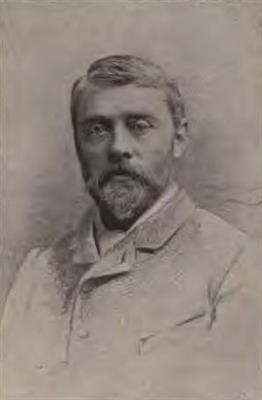
About Alfred Parsons
Victorian painter and illustrator whose watercolours of English gardens brought botanical precision and a painter's eye to the late-nineteenth-century landscape tradition.
Where to see Alfred Parsons
Collection holdings are reported here; current display varies. Check with each museum before visiting.
-
4 recorded works
Yale Center for British Art
New Haven, United States
-
2 recorded works
Gallery Oldham
Oldham, United Kingdom


-
2 recorded works
Walker Art Gallery
Liverpool, United Kingdom
-
2 recorded works
Ferens Art Gallery
Kingston upon Hull, United Kingdom
-
2 recorded works
Aberdeen Archives, Gallery and Museums collections
Aberdeen, United Kingdom
-
2 recorded works
National Museum Cardiff
Cardiff, United Kingdom
-
1 recorded work
Royal Academy of Arts
London, United Kingdom
-
1 recorded work
Glasgow Museums Resource Centre
Glasgow, United Kingdom
-
1 recorded work
National Gallery
London, United Kingdom
-
1 recorded work
Ashmolean Museum
Oxford, United Kingdom


Own a piece of it
Alfred Parsons prints
Hand-finished archival prints from Alfred Parsons's body of work.
 When Nature Painted all Things Gay - Alfred Parsons
From £28.00
When Nature Painted all Things Gay - Alfred Parsons
From £28.00
 Morning on the Kennet - Alfred Parsons
From £28.00
Morning on the Kennet - Alfred Parsons
From £28.00
 On the Cotswolds - Alfred Parsons
From £28.00
On the Cotswolds - Alfred Parsons
From £28.00
 Spring Sunshine - Alfred Parsons
From £28.00
Spring Sunshine - Alfred Parsons
From £28.00
 A Bunch of London Market Garden Moss Roses - Alfred Parsons
From £28.00
A Bunch of London Market Garden Moss Roses - Alfred Parsons
From £28.00
 Thorverton Bridge - Alfred Parsons
From £28.00
Thorverton Bridge - Alfred Parsons
From £28.00
 Poplars in the Thames Valley - Alfred Parsons
From £28.00
Poplars in the Thames Valley - Alfred Parsons
From £28.00
 Ash Trees at Cropthorne, Worcestershire - Alfred Parsons
From £28.00
Ash Trees at Cropthorne, Worcestershire - Alfred Parsons
From £28.00
View all 15 museums
-
1 recorded work
Falmouth Art Gallery
Falmouth, United Kingdom
Also here (1)
-
1 recorded work
National Trust
Swindon, United Kingdom
-
1 recorded work
Kirklees Museums and Galleries
Huddersfield, United Kingdom
-
1 recorded work
Tate
London, United Kingdom
-
1 recorded work
Philadelphia Museum of Art
Philadelphia, United States


Can't travel? Bring Alfred Parsons home.
See all Alfred Parsons prints →Frequently Asked Questions
Where can I see Alfred Parsons's work?
Alfred Parsons's work can be viewed in several locations. In the United Kingdom, you can find his pieces at the Brighton Museum & Art Gallery (Royal Pavilion Gardens, Brighton BN1 1EE), the Manchester Art Gallery (Mosley Street, Manchester M2 3JL), the National Museums of Scotland (Royal Museum, Chambers Street, Edinburgh EH1 1JF), and the Victoria & Albert Museum (Cromwell Road, London SW7 2RL). Outside the UK, several museums also hold his art. These include the Charles Hosmer Morse Museum of American Art (445 North Park Avenue, Winter Park, FL 32789), the Los Angeles County Museum of Art (5905 Wilshire Boulevard, Los Angeles, CA 90036), the Metropolitan Museum of Art (1000 Fifth Avenue, New York, NY 10028), and the Minneapolis Institute of Arts (2400 Third Avenue South, Minneapolis, MN 55404). Other locations are the Royal Ontario Museum (100 Queens Park, Toronto, Ontario M5S 2C6), and the Virginia Museum of Fine Arts (200 N. Boulevard, Richmond, VA 23220).What should I know about Alfred Parsons's prints?
Alfred Parsons (1847[1]-1920[1]) was an English illustrator, painter and garden designer. While he is not as well known for printmaking as some of his Pre-Raphaelite contemporaries, some prints of his work were produced. Prints connected to the Pre-Raphaelite style became popular during the late 19th century. Several artists created works in this style, and their pieces were reproduced using various printmaking methods, including etching, mezzotint, and photogravure. These prints allowed a wider audience to enjoy art that echoed Pre-Raphaelite themes. Prints were often issued in different states, such as Artist Proofs, Lettered Proofs and Proofs before letters. Artist Proofs sometimes had signatures from the artist and engraver. Print publishers like H. Graves and T. Agnew issued Pre-Raphaelite-style prints in large editions. Some firms belonged to the Printsellers’ Association, which had rules about editioning.Why are Alfred Parsons's works important today?
Alfred Parsons (1847[1]-1920[1]) was an English illustrator, watercolourist, and garden designer. His detailed and accurate botanical illustrations, often reproduced as prints, had a significant impact on the development of garden design in the late 19th and early 20th centuries. Parsons collaborated with garden writer Ellen Willmott on *The Genus Rosa* (1910[1]), providing illustrations for her text. Parsons's artwork, especially his prints, contributed to an increased interest in cottage gardens and the use of flowers in a naturalistic style. His images presented an idealised vision of the English countryside, influencing garden design and popular taste. Though his style is no longer at the forefront of art, his impact on garden aesthetics and the popularity of floral imagery remains evident. His works are still appreciated for their beauty, historical value, and influence on garden design.Who was Alfred Parsons?
Alfred Parsons was a Victorian artist known for his landscapes and illustrations. Born in Somerset in 1847[1], he made a name for himself illustrating rural English scenes.What techniques or materials did Alfred Parsons use?
Alfred Parsons was primarily a watercolourist, but he also worked in other media. He is known for his skill in capturing the luminosity of a scene through careful tonal gradations. Parsons's technique involved building up paint meticulously. This approach allowed him to achieve a precise representation of natural appearances. He may have used small, round sable brushes and paint with a liquid consistency to achieve this level of detail. Preliminary drawings were essential to his practice, providing a foundation for his finished works. Parsons's artistic approach can be contrasted with some of his contemporaries, such as Turner, who favoured more absorbent surfaces. Parsons, however, likely sought a smooth, even surface to achieve the desired level of detail in his work.Who did Alfred Parsons influence?
Alfred Parsons's artistic influence is complex. During the late 19th century, many British[1] artists looked to France, particularly Paris, for inspiration. This led to two distinct periods of internationalism in British art, punctuated by a phase of nationalism. One significant French influence on British art students in the early 1880s was the painter Bastien-Lepage. His style was so widespread that one critic noted everyone seemed to be painting like him. British artists encountered him in London, Paris, and Concarneau, absorbing his techniques in Anglo-American art colonies. Artists such as Clausen, La Thangue, and Edward Stott emulated his approach by painting rural villages. Later, figures such as Walter Sickert and George Moore championed Degas, introducing his compositional ideas to British artists. Whistler also attracted followers, influencing artists like Sickert, Starr, and Roussel. However, by the mid-1890s, many artists felt the need to develop a recognisably British style, turning away from direct French imitation.Who influenced Alfred Parsons?
Alfred Parsons, like many British[1] artists in the late 19th century, was affected by developments in French painting. One artist who had a considerable effect on British art students in the 1880s was Jules Bastien-Lepage. His paintings were exhibited in London and Glasgow, and British artists met him in London, Paris, and Concarneau. Even without direct contact, his technique could be absorbed through the 'house style' of Anglo-American art colonies in Britain or France. Bastien-Lepage's appeal lay in his versatility, producing portraits, open-air paintings, and subject pictures. His technical expertise also had affinities with Pre-Raphaelitism, which had special appeal in Britain. Parsons may also have been aware of the work of James McNeill Whistler, who, after returning from Venice in the early 1880s, attracted followers who copied his portrait style and painted small oil panels.What is Alfred Parsons's most famous work?
It is difficult to name one single "most famous" work by Alfred Parsons. He was a prolific artist with a long career, and his notability rests on several areas. Parsons (1847[1]-1920[1]) was an English artist, known for his illustrations and watercolour paintings, particularly of gardens and flowers. He collaborated with Edwin Austin Abbey on illustrations for Harper's Magazine, and his work is associated with the Arts and Crafts movement. Parsons developed a close working relationship with garden designer Ellen Willmott, illustrating her book *The Genus Rosa*. He also worked with Gertrude Jekyll, another influential garden designer. His depictions of gardens, often in an idealised and romantic style, proved popular with the public. He is known for his refined style and attention to detail in botanical subjects.
Sources
Where to See guide aggregates verified holdings of Alfred Parsons's works across the following collections.
- [1] wikipedia Wikipedia: Alfred Parsons Used for: biography.
- [2] book Post-impressionism : cross-currents in European painting Used for: biography.
- [3] book Post-impressionism : cross-currents in European painting Used for: biography.
- [4] book Landauer, Susan, The not-so-still life : a century of California painting and sculpture Used for: biography.
Editorial overseen by Solis Prints. Sources verified 2026-09-30. Click a source for details, or hover over [N] in the page above to preview.
Editorial standardsMethodologyCorrectionsAI disclosureAbout the editorial team