

About Bernard Cohen
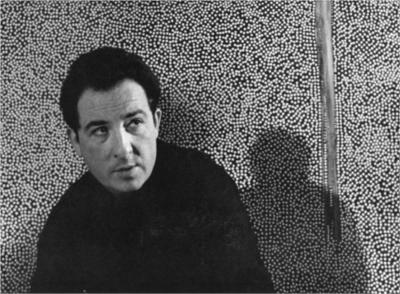
One of the leading British[1] abstract painters of his generation, Cohen directed the Slade School for twelve years and developed a dense, improvisatory approach to abstraction.
Where to see Bernard Cohen
Collection holdings are reported here; current display varies. Check with each museum before visiting.
-
11 recorded works
Tate
London, United Kingdom
-
3 recorded works
Arts Council Collection, Southbank Centre
London, United Kingdom

-
3 recorded works
UCL Art Museum
London, United Kingdom
-
3 recorded works
British Council
London, United Kingdom
-
1 recorded work
Ulster Museum
Belfast, United Kingdom
-
1 recorded work
Museum & Art Swindon
Swindon, United Kingdom
-
1 recorded work
Whitworth Art Gallery
Manchester, United Kingdom
-
1 recorded work
Carnegie Museum of Art
Pittsburgh, United States
-
1 recorded work
Walker Art Gallery
Liverpool, United Kingdom
-
1 recorded work
Stanley & Audrey Burton Gallery
Leeds, United Kingdom


View all 13 museums
-
1 recorded work
Hepworth Wakefield
Wakefield, United Kingdom
-
1 recorded work
Museum of Modern Art
New York City, United States
-
0 recorded works
Vanderbilt Museum of Art
Nashville, United States


Frequently Asked Questions
Where can I see Bernard Cohen's work?
To view Bernard Cohen's work, several museums and galleries have collections that may include his pieces. In the United Kingdom, you might check the Brighton Museum & Art Gallery (Royal Pavilion Gardens, Brighton), Manchester Art Gallery (Mosley Street, Manchester), or the Victoria & Albert Museum (Cromwell Road, London). The National Museums of Scotland, Royal Museum (Chambers Street, Edinburgh) may also hold his work. Outside the UK, consider the Art Gallery of Ontario (317 Dundas Street West, Toronto). In the United States, potential venues include the Los Angeles County Museum of Art (5905 Wilshire Boulevard, Los Angeles), the Metropolitan Museum of Art (1000 Fifth Avenue, New York), and the Museum of Modern Art (11 West 53rd Street, New York). Other possibilities are the Minneapolis Institute of Arts (2400 Third Avenue South, Minneapolis), the Virginia Museum of Fine Arts (200 N. Boulevard, Richmond), and the Wolfsonian at Florida International University (1001 Washington Avenue, Miami Beach).What should I know about Bernard Cohen's prints?
Bernard Cohen taught painting at Ohio State University, Columbus, between 1949 and 1963. He then taught at the State University of New York, Oswego, and finally at Douglass College, Rutgers University, New Brunswick, New Jersey. Prints are often produced in limited editions, with each impression numbered and signed by the artist. This practice distinguishes original graphics from reproductions and confirms the artist's approval of a particular proof. By controlling the edition size, artists influence the price and prevent prints from being made after the plate or stone has deteriorated. However, the definition of an original print has been debated among artists, dealers, and collectors. Some argue that strict definitions limit artistic expression. The Professional Art Dealers Association of Canada (PADAC) defines an original print as an image conceived and executed solely as a print, usually in a numbered edition and signed by the artist. Each print is individually inked and pulled from the matrix. The intent behind the work is a factor. An original print intends to be a work of art in its own right, while a reproduction aims to replicate an image initially created in another medium.What techniques or materials did Bernard Cohen use?
Bernard Cohen is known for abstract paintings that explore colour, line, and form. Regarding materials, Cohen typically employs oil paint, sometimes in conjunction with alkyd. He often works on large canvases, creating complex compositions. His technique involves layering paint, building up surfaces with multiple applications of colour. Cohen's approach is often described as process-based; the finished work reveals the history of its making through visible marks and traces of previous layers. Cohen has also explored printmaking techniques, including screen printing and lithography. These processes allow him to translate his painterly concerns into different media, often resulting in works that share visual similarities with his paintings, such as overlapping shapes and dynamic compositions.Who did Bernard Cohen influence?
Bernard Cohen's drawings use distinct signs that generate sequences and coalitions, like those of discourse. His imagery is cartographic, whether we can find our way somewhere with it or not. The play of signs implies causal relationships that are being recorded or programmed. Among various possible groupings in an exhibition, one connects four artists from Germany, Italy, England and Sweden who were not aware of one another's work in the development of their own styles. However, all have, in one way or another, picked up Klee's proposal of an art making simultaneous use of more than one sign system. Mary Bauermeister's ink drawings consist of striations and series of repetitive marks; spatial display is directionalized by words which can only be read in one direction. Baruchello's drawings, with their scatter of diagrammatic parts and details, are also temporal; one's attention is directed from point to point within the sheet. Fahlstrom's imagery is organised in a narrative, instructional order, but one rich in contradiction and cross reference.Who influenced Bernard Cohen?
Bernard Cohen's influences included a range of figures and movements. He studied Analytic Cubism, particularly the work of Braque and Picasso, early Kandinsky, and Miró. He also examined Matisse and Mondrian, analysing the structure of their paintings. Cohen’s influences extended to Old Masters, Renaissance and Quattrocento artists, American masters, and African art. He studied paintings such as Matisse's *Blue Window* (1913), Miró's *Person Throwing a Stone at a Bird* (1926), Cézanne's *Card Players* (1890-92), and Mondrian's grid paintings. Cohen found inspiration in Jackson Pollock's work, which resonated with him and opened the way for him to make his own contribution. He also expressed interest in Manet, Monet, and Gorky, examining their methods and creating abstract responses to their works.What is Bernard Cohen's most famous work?
It is difficult to identify one single "most famous" work by Bernard Cohen. His career, beginning in the late 1950s, involves a variety of styles and approaches. Cohen is best known for large, abstract paintings featuring complex networks of lines and shapes. These works often employ bright colours and a sense of movement. Elements may seem to float or interweave across the canvas. He developed this style during the 1960s and 1970s. Examples of paintings from this period include "April 26th" (1962), now in the collection of the Tate, and works such as "Dance I" (1965) and "Dance II" (1966). Later in his career, Cohen explored different techniques, including the incorporation of collage and mixed media. He also experimented with computer-generated imagery. This makes it difficult to point to one specific piece that overshadows his other artistic output. His overall contribution to abstract art is probably more significant than any single painting.What style or movement did Bernard Cohen belong to?
It is difficult to assign Bernard Cohen to one specific movement. The term "style" in art refers to weighted preferences, and judging a style involves assessing a tendency, which can be challenging to pin down precisely in individual cases. Styles may be adopted as a badge or to distinguish a group from others. Artists may strike out in different directions, and there is no compulsion for all to compete along the same lines. Individual temperament, talent, and opportunities also play a role. Some classify Cohen as an abstract expressionist, while others see his work as related to colour field painting or even conceptual art. His pieces often include complex, layered lines and shapes, creating a sense of depth and movement. This makes definitive categorisation problematic.What was Bernard Cohen known for?
Bernard Cohen (born 1933[1]) is an English painter, known for abstract works. He studied at Saint Martin's School of Art from 1950 to 1951, then at the Slade School of Fine Art from 1951 to 1954. He taught at Ealing Art College and Chelsea School of Art during the 1960s. From 1988 to 2000, he was Professor of Fine Art at the Slade. Cohen represented Britain at the 1966 Venice Biennale. His paintings often feature complex arrangements of lines and shapes. These create a sense of movement and depth. Colour plays an important role, with many layers building up the final image. Some see Cohen's work as a response to Abstract Expressionism, but with a more controlled, systematic approach. Others view his pieces as explorations of inner space and perception. His notable exhibitions include shows at the Institute of Contemporary Arts, London, in 1964, and a retrospective at the Hayward Gallery, London, in 1972. Cohen continues to paint and exhibit his work internationally.
Sources
Where to See guide aggregates verified holdings of Bernard Cohen's works across the following collections.
- [1] wikipedia Wikipedia: Bernard Cohen Used for: biography.
- [2] book guggenheim-guggenheimintern1964allo Used for: biography.
- [3] book guggenheim-newhorizonsiname00denn Used for: biography.
- [4] book guggenheim-philipguston00gust Used for: biography.
Editorial overseen by Solis Prints. Sources verified 2026-09-30. Click a source for details, or hover over [N] in the page above to preview.
Editorial standardsMethodologyCorrectionsAI disclosureAbout the editorial team