



About Anna Ancher
Danish · 1859–1935
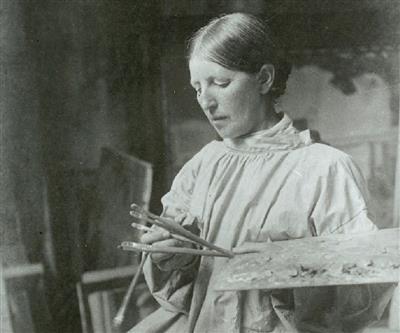
Danish[1] painter whose luminous interior scenes of life in Skagen, the northern artist colony, made her one of Denmark's most celebrated artists.
Museums2
Countries2
Most worksStatens Museum for Kunst, Copenhagen · 9 works
Loading map…
Where to see Anna Ancher
Ranked by works you can see in person.
-
9 works
Statens Museum for Kunst
Copenhagen, Denmark
-
1 works
Nationalmuseum
Stockholm, Sweden


Frequently Asked Questions
Where can I see Anna Ancher's work?
Anna Ancher's works are held in numerous public collections, primarily in Europe. Within Denmark, notable locations include the Aarhus Kunstmuseum, Fyns Stifts Kunstmuseum (Odense), Louisiana Museum of Modern Art (Humlebaek), and Skagens Museum. Elsewhere in Scandinavia, her art can be viewed at the Amos Andersonin Taidemuseo (Helsinki), Arkiv for Dekorativ Konst (Lund, Sweden), Henie-Onstad Art Center (Høvikodden, Norway), and Nationalmuseum (Stockholm). In continental Europe, Ancher's paintings are in the Kunstmuseum Bern and Kunstmuseum Luzern (Switzerland), Graphische Sammlung Albertina (Vienna), Musée National d’Art Moderne, Centre Georges Pompidou (Paris), Musée d’Orsay (Paris), and Musée des Beaux-Arts (Nancy). Outside Europe, The Art Institute of Chicago, Cincinnati Art Museum, Cleveland Museum of Art, Busch-Reisinger Museum (Cambridge, Massachusetts), Solomon R. Guggenheim Museum and the Metropolitan Museum of Art (both in New York) also hold examples of her work.What should I know about Anna Ancher's prints?
It is difficult to discuss Ancher's prints specifically, as she is primarily known as a painter. However, some general information about fine art prints may be useful. Original prints are often produced in limited editions. This means that the artist sets a specific number of prints to be made. Each print is then numbered (for example, 35/100, where 100 is the total edition size). The artist typically signs each print in pencil, adding authenticity. Some artists also create a small number of artist's proofs, marked "AP". The practice of limiting editions is more of a convention than a technical requirement. The artist makes the decision to limit the number. These conventions add value if they are credible. It is reasonable for a customer to expect that a print conforms to the claims written on it. When examining a print, look for the edition number, the title, and the artist's signature, usually found along the bottom margin. The quality of the paper and printing process also affect the print's value.Why are Anna Ancher's works important today?
Anna Ancher (1859[1]-1935[1]) was a Danish[1] painter associated with the Skagen group of artists, who gathered in the fishing village of Skagen in northern Denmark. Her art is important because it offers a view into the lives of women and children in a rural community, rendered with a keen eye for colour and light. Ancher's paintings often depict domestic scenes, such as women sewing or children playing. These works capture the quiet moments of everyday life, and they reveal Ancher's deep understanding of human nature. Her art shares qualities with that of artists such as Carl Holsøe and Vilhelm Hammershøi, other Scandinavian painters who created quiet interior scenes. Like Johannes Vermeer, Ancher was skilled at capturing the effects of light and atmosphere, often creating a sense of stillness and contemplation. Her focus on the daily lives of women, and her ability to find beauty in the ordinary, continue to resonate with audiences today.What techniques or materials did Anna Ancher use?
Anna Ancher was an oil painter, but little has been written about her specific techniques. Oil paint can be thinned with turpentine or other solvents. Some artists apply paint directly, while others employ indirect methods. Direct application involves immediate paint handling, while indirect application uses layering. Artists may also use mediums, such as alkyd resin-based or linseed oil, to modify their paints. Grounds are also important, as some artists prefer white grounds for luminosity, while others use coloured grounds. Some artists apply paint with brushes, palette knives, or other tools to create different effects. Brushes can be hog hair or synthetic, with filberts and flats being common choices. Some artists use unconventional supports, such as cardboard, or unprimed canvas, for absorbent effects. Ultimately, an artist's individual approach will influence their choice of materials and techniques.Who did Anna Ancher influence?
It is difficult to identify specific artists who were directly influenced by Anna Ancher. However, contextualising her within the art world of her time provides some insight into possible reciprocal influences. Ancher belonged to a generation of artists for whom Claude Monet's compositions were a source of inspiration. The Austrian painter Olga Wisinger-Florian, a contemporary, found Monet's garden pictures a recurrent challenge. Her pictures reveal a purposeful style, strong colours, and impasto application. Monet's compositional achievements resonate in her garden and flower pictures, without detracting from her own distinctive style. Similarly, Emilie Mediz-Pelikan may have seen pictures by Claude Monet early on, perhaps while she was in Paris. The pictures completed in Knokke, Duino, and Krems give an indication of the possible influence of his works. Like Monet’s seascapes, the absence of borders conveys an impression of distance and endlessness. Within the Worpswede artist community, Paula Modersohn-Becker developed interests influenced by Volkish ideas. While difficult to draw direct lines of influence, these examples illustrate the artistic milieu in which Ancher worked, and the cross-currents of influence that existed.Who influenced Anna Ancher?
Anna Ancher's influences are not well documented. However, some context can be gleaned from the influences of her contemporaries. For example, Edvard Munch, a Norwegian painter, was influenced by the Norwegian art scene, where he admired the Norwegian school of painting. He enrolled at the Royal School of Art and Design of Kristiania in 1881[1]. His tutors included sculptor Julius Middelthun and naturalistic painter Christian Krohg. Another tutor, Frits Thaulow, admired plein air painting, in the style of the French Barbizon school. Thaulow particularly admired Jean-Baptiste-Camille Corot (1796-1875[1]), a French painter whose work references Neo-Classical tradition and anticipates Impressionism[1]. Munch's early work, From Maridalen (1881), shows the influence of Corot's of pale blue, grey and silver tones. Similarly, Claude Monet said that Jongkind was his true master, and that he owed the final education of his eye to him. The Normandy painters Boudin and Jongkind influenced the Impressionists.What is Anna Ancher's most famous work?
It is difficult to name Anna Ancher's single "most famous" work with certainty. Her output, while consistently praised, does not have one piece that overshadows all others in popular recognition. However, certain paintings are more frequently cited and reproduced. "A Funeral" (1891[1]) is one example; its sombre palette and depiction of a community ritual are often discussed. Another is "Harvesters" (1905), which captures the seasonal labour of rural life with a focus on light and colour. "Sunlight in a Blue Room" (1891) is also well regarded. These paintings, along with others such as "The Sick Girl" (1880s), demonstrate Ancher's skill in portraying everyday life, particularly the lives of women, with sensitivity and artistic merit. They are regularly featured in exhibitions and publications about her work and Danish[1] art. While no single painting may be universally known, these works contribute to her overall reputation as a significant figure in Danish painting.What style or movement did Anna Ancher belong to?
Anna Ancher is associated with the Skagen Painters, a community of Danish[1] artists who gathered in the village of Skagen, Denmark, from the 1870s. This group was part of a broader movement towards realism and plein air painting, with shared interests to the French Impressionists. Like the Impressionists, the Skagen painters were interested in capturing the effects of light and atmosphere. They often painted scenes of everyday life, including portraits of the local people and views of the surrounding area. Their style is characterised by loose brushwork and a focus on colour. While there are similarities between the Skagen painters and the Impressionists, there are also some important differences. The Skagen painters were less interested in capturing fleeting moments and more interested in creating a sense of atmosphere and mood. They also tended to use a more muted palette than the Impressionists.
Sources
Where to See guide aggregates verified holdings of Anna Ancher's works across the following collections.
- [1] wikipedia Wikipedia: Anna Ancher Used for: biography.
- [2] book Beard, Lee, 1973- author, Butler, Adam, author; Van Cleave, Claire, author; Fortenberry, Diane, author; Stirling, Susan, author, Beard, Lee, 1973- author, Butler, Adam, author; Van Cleave, Claire, author; Fortenberry, Diane, author; Stirling, Susan, author - The Art Book_ New Edition, Mini Format Used for: biography.
- [3] book Edvard Munch, Delphi Collected Paintings of Edvard Munch Used for: biography, stylistic analysis.
- [4] book Edvard Munch, Delphi Complete Paintings of Edvard Munch Used for: biography, stylistic analysis.
- [5] book guggenheim-expger00neug Used for: biography.
- [6] book Masterpieces of western art : a history of art in 900 individual studies from the Gothic to the present day Used for: biography.
- [7] book Hodge, Susie, 1960- author, The short story of women artists : a pocket guide to movements, works, breakthroughs, & themes Used for: stylistic analysis.
Editorial overseen by Solis Prints. Sources verified 2026-09-24. Click a source for details, or hover over [N] in the page above to preview.
Editorial standardsMethodologyCorrectionsAI disclosureAbout the editorial team