

About Sean Scully
- Abstract
- Contemporary
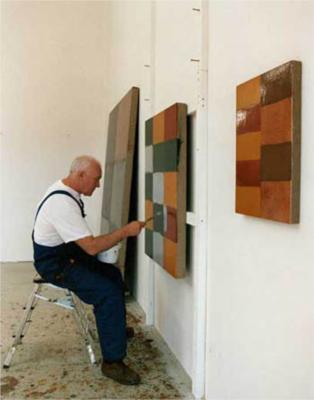
Sean Scully is an Irish-American artist recognised for his distinctive abstract stripe paintings.
Where to see Sean Scully
Ranked by works you can see in person.
-
7 works
Museo Nacional Centro de Arte Reina Sofía
Madrid, Spain
-
6 works
National Gallery of Art
Washington D.C., United States


-
6 works
Tate
London, United Kingdom
-
5 works
Metropolitan Museum of Art
New York City, United States
-
3 works
Museum of Modern Art
New York City, United States
-
3 works
National Gallery of Victoria
Melbourne, Australia
-
3 works
Smithsonian American Art Museum
Washington D.C., United States
-
2 works
Arts Council Collection, Southbank Centre
London, United Kingdom
-
2 works
Buffalo AKG Art Museum
Buffalo, United States
-
2 works
Museum of Fine Arts Boston
Boston, United States


View all 31 museums
-
2 works
British Council
London, United Kingdom
-
2 works
Art Institute of Chicago
Chicago, United States
-
2 works
Museum of Fine Arts, Houston
Houston, United States
-
1 works
Kettle's Yard
Cambridge, United Kingdom
-
1 works
Städel Museum
Frankfurt, Germany
-
1 works
Ulster Museum
Belfast, United Kingdom
-
1 works
Westphalian State Museum of Art and Cultural History
Münster, Germany
-
1 works
Whitworth Art Gallery
Manchester, United Kingdom
-
1 works
Carnegie Museum of Art
Pittsburgh, United States
-
1 works
Princeton Art Museum
Princeton, United States
-
1 works
The Nelson-Atkins Museum of Art
Kansas City, United States
-
1 works
Manchester Art Gallery
Manchester, United Kingdom
-
1 works
Art Gallery of South Australia
Adelaide, Australia
-
1 works
National Museum Cardiff
Cardiff, United Kingdom
-
1 works
Cincinnati Art Museum
Cincinnati, United States
-
1 works
Abbot Hall Art Gallery
Kendal, United Kingdom
-
1 works
Fitzwilliam Museum
Cambridge, United Kingdom
-
1 works
Birmingham Museums Trust
Birmingham, United Kingdom
-
1 works
National Gallery of Ireland
Dublin, Ireland
Also here (6)
-
1 works
Fine Arts Museums of San Francisco
San Francisco, United States
-
1 works
Yale University Art Gallery
New Haven, United States


Frequently Asked Questions
Where can I see Sean Scully's work?
To see Sean Scully's work, one might visit institutions that feature modern and contemporary art. In the United States, the Whitney Museum of American Art and the Solomon R. Guggenheim Museum (both in New York) hold relevant collections. The Sean Kelly Gallery also represents the artist. Outside the United States, museums such as the Scottish National Gallery of Modern Art (Edinburgh), the Musée d’Art Moderne de la Ville de Paris, and the Rijksmuseum Kröller-Müller (Otterlo, Netherlands) may also hold pieces by Scully. These museums offer the opportunity to view his work in the context of broader artistic movements and alongside other significant artists. Always check each institution's current exhibition listings or online catalogue before visiting.What should I know about Sean Scully's prints?
Sean Scully is known for abstract paintings featuring blocks or stripes of colour. He also produces prints, often in limited editions. The size of a print edition is determined by the artist, not by technical limitations. Most printmakers limit their editions, and the edition is defined by a written claim, typically in pencil, at the foot of each print. These claims follow informal conventions widely respected among printmakers. Each print is marked with a fraction (for example, 12/25), with the print number to the left and the total edition size to the right. The print's title is usually centred below the image, and the artist's signature appears on the right. While these conventions are not legally enforced, they are expected to be accurate under the Trade Descriptions Act 1968. Open Studio, a printmaking studio in Toronto, maintains records for all works and provides them to purchasers.Why are Sean Scully's works important today?
Sean Scully's art is important because of its materiality and presence. His stripes, which he has used for over twenty years, have become more architectural. His paintings have an ad hoc quality, reminiscent of downtown New York with its haphazard surfaces. Scully's art is constructed from paint on cloth, dense with time and labour. His surfaces suggest deliberation and earnestness. The light and colour in his works relate to the Old Masters, especially Velásquez's greys and ochres. Scully was born in Dublin during World War II. Economic conditions forced his family to London. At age six, he attended a convent school and resonated with the spiritual ambiance. He was later expelled for his parents' violation of Sabbath rules, which he found disturbing. Scully sees his art as fundamentally spiritual and emotional. He wants emotion to overcome geometry and humanise it. He sees himself as maintaining a line of belief that includes Masaccio, Piero della Francesca, and Matisse. His goal is to create art that has eternal and modern truth.What techniques or materials did Sean Scully use?
Artists have used varied painting materials throughout history, including natural pigments in fresco, egg tempera, watercolour, and oil. More contemporary materials include acrylics, household emulsions, and mixed media, which combines different materials in one artwork. The techniques and processes used are part of the creative process. Knowledge of how oil can be applied thickly in impasto or thinly in glazes affects understanding of the artwork. Brushwork may be fine, disguised, or thickly applied with a palette knife. Understanding the techniques and processes used by artists is essential. The connection between the qualities of medium and technique and the aesthetic choices made by the artist must be understood. This understanding keeps ways of thinking about, writing about, presenting, and reading art history engaged with the work. Artists are not always confined by the medium in which they work, as important choices stand outside the constraints of the materials and techniques.Who did Sean Scully influence?
Sean Scully's impact on other artists is evident in the widespread adoption of his abstract style. His use of stripes and blocks of colour, combined with a textured surface, has been particularly influential. While it is difficult to pinpoint specific individuals who directly emulate Scully, his work has contributed to the revitalisation of abstract painting since the 1980s. His approach, which balances formal structure with emotional expression, has resonated with a younger generation of artists interested in exploring the possibilities of non-representational art. Scully's influence can also be seen in the broader context of contemporary art. Many artists working today engage with similar themes of materiality, process, and the relationship between colour and form. His exhibitions and writings have further disseminated his ideas, making him a significant figure in the development of abstract painting in recent decades. He has inspired painters to explore new avenues within abstraction.Who influenced Sean Scully?
Sean Scully, born in Dublin in 1945, is associated with abstract painting. Critics often discuss the influences on his style. Some observers link Scully's work to Piet Mondrian's geometric abstraction. Mondrian, a Dutch painter, developed non-representational forms of art. Scully's use of stripes and blocks of colour invites comparisons to Mondrian's compositions. Others point to Mark Rothko, an American painter known for his colour field paintings. Rothko's large-scale, atmospheric canvases, with their hazy blocks of colour, resonate with aspects of Scully's approach. Scully's emphasis on colour and its emotional impact may reflect Rothko's influence. Beyond these abstract painters, some see connections to earlier art forms. The art historian Arthur C. Danto suggested that the artist's paintings evoke a sense of architectural structure, comparing them to brickwork. This view suggests that Scully's influences extend beyond the purely painterly.What is Sean Scully's most famous work?
Sean Scully is best known for his abstract paintings. These often feature blocks or stripes of colour. His style incorporates elements of Minimalism with a personal, emotional approach. It is difficult to name one single "most famous" work. However, certain pieces and series are particularly well recognised. *Wall of Light* is a recurring title for many of his works. These paintings explore the interplay of light and colour through rectangular forms. Scully's *Doric* series, begun in the late 1980s, is also significant. These paintings evoke the architectural forms of ancient Greece. They mark a shift towards a more textured and layered surface in his work. Another important series is *Landline*. In these, horizontal bands of colour suggest horizons and the meeting of land and sea. Scully's work is held in many major museum collections. These include the Museum of Modern Art in New York, the Tate Gallery in London, and the Irish Museum of Modern Art in Dublin. His consistent exploration of colour, form, and emotion has established him as a leading figure in contemporary abstraction.What style or movement did Sean Scully belong to?
Sean Scully's work is associated with Abstract Expressionism and Minimalism. These movements developed primarily in the United States during the mid-20th century. Abstract Expressionism, which emerged in New York in the 1940s, is characterised by large canvases and energetic application of paint. Artists often used large brushes or dripped paint, emphasising the spontaneity of the creative process. Minimalism, a trend in painting and sculpture from the 1960s and 1970s, involves paring down art to its essentials. It favours abstract, objective, and anonymous forms, free from surface decoration. Minimalist painting often uses mathematically derived grids and linear matrices. Scully's style incorporates elements of both movements through his use of abstract forms and emphasis on colour and composition.
Sources
Where to See guide aggregates verified holdings of Sean Scully's works across the following collections.
- [1] book Fred S. Kleiner, Gardner’s Art through the Ages: The Western Perspective Used for: stylistic analysis.
- [2] book guggenheim-britishartnowame00wald Used for: biography.
- [3] book guggenheim-refigur00kren Used for: biography.
- [4] book guggenheim-transfsi00wald Used for: biography.
- [5] book Masterpieces of western art : a history of art in 900 individual studies from the Gothic to the present day Used for: biography.
- [6] book Robert Hughes, The Shock of the New, 1980 Used for: stylistic analysis.
Editorial overseen by Solis Prints. Sources verified 2026-09-24. Click a source for details, or hover over [N] in the page above to preview.
Editorial standardsMethodologyCorrectionsAI disclosureAbout the editorial team