

Sean Scully
- Abstract
- Contemporary
Sean Scully’s early life was marked by a move from Dublin to London at a young age. He spent time boxing in his youth, an experience that taught him discipline and a sense of rhythm, elements that later found their way into his abstract compositions. He initially studied art at Croydon College of Art before attending Newcastle University.
Biography
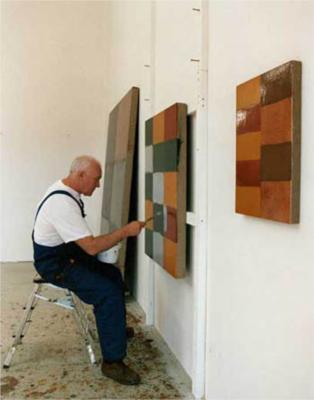
After moving to New York in 1975, Scully developed his signature style of abstract stripe paintings. These works are characterised by their carefully constructed grids and often thick, textured application of paint. His time spent in Morocco during the 1960s and 1970s also influenced his use of colour and light, drawing inspiration from the stacked forms and intense hues of North African architecture and textiles.
Scully builds his paintings layer by layer, sometimes applying paint with a palette knife to create a sculptural surface. He considers his stripes to be emotional, not geometric. They reflect human experience and connection, rather than cold, intellectual constructs. His approach imbues his abstract forms with a sense of presence and materiality.
Timeline
- 1945Born in Dublin, Ireland
- 1960Travels to Morocco
- 1970Travels to Morocco
- 1975Moved to New York
Next stop
Browse the movements →
Every movement in the collection, from the Renaissance to Pop art.
Related Artists

_%E2%80%93_LOC.jpg)
.jpg)


Frequently Asked Questions
What is Sean Scully known for?
Sean Scully is known for his abstract stripe paintings. These paintings feature carefully constructed grids and a thick, textured application of paint.What is Sean Scully's most famous work?
Sean Scully is best known for his abstract paintings. These often feature blocks or stripes of colour. His style incorporates elements of Minimalism with a personal, emotional approach. It is difficult to name one single "most famous" work. However, certain pieces and series are particularly well recognised. *Wall of Light* is a recurring title for many of his works. These paintings explore the interplay of light and colour through rectangular forms. Scully's *Doric* series, begun in the late 1980s, is also significant. These paintings evoke the architectural forms of ancient Greece. They mark a shift towards a more textured and layered surface in his work. Another important series is *Landline*. In these, horizontal bands of colour suggest horizons and the meeting of land and sea. Scully's work is held in many major museum collections. These include the Museum of Modern Art in New York, the Tate Gallery in London, and the Irish Museum of Modern Art in Dublin. His consistent exploration of colour, form, and emotion has established him as a leading figure in contemporary abstraction.What should I know about Sean Scully's prints?
Sean Scully is known for abstract paintings featuring blocks or stripes of colour. He also produces prints, often in limited editions. The size of a print edition is determined by the artist, not by technical limitations. Most printmakers limit their editions, and the edition is defined by a written claim, typically in pencil, at the foot of each print. These claims follow informal conventions widely respected among printmakers. Each print is marked with a fraction (for example, 12/25), with the print number to the left and the total edition size to the right. The print's title is usually centred below the image, and the artist's signature appears on the right. While these conventions are not legally enforced, they are expected to be accurate under the Trade Descriptions Act 1968. Open Studio, a printmaking studio in Toronto, maintains records for all works and provides them to purchasers.What style or movement did Sean Scully belong to?
Sean Scully's work is associated with Abstract Expressionism and Minimalism. These movements developed primarily in the United States during the mid-20th century. Abstract Expressionism, which emerged in New York in the 1940s, is characterised by large canvases and energetic application of paint. Artists often used large brushes or dripped paint, emphasising the spontaneity of the creative process. Minimalism, a trend in painting and sculpture from the 1960s and 1970s, involves paring down art to its essentials. It favours abstract, objective, and anonymous forms, free from surface decoration. Minimalist painting often uses mathematically derived grids and linear matrices. Scully's style incorporates elements of both movements through his use of abstract forms and emphasis on colour and composition.What techniques or materials did Sean Scully use?
Artists have used varied painting materials throughout history, including natural pigments in fresco, egg tempera, watercolour, and oil. More contemporary materials include acrylics, household emulsions, and mixed media, which combines different materials in one artwork. The techniques and processes used are part of the creative process. Knowledge of how oil can be applied thickly in impasto or thinly in glazes affects understanding of the artwork. Brushwork may be fine, disguised, or thickly applied with a palette knife. Understanding the techniques and processes used by artists is essential. The connection between the qualities of medium and technique and the aesthetic choices made by the artist must be understood. This understanding keeps ways of thinking about, writing about, presenting, and reading art history engaged with the work. Artists are not always confined by the medium in which they work, as important choices stand outside the constraints of the materials and techniques.What was Sean Scully known for?
Sean Scully (born 1945) is an Irish-American artist known for his abstract paintings, prints, and sculptures. His work typically features rectangular forms arranged in grid-like compositions. He often uses stripes or blocks of colour to create a sense of depth and texture. Scully's early work was influenced by Minimalism, but he later developed a more personal style. This style incorporates elements of Abstract Expressionism. He often builds up layers of paint on the canvas, creating a tactile surface. Scully's colour choices are often muted or earthy, and he is interested in the way that colours interact with each other. Throughout his career, Scully has explored the possibilities of abstraction. He has created a body of work that is both visually striking and emotionally resonant. His art explores themes of memory, place, and the human condition. Scully has exhibited extensively throughout the world, and his work is included in many major museum collections.When did Sean Scully live and work?
Sean Scully was born in Dublin, Ireland, in 1945. His family relocated to London, where he was raised. He studied at Croydon College of Art from 1968 to 1972, then at Newcastle University from 1969 to 1972. Scully received a Harkness Fellowship to the United States in 1975; he settled there, becoming an American citizen in 1983. He has lived and worked in New York City for many years. He also maintains studios in other locations, including Barcelona and Munich. His career has included teaching positions at institutions such as Princeton University and Cooper Union. Scully continues to create abstract paintings and prints, often characterised by their use of stripes and blocks of colour. He is still living and working.Where can I see Sean Scully's work?
To see Sean Scully's work, one might visit institutions that feature modern and contemporary art. In the United States, the Whitney Museum of American Art and the Solomon R. Guggenheim Museum (both in New York) hold relevant collections. The Sean Kelly Gallery also represents the artist. Outside the United States, museums such as the Scottish National Gallery of Modern Art (Edinburgh), the Musée d’Art Moderne de la Ville de Paris, and the Rijksmuseum Kröller-Müller (Otterlo, Netherlands) may also hold pieces by Scully. These museums offer the opportunity to view his work in the context of broader artistic movements and alongside other significant artists. Always check each institution's current exhibition listings or online catalogue before visiting.Where was Sean Scully from?
Sean Scully is an Irish-American artist, born in Dublin on 30 June 1945. His family relocated to London in 1949, where he was raised. Scully's early life included periods of manual labour. He worked in printing and also at a garage. He began art studies at the Central School of Art in London in 1965, then studied at Newcastle University from 1968 to 1972. A travelling scholarship took him to Harvard University in 1972-1973. He moved to New York City in 1975, initially on a visiting artist programme. Scully became an American citizen in 1983, though he has maintained connections with Europe throughout his career. He has lived and worked in various locations, including New York, Barcelona, and Munich. His work often reflects an interest in the interaction between colour and structure.Who did Sean Scully influence?
Sean Scully's impact on other artists is evident in the widespread adoption of his abstract style. His use of stripes and blocks of colour, combined with a textured surface, has been particularly influential. While it is difficult to pinpoint specific individuals who directly emulate Scully, his work has contributed to the revitalisation of abstract painting since the 1980s. His approach, which balances formal structure with emotional expression, has resonated with a younger generation of artists interested in exploring the possibilities of non-representational art. Scully's influence can also be seen in the broader context of contemporary art. Many artists working today engage with similar themes of materiality, process, and the relationship between colour and form. His exhibitions and writings have further disseminated his ideas, making him a significant figure in the development of abstract painting in recent decades. He has inspired painters to explore new avenues within abstraction.Who influenced Sean Scully?
Sean Scully, born in Dublin in 1945, is associated with abstract painting. Critics often discuss the influences on his style. Some observers link Scully's work to Piet Mondrian's geometric abstraction. Mondrian, a Dutch painter, developed non-representational forms of art. Scully's use of stripes and blocks of colour invites comparisons to Mondrian's compositions. Others point to Mark Rothko, an American painter known for his colour field paintings. Rothko's large-scale, atmospheric canvases, with their hazy blocks of colour, resonate with aspects of Scully's approach. Scully's emphasis on colour and its emotional impact may reflect Rothko's influence. Beyond these abstract painters, some see connections to earlier art forms. The art historian Arthur C. Danto suggested that the artist's paintings evoke a sense of architectural structure, comparing them to brickwork. This view suggests that Scully's influences extend beyond the purely painterly.Who was Sean Scully?
Sean Scully (born 1945) is an Irish-American painter and printmaker known for his abstract works featuring stripes or blocks of colour. Born in Dublin, he moved to London with his family in 1949. He studied at Croydon College of Art (1965-1968) and Newcastle University (1968-1972), then he received a fellowship to Harvard University in 1972. Scully's early work was influenced by artists such as Piet Mondrian and Mark Rothko. However, he developed his own distinctive style, characterised by the use of thick, layered paint and simple geometric forms. His paintings often explore themes of space, light, and emotion. Throughout his career, Scully has exhibited extensively in Europe and the United States. His works are held in many public collections, including the Museum of Modern Art in New York, the Tate Gallery in London, and the Irish Museum of Modern Art in Dublin. He has received numerous awards and honours, solidifying his position as a significant figure in contemporary abstraction.
Sources
Editorial draws on the following primary and tertiary references for Sean Scully.
- [1] book Fred S. Kleiner, Gardner’s Art through the Ages: The Western Perspective Used for: stylistic analysis.
- [2] book guggenheim-britishartnowame00wald Used for: biography.
- [3] book guggenheim-refigur00kren Used for: biography.
- [4] book guggenheim-transfsi00wald Used for: biography.
- [5] book Masterpieces of western art : a history of art in 900 individual studies from the Gothic to the present day Used for: biography.
- [6] book Robert Hughes, The Shock of the New, 1980 Used for: stylistic analysis.
Editorial overseen by Solis Prints. Sources verified 2026-09-22. Click a source for details, or hover over [N] in the page above to preview.
Editorial standardsMethodologyCorrectionsAI disclosureAbout the editorial team