



About Bridget Riley
- contemporary art
- modern art
- op art
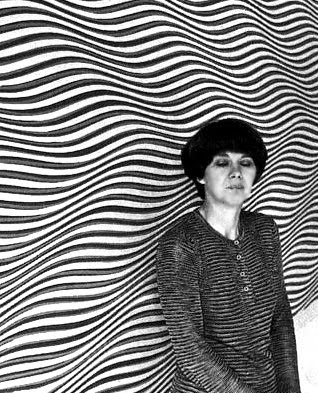
Paints stripes that make your eyes vibrate, was furious when the fashion industry copied her patterns without paying, and is still working in her nineties.
Where to see Bridget Riley
Collection holdings are reported here; current display varies. Check with each museum before visiting.
-
 9 recorded works
Tate
London, United Kingdom
-
3 recorded works
Arts Council Collection, Southbank Centre
London, United Kingdom
-
 3 recorded works
Buffalo AKG Art Museum
Buffalo, United States
-
 3 recorded works
National Galleries Scotland
Edinburgh, United Kingdom
-
3 recorded works
Glasgow Museums Resource Centre
Glasgow, United Kingdom
-
 3 recorded works
British Council
London, United Kingdom
-
 3 recorded works
Museum of Modern Art
New York City, United States
-
3 recorded works
National Gallery of Australia
Canberra, Australia
-
2 recorded works
Neue Nationalgalerie
Berlin, Germany
-
2 recorded works
Kunsthaus Zürich
Zurich, Switzerland


View all 38 museums
-
1 recorded work
Musée d'art moderne de Paris
Paris, France
Also here (6)
-
1 recorded work
Kunstsammlung Nordrhein-Westfalen
Düsseldorf, Germany
-
1 recorded work
Whitworth Art Gallery
Manchester, United Kingdom
-
 1 recorded work
Museum Boijmans Van Beuningen
Rotterdam, Netherlands
-
1 recorded work
Museum of Fine Arts Boston
Boston, United States
-
1 recorded work
Carnegie Museum of Art
Pittsburgh, United States
-
 1 recorded work
Walker Art Gallery
Liverpool, United Kingdom
-
1 recorded work
Dallas Museum of Art
Dallas, United States
-
 1 recorded work
The Nelson-Atkins Museum of Art
Kansas City, United States
-
1 recorded work
National Gallery of Art
Washington D.C., United States
-
1 recorded work
Art Gallery of New South Wales
Sydney, Australia
-
1 recorded work
Manchester Art Gallery
Manchester, United Kingdom
-
1 recorded work
Art Gallery of South Australia
Adelaide, Australia
-
1 recorded work
Maclaurin Art Gallery
Ayr, United Kingdom
-
1 recorded work
National Museum Cardiff
Cardiff, United Kingdom
-
1 recorded work
Norfolk Museums Collections
Norwich, United Kingdom
-
 1 recorded work
Art Institute of Chicago
Chicago, United States
-
1 recorded work
National Trust
Swindon, United Kingdom
-
1 recorded work
Abbot Hall Art Gallery
Kendal, United Kingdom
-
1 recorded work
Minneapolis Institute of Art
Minneapolis, United States
-
1 recorded work
Metropolitan Museum of Art
New York City, United States
-
1 recorded work
Los Angeles County Museum of Art
Los Angeles, United States
-
 1 recorded work
Fitzwilliam Museum
Cambridge, United Kingdom
-
1 recorded work
National Gallery of Victoria
Melbourne, Australia
-
1 recorded work
Kunstmuseum Den Haag
The Hague, Netherlands
-
 1 recorded work
Museum of Croydon
Croydon, United Kingdom
-
0 recorded works
Cleveland Museum of Art
Cleveland, United States


Frequently Asked Questions
Where can I see Bridget Riley's work?
Bridget Riley's paintings and prints are held in many public art collections. These holdings range from single prints to substantial collections that represent the artist's career. In the United Kingdom, major holdings of Riley's work can be found at the Tate Gallery, London; the British Council Collection; the Arts Council Collection; and the National Galleries of Scotland. Regional museums with works by Riley include the Whitworth Art Gallery[6] (Manchester), Birmingham Museums Trust, and Southampton City Art Gallery. Internationally, Riley's pieces are frequently exhibited at major museums. The Museum of Modern Art (MoMA) in New York holds several important paintings and prints. Other American museums with Riley's work include the Art Institute of Chicago, the Dallas Museum of Art, and the Yale University Art Gallery. In Europe, one can view Riley's output at the Centre Pompidou in Paris, the Museo Nacional Thyssen-Bornemisza in Madrid, and the Galleria Nazionale d'Arte Moderna e Contemporanea in Rome. These institutions often feature her work in both permanent collection displays and temporary exhibitions.Where can I see Bridget Riley paintings?
Bridget Riley's works can be seen at Tate, National Gallery of Australia, National Galleries Scotland[3], and 2 other museums worldwide.What should I know about Bridget Riley's prints?
Bridget Riley is an English artist best known for her Op Art paintings and prints. Born in 1931, she studied at Goldsmiths College and the Royal College of Art in London. Riley's prints translate her exploration of optical phenomena into a more accessible medium. Her work plays with visual perception, using abstract geometric forms to create effects of movement and light. These compositions often involve black and white contrasts, as well as colour relationships, to produce disorienting, dynamic surfaces. Although Riley began experimenting with printmaking in the 1960s, it was in the 1980s that she began to produce prints in earnest. These later works often rework earlier paintings. For example, the print series, Fragments (1980), reinterprets elements from her earlier paintings. Similarly, the screenprint, Song of Orpheus (1991), relates to a painting of the same name from 1978. Her prints are created through screen printing and other techniques, allowing for precise registration and reproduction of her designs. Riley closely supervises the printing process to ensure the final product accurately reflects her artistic vision. Her prints offer a way to experience her innovative approach to abstraction at a range of price points.Why are Bridget Riley's works important today?
Bridget Riley's paintings and prints are important because of her sustained investigation into optical phenomena. Riley creates non-figurative works that actively engage the viewer's perception. Her art explores how the eye and brain interpret visual information. Riley first gained attention in the 1960s with black-and-white paintings that produced disorienting effects. These works, such as "Fall" (1963), explored the dynamism of geometric forms. She later introduced colour into her palette, further expanding the possibilities of optical art. Her use of colour relationships creates a sense of movement and depth. Riley's practice involves careful planning and execution. She often uses assistants to execute her designs, allowing her to focus on the conceptual aspects of her work. Her systematic approach to art-making has influenced generations of artists interested in perception and abstraction. She continues to exhibit internationally, and her works are held in major museum collections. Her art remains relevant for its exploration of how we see and experience the world around us.Who was Bridget Riley inspired by?
Jackson Pollock had a powerful impact on Bridget Riley, and the origins of her ‘kinetic art’ can be found in the work of Alexander Calder.When did Bridget Riley start making art?
Bridget Riley became fascinated by Pointillism as an art student and began following the ideas of Georges Seurat.What techniques or materials did Bridget Riley use?
Bridget Riley's early works, created before the 1980s, were often monochrome. She aimed to generate optical effects, exploring how new colours and dynamism can seem to appear through lines and shapes, even when not physically present. Riley's technique involves applying smooth paint in geometric abstract patterns. This creates illusions of colour and motion. Her work with colour placement was influenced by Georges Seurat and Pointillism. Early on, she painted primarily in black and white. One of her paintings was used on the catalogue cover for the 1965 exhibition, "The Responsive Eye". Later, after a trip abroad in the 1980s, Riley adopted a colourful "Egyptian Palette". She worked out compositions meticulously with gouache on paper, exploring colour interactions before creating the final work in oils. Her paintings evoke rhythm and counter-rhythm, creating what she described as ‘stabilities and instabilities, certainties and uncertainties’.What is Bridget Riley's most famous work?
Bridget Riley (born 1931) is best known for her abstract paintings that generate optical effects. She explores space, shape, line, and optical connections, often creating illusions of colour and motion. Riley's work gained prominence with the rise of Op Art, a term coined in 1964. In 1965, the Museum of Modern Art in New York held an exhibition called "The Responsive Eye". Riley was one of the featured artists, and one of her paintings was used on the catalogue cover, solidifying her place in the movement. Early in her career, Riley worked primarily in monochrome, creating geometric patterns that produced optical illusions. Later, she began to experiment with colour, exploring the interactions between different hues. For example, after a trip abroad in the 1980s, she adopted what she called her "Egyptian Palette". One painting from this period, "Certain Day", uses carefully considered colour placement to evoke a bright, hot day. Another notable work is "Cataract 3" (1967), which features undulating red, turquoise, and grey curves.
Sources
Where to See guide aggregates verified holdings of Bridget Riley's works across the following collections.
- [1] museum Buffalo AKG Art Museum Used for: museum holdings.
- [2] museum Government Art Collection Used for: museum holdings.
- [3] museum National Galleries Scotland Used for: museum holdings.
- [4] museum Musée d'art moderne de Paris Used for: museum holdings.
- [5] museum Neue Nationalgalerie Used for: museum holdings.
- [6] museum Whitworth Art Gallery Used for: museum holdings.
- [7] book Susie Hodge, Artistic Circles Used for: biography.
- [8] book Beard, Lee, 1973- author, Butler, Adam, author; Van Cleave, Claire, author; Fortenberry, Diane, author; Stirling, Susan, author, Beard, Lee, 1973- author, Butler, Adam, author; Van Cleave, Claire, author; Fortenberry, Diane, author; Stirling, Susan, author - The Art Book_ New Edition, Mini Format Used for: biography.
- [9] book Hodge, Susie, 1960- author, The short story of women artists : a pocket guide to movements, works, breakthroughs, & themes Used for: biography.
Editorial overseen by Solis Prints. Sources verified 2026-09-30. Click a source for details, or hover over [N] in the page above to preview.
Editorial standardsMethodologyCorrectionsAI disclosureAbout the editorial team