



About Eugene Leroy
1910–2000
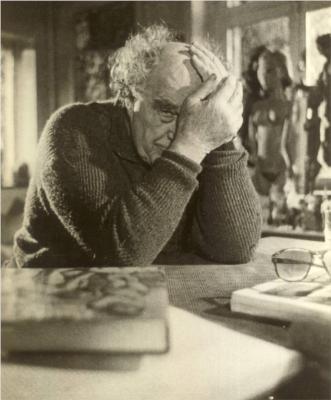
Northern French painter known for densely layered oils in which the nude figure dissolves beneath accumulated paint; recognised late after decades of rural obscurity.
Museums12
Countries6
Most worksMusée d'art moderne de Paris, Paris · 26 works
Loading map…
Where to see Eugene Leroy
Ranked by works you can see in person.
-
26 works
Musée d'art moderne de Paris
Paris, France
Also here (6)
-
 4 works
Victoria and Albert Museum
London, United Kingdom

-
2 works
Buffalo AKG Art Museum
Buffalo, United States
-
2 works
Städel Museum
Frankfurt, Germany
-
2 works
Museum Ludwig
Cologne, Germany
-
2 works
Musée National d'Art Moderne
Paris, France
-
1 works
Van Abbemuseum
Eindhoven, Netherlands
-
1 works
Stedelijk Museum Amsterdam
Amsterdam, Netherlands
-
1 works
Staatliche Kunsthalle Karlsruhe
Karlsruhe, Germany
-
1 works
Palais des Beaux-Arts de Lille
Lille, France


View all 12 museums
-
1 works
Mu.ZEE - Kunstmuseum aan Zee
Ostend, Belgium
-
1 works
Stedelijk Museum voor Actuele Kunst
Ghent, Belgium


Frequently Asked Questions
Where can I see Eugene Leroy's work?
Eugene Leroy's artworks can be viewed in several museums. In France, the Musée d’Art et d’Industrie in Roubaix, and the Musée des Beaux-Arts in Nancy hold examples. The Musée des Arts Décoratifs, and the Musée d’Orsay, both in Paris, also have works. Other European museums include the Brangwyn Museum (Bruges, Belgium), the Clockarium Museum (Brussels, Belgium), and the Koninklijk Museum voor Schone Kunsten (Antwerp, Belgium). In the United Kingdom, collections are held at the Brighton Museum & Art Gallery, Manchester Art Gallery, the National Museums of Scotland (Royal Museum, Edinburgh), and the Victoria & Albert Museum in London. In the United States, visit the Charles Hosmer Morse Museum of American Art (Winter Park, Florida), the Los Angeles County Museum of Art, the Metropolitan Museum of Art (New York), the Minneapolis Institute of Arts, the Museum of Modern Art (New York), the Virginia Museum of Fine Arts (Richmond), and the Wolfsonian at Florida International University (Miami Beach).What should I know about Eugene Leroy's prints?
When considering an Eugene Leroy print, bear in mind that the print market has, since the late 19th century, struggled to define what constitutes an original print versus a reproduction. Photographic and other commercial printing technologies allow for high-quality reproductions of existing images, accompanied by marketing that can confuse buyers. An original print is typically produced by hand, with the artist creating the artwork directly on a plate, woodblock, or screen. Each print is considered an original because the artist creates the work specifically to be a print. Plates for original prints are made by hand and can only withstand a certain amount of use; the number of prints is limited by the number of impressions that can be made before the plate wears out. Offset reproductions, also known as posters, are reproduced by photochemical means. Quantities may be limited by the publisher to add value. Giclée prints are inkjet fine art prints gaining popularity. Canvas transfers, where the image is transferred onto canvas, are also becoming increasingly popular.Why are Eugene Leroy's works important today?
Eugène Leroy (1898-2000[2]) was a French artist known for his thickly impastoed paintings. Working outside mainstream movements, he developed a unique style that continues to influence artists today. Leroy's importance lies in his radical approach to painting. He built up surfaces with layers of paint, sometimes taking years to complete a single work. This process resulted in tactile, almost sculptural surfaces that challenge traditional notions of painting. While some artists suppressed visible brushstrokes, Leroy made the mark of the brush a central element. This emphasis on the artist's individual expression resonates with modern ideas about originality. His work encourages viewers to reconsider their perception of colour, form, and the materiality of paint itself. By pushing the boundaries of the medium, Leroy expanded the possibilities of what painting could be.What techniques or materials did Eugene Leroy use?
Eugene Leroy's methods are not described in the reference passages. However, the passages do discuss the technical methods used by some other nineteenth-century French artists. These included a sequence of steps beginning with drawings, outlining the composition on prepared canvas, and indicating the modelling, often with reddish-brown. Local colour, light and shade were then added. The final stage further refined this process. Some artists used small model rooms, within which they arranged wax figures to assist in the composition of their paintings. Some painters were deeply impressed with the masterpieces of the Italian Renaissance and dreamed of reviving the art of the masters of the past. They hunted for lost secrets or exhausted themselves in efforts to achieve works similar in general effect to those of the Venetians.Who did Eugene Leroy influence?
Eugène Carrière, a symbolist painter, opened an 'academy' in 1898 where he trained artists such as Derain and Matisse. Carrière's style moved away from academic influences during the 1880s. His work is characterised by monochrome, stylised detail, and sometimes distorted elements. He extracted portraits and intimate scenes from evanescent forms by employing a carefully chosen tonality. Also of note, the critic Théodore Duret observed that Manet's painting inspired the Impressionists in the 1860s. By the 1870s, Manet was generally recognised as the leader of the new painting they were creating. During that decade, Manet was in turn influenced by the Impressionists, as he developed a looser style, began to use a brighter palette, and increasingly drew his subjects from scenes of modern life.What is Eugene Leroy's most famous work?
It is difficult to identify Eugene Leroy's single most famous work, but several paintings are well known. These include: * *The Barque of Dante*, completed in 1822, is held at the Musée du Louvre in Paris. * *The Massacre at Chios*, completed in 1824, is held at the Musée du Louvre in Paris. * *Liberty Leading the People*, completed in 1830, is held at the Musée du Louvre in Paris. * *The Women of Algiers*, completed in 1834, is held at the Musée du Louvre in Paris. * *Sultan of Morocco*, completed in 1845, is held at the Musée des Augustins, Toulouse. These paintings are all oil on canvas. They are history paintings, a genre that was popular in the 19th century.What style or movement did Eugene Leroy belong to?
It is difficult to assign Eugène Leroy to a single movement. Art history recognises many styles, and artists may incorporate different approaches. Some classify Leroy as a late Expressionist, because of his heavily worked surfaces and emotional intensity. Others see him as a precursor to Neo-Expressionism, a late-twentieth-century movement that revived expressive figuration. Leroy's thick impasto and concern with colour can also be linked to aspects of Post-Impressionism. This is because of the emphasis on subjective vision and the use of colour to convey emotion, rather than simply representing reality. Ultimately, Leroy's style resists easy categorisation. His work synthesises elements from various movements, resulting in a distinctive and individual approach to painting.What was Eugene Leroy known for?
Julien-David Le Roy (1724-1803[2]) was an architect, archaeologist, and writer, best known for his work on ancient Greek architecture and naval history. He published "The Ruins of the Most Beautiful Monuments of Greece" in 1758, which influenced Neoclassical architecture. Le Roy was interested in naval matters. His writings covered ancient and modern ships, and methods to improve navigation. He wrote "La marine des anciens peuples" in 1777, explaining ancient naval practices and considering their relevance to modern shipbuilding. He also wrote "Les navires des anciens, consideres par rapport a leurs voiles" in 1783, about the sails of ancient ships. Le Roy's other works include "Lettres a M. Franklin, sur la marine" (1790), and "Nouvelle voilure proposee pour les vaisseaux de toutes grandeur" (1792). He also collaborated with Charles Bossut on projects related to the Canal de Paris. Le Roy was a member of the Commune des arts, and a professor of architecture at the museum.
Sources
Where to See guide aggregates verified holdings of Eugene Leroy's works across the following collections.
- [1] museum Victoria and Albert Museum Used for: museum holdings.
- [2] wikipedia Wikipedia: Eugene Leroy Used for: biography.
- [3] book guggenheim-guhe00solo Used for: biography.
- [4] book guggenheim-twopri00weis Used for: biography.
- [5] book guggenheim-youngereuropeanp00swee Used for: biography.
Editorial overseen by Solis Prints. Sources verified 2026-09-24. Click a source for details, or hover over [N] in the page above to preview.
Editorial standardsMethodologyCorrectionsAI disclosureAbout the editorial team