



Bridget Riley
- contemporary art
- modern art
- op art
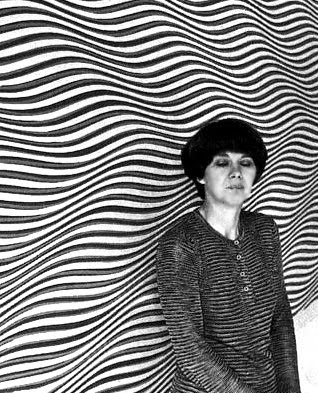
Riley paints stripes and dots and curves that make your eyes vibrate. The effect is physical, not metaphorical: the paintings produce actual optical sensations, afterimages, moiré patterns, the illusion of movement on a flat surface. Stand in front of Fall (1963) for long enough and the black and white curves start to ripple. Some viewers get dizzy. She considers this a success.
Biography
She studied at Goldsmiths and then the Royal College of Art in London. Her early work was figurative, influenced by Impressionism and Pointillism. The shift to Op Art came after she saw a Futurist exhibition in 1959 and studied Seurat's Pointillist technique closely. She realised that colour and pattern could produce perceptual effects without representing anything. The first black and white paintings followed immediately.
She was included in the MoMA exhibition The Responsive Eye in 1965, which brought Op Art to international attention. The fashion industry immediately copied her patterns for fabric prints. She was furious. Dresses covered in Riley-style stripes appeared in shop windows within weeks. She had no legal protection and received no royalties. The experience soured her relationship with popular culture permanently.
The colour came in the late 1960s. Stripes of warm and cool colour placed next to each other, creating optical vibration. Egypt, India, and visits to the south of France influenced the palette. The recent paintings use curves and lozenges in combinations that shift as you move across the canvas. She is in her nineties and still working.
She has always insisted that her paintings are about perception, not decoration. The stripes are not patterns. They are instruments for producing visual experiences that the viewer's nervous system creates involuntarily.
Timeline
- 1931Born in Norwood, London
- 1952Entered Royal College of Art aged 21
- 1961Painted Movement in Squares aged 30; first Op Art work
- 1963Painted Fall aged 32; black and white curves that induce optical vertigo
- 1968Won International Prize for Painting at Venice Biennale aged 37
- 1978Began stripe paintings in Egypt-inspired colours aged 47
Notable Works
Tap to view larger.
Where to See Bridget Riley
11 museums worldwide.
-

-
 3 works
British Council
London, United Kingdom
-
 3 works
Buffalo AKG Art Museum
Buffalo, United States
Mon 10:00–17:00, Thu 10:00–17:00, Fri 10:00–20:00 (until 21:00 on M&T First Fridays), Sat 10:00–18:00, Sun 10:00–17:00, closed Tuesdays and Wednesdays · $24 adults, $20 seniors/college students, $10 youth (5-18), free for children 4 and under and members
-
 3 works
Museum of Modern Art
New York City, United States
Daily 10:30–17:30 (Sat until 19:00; first Fri of month until 20:00) · Adults $30, students $17
-
 3 works
National Galleries Scotland
Edinburgh, United Kingdom
Next stop
Browse the movements →
Every movement in the collection, from the Renaissance to Pop art.
Related Artists

Frequently Asked Questions
Bridget riley art movement?
The origins of Bridget Riley’s kinetic art can be found in the work of Alexander Calder.Does bridget riley still paint?
Bridget Riley is in her nineties and still working.Is bridget riley still alive?
Yes, Bridget Riley is still alive.Was bridget riley married?
Bridget Riley had an intense relationship with painter and teacher Maurice de Sausmarez, with whom she travelled to Italy in 1960.What is Bridget Riley's most famous work?
Bridget Riley (born 1931) is best known for her abstract paintings that generate optical effects. She explores space, shape, line, and optical connections, often creating illusions of colour and motion. Riley's work gained prominence with the rise of Op Art, a term coined in 1964. In 1965, the Museum of Modern Art in New York held an exhibition called "The Responsive Eye". Riley was one of the featured artists, and one of her paintings was used on the catalogue cover, solidifying her place in the movement. Early in her career, Riley worked primarily in monochrome, creating geometric patterns that produced optical illusions. Later, she began to experiment with colour, exploring the interactions between different hues. For example, after a trip abroad in the 1980s, she adopted what she called her "Egyptian Palette". One painting from this period, "Certain Day", uses carefully considered colour placement to evoke a bright, hot day. Another notable work is "Cataract 3" (1967), which features undulating red, turquoise, and grey curves.What should I know about Bridget Riley's prints?
Bridget Riley is an English artist best known for her Op Art paintings and prints. Born in 1931, she studied at Goldsmiths College and the Royal College of Art in London. Riley's prints translate her exploration of optical phenomena into a more accessible medium. Her work plays with visual perception, using abstract geometric forms to create effects of movement and light. These compositions often involve black and white contrasts, as well as colour relationships, to produce disorienting, dynamic surfaces. Although Riley began experimenting with printmaking in the 1960s, it was in the 1980s that she began to produce prints in earnest. These later works often rework earlier paintings. For example, the print series, Fragments (1980), reinterprets elements from her earlier paintings. Similarly, the screenprint, Song of Orpheus (1991), relates to a painting of the same name from 1978. Her prints are created through screen printing and other techniques, allowing for precise registration and reproduction of her designs. Riley closely supervises the printing process to ensure the final product accurately reflects her artistic vision. Her prints offer a way to experience her innovative approach to abstraction at a range of price points.What style or movement did Bridget Riley belong to?
Bridget Riley is most closely associated with Op Art, a movement that emerged in the 1960s. Op Art, short for Optical Art, uses geometric forms to create visual effects. These effects include movement, vibration, and moiré patterns. Riley's paintings often feature black and white shapes, carefully arranged to stimulate the viewer's perception. Her early works, such as "Fall" (1963), exemplify this approach. Later, she introduced colour into her compositions, expanding the range of optical experiences. Although Riley is a central figure in Op Art, her work also connects to broader trends in modern art. Some critics link her systematic exploration of visual phenomena to aspects of Minimalism. Others see connections to earlier movements, such as Futurism, which also explored motion and perception. Riley herself has cited Seurat's pointillism as an influence, noting his interest in the science of vision. While Op Art remains her primary affiliation, her art engages with a range of historical and contemporary dialogues.What techniques or materials did Bridget Riley use?
Bridget Riley's early works, created before the 1980s, were often monochrome. She aimed to generate optical effects, exploring how new colours and dynamism can seem to appear through lines and shapes, even when not physically present. Riley's technique involves applying smooth paint in geometric abstract patterns. This creates illusions of colour and motion. Her work with colour placement was influenced by Georges Seurat and Pointillism. Early on, she painted primarily in black and white. One of her paintings was used on the catalogue cover for the 1965 exhibition, "The Responsive Eye". Later, after a trip abroad in the 1980s, Riley adopted a colourful "Egyptian Palette". She worked out compositions meticulously with gouache on paper, exploring colour interactions before creating the final work in oils. Her paintings evoke rhythm and counter-rhythm, creating what she described as ‘stabilities and instabilities, certainties and uncertainties’.What was Bridget Riley known for?
Bridget Riley is known for abstract paintings that create optical effects. Early in her career, Riley experimented with colour placement, inspired by Georges Seurat's Pointillism. This led her to create works that seemed to generate new colours through the juxtaposition of lines and shapes. Initially, Riley worked almost exclusively in black and white. She applied smooth paint in geometric patterns, creating illusions of motion. These paintings became some of the best-known examples of Op art, a term coined in 1964. In 1965, Riley's work was featured in the exhibition "The Responsive Eye" at the Museum of Modern Art in New York; one of her paintings appeared on the catalogue cover. Riley's artistic approach was also influenced by Jackson Pollock and Alexander Calder, and her work "Painting with Verticals" reflects her study of Henri Matisse and Paul Cezanne. Over time, Riley's style evolved. In the 1980s, following a trip abroad, she adopted what she called her "Egyptian Palette" and simplified her compositions. Her paintings explore the fundamentals of painting, including space, shape, line, and optical connections.When did Bridget Riley live and work?
Bridget Riley was born in London on 24 April 1931. Her early education was at Cheltenham Ladies College (1946-1948) and then Goldsmiths College (1949-1952), followed by the Royal College of Art from 1952 to 1955. Riley's career began with teaching positions. From 1959 to 1960, she taught art at the Convent of the Sacred Heart, Woldingham. Subsequently, she taught at Loughborough School of Art from 1960 to 1961, and Hornsey College of Art from 1962 to 1964. Her first solo exhibition was in 1962, at Gallery One, London. Riley gained wider recognition in 1965 when she participated in the exhibition "The Responsive Eye" at the Museum of Modern Art in New York. Riley continues to live and work, mainly in London and Cornwall.When did bridget riley start painting?
Bridget Riley became fascinated by Pointillism as an art student and began following the ideas of Georges Seurat.Where can i see bridget riley paintings?
Bridget Riley's works can be seen at Tate, National Gallery of Australia, National Galleries Scotland[3], and 2 other museums worldwide.
Sources
Editorial draws on the following primary and tertiary references for Bridget Riley.
- [1] museum Buffalo AKG Art Museum Used for: museum holdings.
- [2] museum Government Art Collection Used for: museum holdings.
- [3] museum National Galleries Scotland Used for: museum holdings.
- [4] museum Musée d'art moderne de Paris Used for: museum holdings.
- [5] museum Neue Nationalgalerie Used for: museum holdings.
- [6] museum Whitworth Art Gallery Used for: museum holdings.
- [7] book Susie Hodge, Artistic Circles Used for: biography.
- [8] book Beard, Lee, 1973- author, Butler, Adam, author; Van Cleave, Claire, author; Fortenberry, Diane, author; Stirling, Susan, author, Beard, Lee, 1973- author, Butler, Adam, author; Van Cleave, Claire, author; Fortenberry, Diane, author; Stirling, Susan, author - The Art Book_ New Edition, Mini Format Used for: biography.
- [9] book Hodge, Susie, 1960- author, The short story of women artists : a pocket guide to movements, works, breakthroughs, & themes Used for: biography.
Editorial overseen by Solis Prints. Sources verified 2026-08-29. Click a source for details, or hover over [N] in the page above to preview.
Editorial standardsMethodologyCorrectionsAI disclosureAbout the editorial team