Number 1, 1950 (Lavender Mist) by Jackson Pollock
Abstract Composition in Black, Gray, Pink, Blue, and Green [verso] by Mark Rothko
Abstract Composition in Brown, Green, Blue, Black, and Orange [recto] by Mark Rothko
The Swimmer in the Econo-mist (painting 1) by James Rosenquist
The Swimmer in the Econo-mist (painting 3) by James Rosenquist
Mountains and Sea by Helen Frankenthaler
Reflections by Arthur Dove
Salut Tom by Joan Mitchell
The Ten Largest by Hilma af Klint
Gaea by Lee Krasner
The Seasons by Lee Krasner
Dogs Chasing Each Other by Arthur Dove

Abstract Expressionism

57 artists · 1943–1965

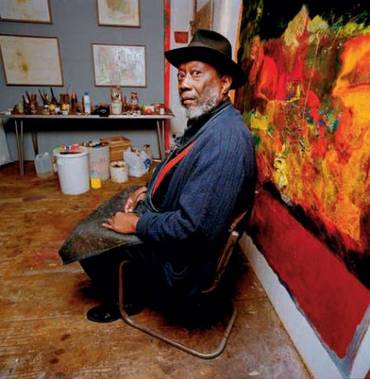
Abstract Expressionism[4] emerged in New York during the early 1940s and became the first American art movement to achieve international influence. A small group of painters, many of them immigrants or children of immigrants, broke with European tradition by treating the canvas as an arena for spontaneous, large-scale gesture. The movement divided loosely into two camps: action painters like Franz Kline, who attacked the surface with sweeping brushstrokes, and colour field painters like Mark Rothko and Helen Frankenthaler, who filled vast canvases with luminous expanses of hue. What united them was scale, ambition, and a belief that painting could communicate emotional states directly, without narrative or figuration. Hilma af Klint[10]'s abstract paintings, made decades earlier in Stockholm, anticipated many of the movement's concerns, though her work remained hidden until 1986. Frank Bowling carried Abstract Expressionist principles into the 1970s and beyond, fusing gestural painting with Caribbean light and poured colour. The movement reshaped expectations of what painting could do and where serious art could originate.

Key Ideas

  • The Canvas as Arena

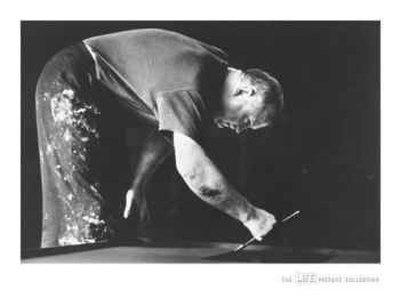
    Harold Rosenberg coined the phrase 'action painting' in 1952 to describe a new relationship between artist and surface. The canvas was no longer a space for representing the world; it became a field for action, a record of physical encounter. Franz Kline's housepainter-scale brushstrokes and Willem de Kooning's slashing gestures treated the act of painting as an event. The finished work preserved that event's energy, speed, and risk. Size mattered: these paintings demanded large canvases because the body needed room to move.

  • Colour as Emotion

    Mark Rothko, Barnett Newman, and Clyfford Still pursued a different path. Their canvases replaced gesture with fields of colour meant to produce direct emotional response. Rothko's stacked rectangles of thinned pigment hover and pulse, their edges soft and breathing. He insisted his paintings were about human feeling, not abstraction. Frankenthaler's soak-stain technique, pouring thinned paint onto unprimed canvas, removed the boundary between paint and surface entirely, producing luminous washes that seemed to emanate from within the cloth.

  • New York Replaces Paris

    Before 1945, the centre of the Western art world was Paris. The war scattered European artists across the globe, and many settled in New York. This concentration of talent, combined with American economic power and institutional support from galleries like Peggy Guggenheim's Art of This Century, shifted the axis of contemporary art westward. By the mid-1950s, American painting was exhibited and discussed in European capitals, reversing decades of cultural traffic. Abstract Expressionism was the vehicle for that shift.

  • Precursors and Continuations

    Hilma af Klint produced large-scale abstract canvases in Stockholm between 1906 and 1915, decades before the New York School. Her spiral forms and spectral colour anticipated the spiritual ambitions of later abstract painting. Frank Bowling extended the movement's legacy from the 1960s onward, pouring acrylic across enormous canvases and incorporating map imagery, Caribbean light, and metallic pigment. These artists complicate the standard narrative of Abstract Expressionism as a purely American, mid-century phenomenon.

Origins

Wartime New York and Émigré Influence

The fall of Paris in 1940 sent a wave of European modernists to New York. Piet Mondrian, Max Ernst, Fernand Léger, André Breton, and others settled in Manhattan, where they exhibited alongside younger American painters. Peggy Guggenheim's Art of This Century gallery, which opened in 1942, showed Surrealist and abstract work side by side and gave early exhibitions to Pollock, Rothko, and others. The Surrealist emphasis on automatism, on letting the unconscious guide the hand, filtered directly into the working methods of the emerging New York School. European rigour met American scale and physical confidence.

The Cedar Bar and Tenth Street

Through the late 1940s and 1950s, the artists who would define Abstract Expressionism gathered in downtown Manhattan. The Cedar Tavern on University Place and the studios of Tenth Street became informal headquarters. The Club, founded in 1949 by a rotating group that included de Kooning, Kline, and the sculptor Philip Pavia, hosted weekly panels and lectures. These gatherings were argumentative and competitive. Aesthetic disagreements were aired publicly, and reputations were made or damaged in a single evening. The social density of this scene, its concentration in a few city blocks, produced a creative intensity that no museum or university programme could have manufactured.

Critical Champions and Institutional Support

The critic Clement Greenberg championed the new painting from the early 1940s, arguing that abstract art represented the logical next stage in modernism's progress toward flatness and medium specificity. Harold Rosenberg offered a competing interpretation, emphasising the existential drama of the act of painting itself. The Museum of Modern Art, under Alfred Barr, acquired key works and organised travelling exhibitions that carried American abstraction to Europe, Latin America, and Asia. By 1958, when MoMA sent The New American Painting on a European tour, Abstract Expressionism was established as the dominant movement in Western art.

In Their Words

“I'm not an abstractionist. I'm interested only in expressing basic human emotions: tragedy, ecstasy, doom.”
Mark Rothko, Lecture at the Pratt Institute, 1958
“There are no rules. That is how art is born, how breakthroughs happen. Go against the rules or ignore the rules.”
Helen Frankenthaler, Interview, Smithsonian Archives of American Art, 1968
“A painting is not a picture of an experience, but is the experience.”
Mark Rothko, The Artist's Reality: Philosophies of Art, published posthumously 2004

All Abstract Expressionism Artists

46 artists.

Recommended Reading

  • Abstract Expressionism

    Abstract Expressionism

    David Anfam · 1990

    The standard survey of the movement, covering both action painting and colour field strands with close attention to individual works.

  • The Triumph of American Painting

    The Triumph of American Painting

    Irving Sandler · 1970

    Early critical history written by a participant-observer who knew the artists personally.

  • Ninth Street Women

    Ninth Street Women

    Mary Gabriel · 2018

    Recovers the careers of Lee Krasner, Elaine de Kooning, Grace Hartigan, Joan Mitchell, and Helen Frankenthaler within the male-dominated New York School.

Frequently Asked Questions

  • What is Abstract Expressionism?
    Abstract Expressionism[4] was the first American art movement to win international standing, running in New York from roughly 1943 to 1965. Its painters abandoned recognisable subject matter in favour of large-scale canvases whose surface marks recorded the physical act of painting itself. The term covers two distinct branches: Action Painting (Pollock, de Kooning, Kline) and Colour Field (Rothko, Newman, Still), unified by shared scale and ambition rather than style.
  • When did Abstract Expressionism start?
    The movement took shape in New York during the Second World War among European émigrés and their American pupils. Jackson Pollock's breakthrough drip paintings appeared in 1947, starting with Cathedral and Full Fathom Five. Mark Rothko settled on the floating-rectangle format by 1949. Clement Greenberg's 1948 essay 'The Crisis of the Easel Picture' identified the movement's break with European tradition. The 1950s were its dominant decade.
  • Who are the most famous Abstract Expressionist artists?
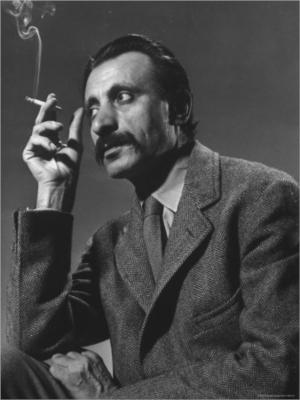
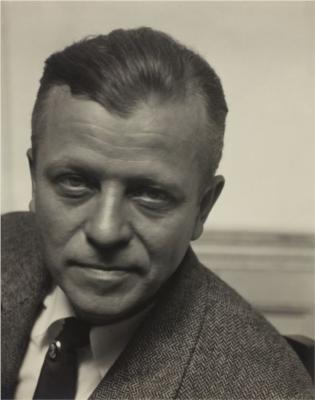
    Jackson Pollock, Willem de Kooning, Mark Rothko, Barnett Newman, Clyfford Still, Franz Kline, Robert Motherwell, Adolph Gottlieb[8] and Arshile Gorky[11] form the core first-generation group. Lee Krasner, Joan Mitchell, Elaine de Kooning and Helen Frankenthaler were central figures of the movement, though their contributions were systematically underplayed at the time. Hans Hofmann taught many of the younger members at his New York school.
  • What defines Abstract Expressionism?
    Abstract Expressionist paintings tend to be large, often scaled to the architecture of a room rather than the easel, and treat the canvas as a field of action rather than a window onto subject matter. Action painters like Pollock and de Kooning emphasise visible gesture and accident. Colour Field painters like Rothko and Newman suppress gesture in favour of flat expanses of colour designed to be experienced at close range.
  • What is the difference between Action Painting and Colour Field?
    Action Painting, a term coined by the critic Harold Rosenberg in 1952, applies to Pollock, de Kooning and Kline, whose paintings record rapid physical gestures, drips and swipes on the canvas. Colour Field applies to Rothko, Newman, Still and, later, Helen Frankenthaler, whose canvases present large simplified zones of saturated colour with suppressed brushwork. The two branches shared scale and ambition, differing in surface method.
  • Why was Abstract Expressionism important?
    Abstract Expressionism[4] moved the international centre of avant-garde painting from Paris to New York, partly on the strength of the work itself and partly on CIA-backed exhibitions touring Europe during the Cold War as evidence of American cultural freedom. It established the scale of the museum-sized canvas as a baseline for ambitious contemporary painting, and its gestural mark making shaped half a century of subsequent abstract work.
  • Where can I see the best Abstract Expressionist paintings?
    The Museum of Modern Art in New York holds the canonical collection, including Pollock's One: Number 31, 1950 and Rothko's Slow Swirl at the Edge of the Sea. The National Gallery of Art in Washington owns Rothko's chapel studies and Pollock's Lavender Mist. Tate Modern in London has the Rothko Seagram murals. The Clyfford Still Museum in Denver holds ninety-five per cent of that artist's output.

Sources

Abstract Expressionism editorial draws on the following published scholarship.

  1. [1] book David Anfam, Abstract Expressionism, 1990 Used for: biography, exhibition history, stylistic analysis, technique.
  2. [2] book Irving Sandler, The Triumph of American Painting, 1970 Used for: biography, stylistic analysis.
  3. [3] book Mary Gabriel, Ninth Street Women, 2018 Used for: biography, stylistic analysis.
  4. [4] wikipedia Wikipedia: Abstract Expressionism Used for: biography.
  5. [5] book Horst Woldemar Janson; Anthony F. Janson, A Basic History of Art_1 Used for: biography.
  6. [6] book The Editors of New York Magazine, The Encyclopedia of New York Used for: biography.
  7. [7] book Beckett, Wendy, The story of painting Used for: biography.
  8. [8] wikipedia Wikipedia: Adolph Gottlieb Used for: biography.
  9. [9] wikipedia Wikipedia: Ellsworth Kelly Used for: biography.
  10. [10] wikipedia Wikipedia: Hilma af Klint Used for: biography.
  11. [11] wikipedia Wikipedia: Arshile Gorky Used for: biography.
  12. [12] wikipedia Wikipedia: Albert Irvin Used for: biography.

Editorial overseen by Solis Prints. Sources verified 2026-05-30. Click a source for details, or hover over [N] in the page above to preview.

See Abstract Expressionism art in person.

Plan your visit to see Abstract Expressionism art →

Take Abstract Expressionism home.

See all Abstract Expressionism prints →
Back to Discover