



Alma Woodsey Thomas
- Abstract Expressionism
- Color Field
- Washington Color School
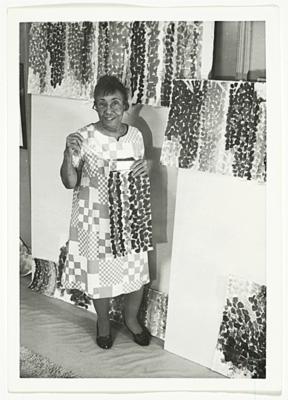
In 1972[1], at the age of eighty, Alma Thomas became the first African-American[1] woman to have a solo exhibition at the Whitney Museum of American Art in New York. The recognition came late; she had spent thirty-five years teaching art at Shaw Junior High School in Washington DC before devoting herself to painting full-time at sixty-nine. She died six years after the Whitney show, leaving behind a body of work that continues to rise in institutional standing.
Biography
Thomas was born in Columbus, Georgia, in 1891[1], and moved north with her family as part of the Great Migration. In 1924[1], she became the first graduate of Howard University's newly formed art department. She later earned a master's degree in education from Columbia University and settled permanently in Washington, where her house on 15th Street served as a studio and a gathering point for artists and intellectuals.
Her mature paintings, made in the 1960s and 1970s, belong loosely to the Colour Field tendency but diverge from peers such as Helen Frankenthaler and Morris Louis in method. Where they poured and stained large expanses of paint, Thomas worked in tight, energetic brushstrokes arranged in concentric arcs and mosaic-like formations that produce considerable optical movement. Many works take their subjects from the parks, traffic circles, and gardens of her neighbourhood: "Iris, Tulips, Jonquils and Crocuses" (1969[1], National Museum of Women in the Arts) and "Starry Night and the Astronauts" (1972, Art Institute of Chicago) both began as observations of specific places in Washington.
Thomas was explicit about the politics of her palette. "Through colour, I have sought to concentrate on beauty and happiness," she said, "rather than on man's inhumanity to man." She made that choice consciously, during the civil rights era, as a form of refusal.
Timeline
- 1891Born in Columbus, Georgia.
- 1924Became the first graduate of Howard University's art department.
- 1960At 69, she devoted herself to painting full-time after retiring from teaching.
- 1969Painted "Iris, Tulips, Jonquils and Crocuses".
- 1972Became the first African-American woman to have a solo exhibition at the Whitney Museum of American Art in New York at 80.
- 1972Painted "Starry Night and the Astronauts".
- 1978Died at 86. Her work continued to rise in institutional standing after her death.
Notable Works
Tap to view larger.
Where to See Alma Woodsey Thomas
1 museum worldwide.
-
 8 works
Art Institute of Chicago
Chicago, United States
Mon 11:00–17:00, Tue closed, Wed 11:00–17:00, Thu 11:00–20:00, Fri–Sun 11:00–17:00 · $32 adults
Next stop
Abstract Expressionism →
Explore the artists and ideas of Abstract Expressionism.
Related Artists


Frequently Asked Questions
What is Alma Woodsey Thomas known for?
Alma Woodsey Thomas is known for her vividly coloured work. Her paintings, such as "Iris, Tulips, Jonquils and Crocuses" and "Starry Night and the Astronauts", correspond with Colour Field paintings. In 1972[1], she became the first African-American[1] woman to have a solo exhibition at the Whitney Museum.What is Alma Woodsey Thomas's most famous work?
It is difficult to name a single "most famous" work by Alma Woodsey Thomas, as popularity can vary. However, several of her paintings from the 1960s are well-documented and frequently exhibited. These include works such as *Turnsole* (1961[1]), *Winter Sun* (1961 and 1962), *Burnt Day* (1961), *New Problem* (1961), *Spring Cool* (1962), *Eyre* (1962), *Target* (1961), *Blue Horizon* (1963), *Dusk* (1963), *East-West* (c. 1963), *Hover* (1963), *Sun Dried: Japanese Space* (1963), and *Trans Flux* (1963). Other notable pieces from the middle of the decade are *And Again* (1964), *Baba Yagga* (1964), *Bend Sinister* (1964), *Half Time* (1964), *Embrown* (1964), *Magenta Haze* (1964), *Sarah's Reach* (1964), *Prime Course* (1964), *Summertime* (1964), *17th Stage* (1964), *3-64* (1964), and *Trans Shift* (1964). These paintings demonstrate her use of colour and abstract composition.What should I know about Alma Woodsey Thomas's prints?
Alma Woodsey Thomas (1891[1]-1978[1]) was an African-American[1] expressionist painter and art educator. She is known for her colourful, abstract paintings inspired by nature. Although Thomas is best known for her paintings, prints of her work are available. These prints allow a wider audience to engage with her distinctive style. Her prints often replicate the mosaic-like compositions and the use of colour seen in her original paintings. Thomas's mature style emerged after her retirement from teaching in 1960[1]. She then began to produce abstract works that reflected her observations of the natural world, particularly the light and colour in her garden. Her paintings from the 1960s onward often feature tessellated strokes of colour arranged in concentric circles or radiating patterns. These patterns evoke the shapes of flowers, trees, and sunlight. Prints capture these qualities, offering an accessible way to experience Thomas's unique artistic vision. When acquiring a print, collectors should check for authentication and provenance information.What style or movement did Alma Woodsey Thomas belong to?
Alma Woodsey Thomas (1891[1]-1978[1]) is identified with Colour Field painters. This movement emerged in the late 1940s and early 1950s among New York School painters. They moved away from Action Painting, choosing instead to focus on expanses or 'fields' of colour. Colour Field paintings were invariably abstract and often very large, almost mural-sized. Thomas lived, taught, and painted in Washington, DC, from 1921[1]. In 1972, she became the first African-American[1] woman to have a solo exhibition at the Whitney Museum in New York. Thomas's work shares similarities with Colour Field painting, conveying emotion through colour and shape. However, she diverged from other Colour Field artists by hinting at elements of the real world. She concentrated on flowers and plants in Washington's parks and gardens. Examples include *Iris, Tulips, Jonquils and Crocuses* (1969) and *Elysian Fields* (1973).What techniques or materials did Alma Woodsey Thomas use?
Alma Woodsey Thomas is best known for her paintings from the 1960s onwards. She worked primarily in acrylic on canvas. Her mature style features blocks and strokes of colour arranged in mosaic-like patterns. Thomas's approach to painting involved careful planning. She created watercolour studies before working on larger canvases. These studies allowed her to experiment with colour combinations and compositions. She thinned her acrylic paints to achieve a watercolour-like effect. This technique allowed the white of the canvas to show through, creating luminosity. Thomas's distinctive style emerged after her retirement from teaching in 1960[1]. She was interested in colour theory and the effects of light and atmosphere. Her paintings often evoke natural phenomena, such as flowers, gardens, and atmospheric conditions. She was influenced by the Washington Color School[1], a group of abstract painters working in Washington, D.C., during the 1950s, 1960s, and 1970s. This movement favoured large-scale abstract works with simplified forms and intense colours.What was Alma Woodsey Thomas known for?
Alma Woodsey Thomas (1891[1]-1978[1]) was an American[1] artist known for her association with Colour Field painting. She spent most of her career painting in Washington, DC, and became identified with the movement. Thomas was the first African-American woman to have a solo exhibition at the Whitney Museum in New York in 1972[1]. In 1924, she was the first graduate of Howard University’s newly formed art department. Later, she obtained an MA in education from Columbia University. Her work often hinted at elements of the real world, setting her apart from other Colour Field artists. Thomas concentrated on flowers and plants in the city’s parks and gardens, such as those in *Iris, Tulips, Jonquils and Crocuses*, 1969, and *Elysian Fields*, 1973. She created imaginary panoramas viewed from above, alluding to reality without direct depiction. While other Colour Field painters minimised their personal involvement, Thomas applied energetic, irregular brushstrokes, creating uneven shapes in her radiating compositions. Thomas stated that, "Through colour, I have sought to concentrate on beauty and happiness, rather than on man’s inhumanity to man.When did Alma Woodsey Thomas live and work?
Alma Woodsey Thomas (1891[1]-1978[1]) was an African-American[1] expressionist painter and art educator. She spent her career in Washington, D.C. Born in Columbus, Georgia, Thomas moved to Washington with her family in 1907[1] to escape racial violence in the South. She graduated from Armstrong Manual Training School in 1911 and began studying kindergarten education at Miner Normal School (now University of the District of Columbia). Thomas taught kindergarten in the D.C. public school system from 1917 until 1925. In 1924, she graduated from Howard University with a degree in fine arts, the first student in that programme. At Howard, she was encouraged by James V. Herring and Lois Mailou Jones. Thomas continued to teach art at Shaw Junior High School from 1925 until her retirement in 1960. During this period, she also earned a master's degree in art education from Columbia University in 1934 and studied painting at American University from 1950 to 1960. After retiring from teaching, Thomas devoted herself to painting full-time. Her mature style, characterised by colourful, abstract compositions, emerged in the 1960s. In 1972, at the age of 80, she was the first African-American woman to have a solo exhibition at the Whitney Museum of American Art in New York. Thomas continued to paint and exhibit her work until her death in 1978.Where can I see Alma Woodsey Thomas's work?
You can find works by Alma Woodsey Thomas in several prominent museums. In New York City, The Metropolitan Museum of Art and the Museum of Modern Art (MoMA) hold examples of her output. Other American[1] museums with her pieces include the Los Angeles County Museum of Art (LACMA); the Minneapolis Institute of Arts; the Virginia Museum of Fine Arts in Richmond; the Charles Hosmer Morse Museum of American Art in Winter Park, Florida; the Yale University Art Gallery in New Haven; the National Gallery of Art, and the Hirshhorn Museum, in Washington, D.C. Outside the United States, the Art Gallery of Ontario in Toronto also has works by Thomas. These institutions offer the opportunity to view her paintings and appreciate her contribution to American art.Where was Alma Woodsey Thomas from?
Alma Woodsey Thomas was born in Columbus, Georgia, on 22 September 1891[1]. Her family moved north in 1907[1], as part of the Great Migration, seeking to escape the racial segregation of the Jim Crow South. They settled in Washington, D.C., where Thomas lived for the rest of her life. Thomas's childhood home in Columbus was a simple wood-frame house on a large plot of land. This allowed her to observe the colours and patterns of nature from a young age. The family's move to Washington, D.C., exposed her to a more diverse cultural environment, with museums and galleries that further stimulated her artistic interests. She attended Armstrong Manual Training School, where she studied costume design and illustration. Later, she enrolled at Howard University, becoming the first graduate of its fine arts programme in 1924. After graduating, Thomas taught art at Shaw Junior High School for 35 years, while continuing to develop her own artwork. She did not become a full-time professional artist until her retirement in 1960.Who did Alma Woodsey Thomas influence?
Alma Woodsey Thomas (1891[1]-1978[1]) is associated with Colour Field painters, and her paintings correspond with that movement's aims of conveying emotion through colour and shape. Thomas's paintings often hint at elements of the real world, such as flowers and plants in Washington, D.C. parks and gardens; examples include *Iris, Tulips, Jonquils and Crocuses* (1969[1]) and *Elysian Fields* (1973). Thomas diverged from other Colour Field artists by applying energetic, irregular brushstrokes, creating uneven shapes. Thomas's legacy can be seen in the work of William T. Williams (born 1942). Williams belongs to the generation of African American[1] artists born around 1940; they brought black painting and sculpture to artistic maturity. After a period of self-scrutiny, Williams developed a sophisticated technique, seen in *Batman* (1979). His method has been compared to jazz improvisation. Although Williams is concerned primarily with formal issues, the play of colour and abstract shapes evokes the patterns, light, and space of nature.Who influenced Alma Woodsey Thomas?
Alma Woodsey Thomas (the first graduate of Howard University’s art department in 1924[1]) lived, taught, and painted in Washington, DC from 1921. She is identified with Colour Field painters. Thomas also obtained an MA in education from Columbia University. Modernist colour theory, and the work of Josef Albers and Ilya Bolotowsky, were influential at Black Mountain College. Bolotowsky, a charter member of the American[1] Abstract Artists group (founded in 1936), introduced artists to the expressive possibilities of colour. He conveyed the influence of Piet Mondrian, who used colour and space to communicate feeling without reference to the outside world. In the 1940s, some artists were influenced by Henri Matisse, a colourist. By 1950, the New York School, including Pollock, de Kooning, and Rothko, had become mentors for some. Arshile Gorky's work was also important at this time. Some were moved by Louis's Veils and Unfurleds and Noland's targets and chevrons in the later 1950s and early 1960s. Lois Mailou Jones (who formed the art department at the Palmer Memorial Institute in 1928) taught design and watercolour painting at Howard University from 1930. She mentored thousands of students for nearly fifty years.Who was Alma Woodsey Thomas?
Alma Woodsey Thomas (1891[1]-1978[1]) was an American[1] artist associated with the Colour Field style. She spent most of her career painting in and near Washington DC, focusing on flowers and plants in the city’s parks and gardens. Thomas's paintings often hint at elements of the real world. She created imaginary panoramas viewed from above, alluding to reality without trying to depict it directly. Unlike some Colour Field painters who minimised their personal involvement, Thomas applied energetic, irregular brushstrokes, creating uneven shapes. Examples of her work include *Iris, Tulips, Jonquils and Crocuses* (1969[1]) and *Elysian Fields* (1973). In 1924, Thomas was the first graduate of Howard University’s newly formed art department. She later obtained an MA in education from Columbia University. Thomas became the first African-American woman to have a solo exhibition at the Whitney Museum in New York in 1972. As a black woman artist, Thomas encountered obstacles during her career. However, she believed that the creative spirit is independent of race or gender and concentrated on beauty and happiness in her art. One of her works is *Starry Night and the Astronauts* (1972).
Sources
Editorial draws on the following primary and tertiary references for Alma Woodsey Thomas.
- [1] wikipedia Wikipedia: Alma Woodsey Thomas Used for: biography, birth dates, death dates, identifiers, movement attribution, nationality.
- [2] book 20210601artandantiques Used for: stylistic analysis.
- [3] book Dorling Kindersley, Artists: Inspiring Stories of the World's Most Creative Minds Used for: biography.
- [4] book guggenheim-museum00solo Used for: biography.
- [5] book Massey, Anne,Seago, Alex, Pop Art and Design Used for: biography.
- [6] book Norma Broude, The Expanding Discourse Used for: stylistic analysis.
- [7] book Hodge, Susie, 1960- author, The short story of women artists : a pocket guide to movements, works, breakthroughs, & themes Used for: biography, stylistic analysis.
Editorial overseen by Solis Prints. Sources verified 2026-09-27. Click a source for details, or hover over [N] in the page above to preview.
Editorial standardsMethodologyCorrectionsAI disclosureAbout the editorial team