



Edward Corbett
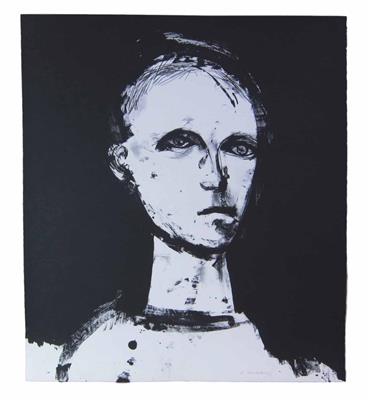
Edward Corbett once described his intentions simply: 'I intend my work as poetry.' That statement captures something real about his painting, which occupies an unusually contemplative corner of American[1] Abstract Expressionism[1]. His canvases are quiet, often near-monochrome, built through layered washes that suggest depth rather than declare it.
Biography
Born in Chicago in 1919[1], Corbett studied at the California School of Fine Arts in San Francisco, where he subsequently taught alongside Richard Diebenkorn, Mark Rothko, and Clyfford Still. His period on the West Coast shaped his sensibility: the San Francisco school's engagement with light and atmosphere left a lasting imprint on his practice, particularly in the austere 'black paintings' he produced there.
By 1952[1] he had moved to New York and been included in MoMA's '15 Americans' exhibition, one of the most selective surveys of emerging abstraction of its generation. Grace Borgenicht Gallery represented him from that year. He later taught at Mount Holyoke, the University of New Mexico, and Tulane. One of his paintings, 'Washington, D.C. November 1963 III', was borrowed from the National Gallery of Art for display in the White House during Barack Obama's presidency. Corbett died in Provincetown, Massachusetts, in June 1971[1], aged 51.
Timeline
- 1919Born in Chicago.
- 1952Moved to New York.
- 1952Included in MoMA's '15 Americans' exhibition.
- 1952Began to be represented by Grace Borgenicht Gallery.
- 1963Painted 'Washington, D.C. November 1963 III'.
- 1971Died in Provincetown, Massachusetts, in June, aged 51.
Notable Works
Tap to view larger.
Next stop
Abstract Expressionism →
Explore the artists and ideas of Abstract Expressionism.
Related Artists


Frequently Asked Questions
What should I know about Edward Corbett's prints?
When considering Edward Corbett's prints, it is useful to understand some basic printmaking conventions. Printmakers often create limited editions, declaring the edition size in pencil, usually on the bottom margin of the print. This declaration typically includes a print number and the total edition number (for example, 12/25, meaning the 12th print in an edition of 25). The title is written in the centre, and the artist's signature appears on the right. The concept of a limited edition signifies that the artist has decided to restrict the number of prints made. Each print in the edition is considered an original, produced from a plate, stone, screen, or block created specifically for that purpose. The artist, or someone working under their direction, individually inks and pulls each print. The Professional Art Dealers Association of Canada defines an original print as an image conceived and executed solely as a print, usually in a numbered edition and signed by the artist.What style or movement did Edward Corbett belong to?
Edward Corbett (1919[1]-1971[1]) is associated with Abstract Expressionism[1], although his work displays individual characteristics that set him apart. He developed a personal visual language within that broad movement. After serving in the military during the Second World War, Corbett studied at the California School of Fine Arts (now the San Francisco Art Institute) under Mark Rothko, Clyfford Still, and Ad Reinhardt. These instructors were influential figures in Abstract Expressionism, and their guidance shaped Corbett's early artistic development. Corbett's mature style involved simplified forms and muted colour palettes. His paintings often feature geometric shapes and subtle gradations of tone. These elements create a sense of quiet contemplation, distinguishing his work from the more gestural styles of some Abstract Expressionists. While sharing certain aesthetic concerns with his peers, Corbett forged his own path, producing a body of work that is both related to and distinct from the mainstream of Abstract Expressionism.What was Edward Corbett known for?
Edward Corbett (1919[1]-1971[1]) was an American[1] abstract expressionist painter, associated with the second generation of the New York School. He is best known for his minimalist compositions and personal symbolism. Born in Chicago, Corbett studied at the California School of Fine Arts in San Francisco during the late 1940s. There, he was influenced by artists such as Clyfford Still, Mark Rothko, and Ad Reinhardt. These artists favoured large-scale abstraction and simplified forms. Corbett's mature style emerged in the 1950s. It featured spare arrangements of geometric shapes and lines, often in muted colours. These works evoke a sense of quiet contemplation. Corbett's paintings are characterised by their reductive aesthetic. He sought to express essential forms and emotions through a carefully controlled vocabulary of shapes and colours. Although abstract, his work often suggests architectural or figurative elements. This invites viewers to find their own interpretations. Throughout his career, Corbett exhibited at galleries, including the Betty Parsons Gallery in New York. His work can be found in museum collections in the United States.Where can I see Edward Corbett's work?
Edward Corbett's paintings are held in several public collections in the United States. These include the Blanton Museum of Art (Austin, Texas), the Smithsonian American[1] Art Museum (Washington, DC), and the Whitney Museum of American Art (New York). Corbett's mature style emerged in the late 1940s, after he moved away from representational subject matter. His work from this period is characterised by simplified forms and muted colour. He developed a personal vocabulary of shapes, including bars, rectangles, and crosses. These elements recur throughout his paintings. Although Corbett lived for many years in New York City, he also spent time in Europe. He studied at the Académie Julian in Paris during the 1930s. Later, in the 1950s, he lived and worked in Venice for a period. The influence of these experiences can be seen in his work, which often evokes a sense of place and atmosphere. His paintings are not literal depictions; instead, they suggest a feeling or memory.Who did Edward Corbett influence?
It is difficult to say with certainty who Edward Corbett influenced directly. Some scholars suggest that Abstract Expressionist painters such as Clyfford Still indirectly influenced how later generations viewed Impressionist painters like Claude Monet. According to this theory, influence is not simply a matter of direct visual inspiration; later artists' work can reframe how we understand earlier art. Willem de Kooning claimed Courbet as a point of reference and confirmed that seeing works of art in person is important for dialogues between living artists and the art of the past. Pre-Raphaelite art influenced the Aesthetic Movement, including James Whistler and Aubrey Beardsley. The later Pre-Raphaelite paintings influenced the Symbolist movement. Burne-Jones's work was admired by Joséphin Péladan, who invited him to participate in the Symbolist exhibitions of the Salon de la Rose + Croix in Paris, but Burne-Jones declined. Rossetti's portraits of women influenced the Symbolists with their flat pictorial spaces and saturated colour. Burne-Jones's languid, serpentine line may have influenced the Art Nouveau aesthetic in the 1890s.Who was Edward Corbett?
Edward Corbett (1919[1]-1971[1]) was an American[1] abstract expressionist painter and educator. Born in Chicago, he is best known for his minimalist compositions that explore subtle variations in colour and form. Corbett studied at the California School of Fine Arts (now the San Francisco Art Institute) during the late 1940s. There, he was influenced by artists such as Clyfford Still, Mark Rothko, and Ad Reinhardt. These figures helped shape his move toward abstraction. Corbett's work moved away from representational imagery, focusing instead on the expressive potential of colour and simple geometric shapes. In the 1950s, Corbett taught at various institutions, including the University of Washington and Yale University. He later settled in Paris, where he continued to paint and exhibit his work. His paintings often feature muted tones and carefully balanced compositions, creating a sense of quiet contemplation. Corbett's artistic output, while not as widely recognised as some of his contemporaries, is appreciated for its refined aesthetic and thoughtful exploration of abstract principles. He died relatively young, at age 52, in 1971[1].Why are Edward Corbett's works important today?
Edward Corbett (1919[1]-1971[1]) was an American[1] abstract expressionist painter. He is associated with the second generation of abstract expressionists. Abstract expressionism, which emerged in the United States after the Second World War, moved away from traditional representational art. Instead, it focused on non-objective forms to convey emotion and ideas. Corbett's work fits into this movement, although his style is distinct. Corbett's paintings often feature simplified shapes and a limited colour palette. These elements create a sense of quiet contemplation. His work provides a visual experience that invites introspection. Interest in Corbett's work has grown since his death. His paintings are now held in major museum collections. They offer insight into a period of artistic change. His work is a reminder of the diverse approaches within abstract expressionism.What was Edward Corbett's art style?
Edward Corbett's art style is Abstract Expressionism[1]. His canvases are often near-monochrome, built through layered washes that suggest depth.How did Edward Corbett die?
Edward Corbett died in 1971[1] at the age of 52.
Sources
Editorial draws on the following primary and tertiary references for Edward Corbett.
- [1] wikipedia Wikipedia: Edward Corbett Used for: biography, birth dates, death dates, identifiers, movement attribution, nationality.
- [2] book Beard, Lee, 1973- author, Butler, Adam, author; Van Cleave, Claire, author; Fortenberry, Diane, author; Stirling, Susan, author, Beard, Lee, 1973- author, Butler, Adam, author; Van Cleave, Claire, author; Fortenberry, Diane, author; Stirling, Susan, author - The Art Book_ New Edition, Mini Format Used for: biography.
- [3] book guggenheim-guggenheimintern1960sven Used for: biography.
- [4] book guggenheim-youngereuropeanp00swee Used for: biography.
- [5] book Palmer, Allison Lee, Historical Dictionary of Neoclassical Art and Architecture Used for: biography.
- [6] book Allison Lee Palmer, Historical Dictionary of Neoclassical Art and Architecture Used for: biography.
- [7] book Jennifer D. Milam, Historical Dictionary of Rococo Art Used for: biography.
Editorial overseen by Solis Prints. Sources verified 2026-10-15. Click a source for details, or hover over [N] in the page above to preview.
Editorial standardsMethodologyCorrectionsAI disclosureAbout the editorial team