



Charles Alston
- Abstract Expressionism
- Harlem Renaissance
The first mural painted by a Black artist in a New York City public building was completed in 1936[1] by Charles Alston. The commission at Harlem Hospital had not come easily: administrators initially rejected Alston's designs incorporating African motifs and African-American[1] doctors and nurses, preferring images that erased Black identity from the narrative of medicine. Alston held firm, and the two completed panels, "Magic in Medicine" and "Modern Medicine", became foundational works in the history of American mural art.
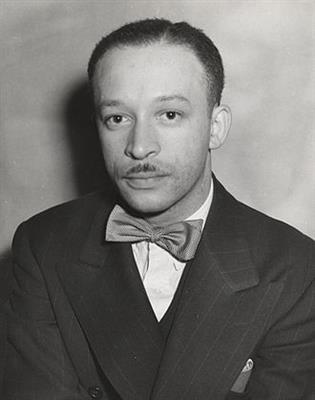
Biography
Born in Charlotte, North Carolina in 1907[1], Alston moved to New York after his father's death, earning a BA from Columbia University in 1929[1] and an MA from Teachers College in 1931. In Harlem during the 1930s, he ran the studio at 306 West 141st Street known as "306", a gathering point for artists, writers, and musicians at the edge of the Harlem Renaissance[1]. His 1935 appointment as the first African-American[1] supervisor for the WPA Federal Art Project gave him institutional reach, but his lasting contribution to younger artists came through his teaching: the first Black instructor at the Art Students League in 1950, and the first at MoMA in 1956.
Alston's painting moved from figural realism through modernism toward abstraction. "Walking" (1958[1]), made in response to the Montgomery bus boycott, shows compressed, striding forms in which movement carries political weight without slipping into illustration.
In 1970[1] he completed a bronze bust of Martin Luther King Jr. that the White House acquired, making it the first work by a Black artist displayed there. He co-founded Spiral in 1963, a collective of Black artists that included his cousin Romare Bearden. He died in New York in April 1977[1].
Timeline
- 1907Born in Charlotte, North Carolina.
- 1929Earned a BA from Columbia University, New York.
- 1931Received an MA from Teachers College, New York.
- 1935Appointed as the first African-American supervisor for the WPA Federal Art Project.
- 1936Completed murals "Magic in Medicine" and "Modern Medicine" at Harlem Hospital, New York.
- 1950Became the first Black instructor at the Art Students League.
- 1956Became the first Black instructor at MoMA.
- 1958Painted "Walking" in response to the Montgomery bus boycott.
- 1963Co-founded Spiral, a collective of Black artists, with Romare Bearden and others.
- 1970Completed a bronze bust of Martin Luther King Jr., acquired by the White House.
- 1977Died in New York in April, at 70.
Notable Works
Tap to view larger.
Next stop
Abstract Expressionism →
Explore the artists and ideas of Abstract Expressionism.
Related Artists


Frequently Asked Questions
What is Charles Alston known for?
Charles Alston is known for completing the first mural painted by a Black artist in a New York City public building. He is also recognised for his work "Walking" (1958[1]), responding to the Montgomery bus boycott, and for his bronze bust of Martin Luther King Jr.What is Charles Alston's most famous work?
Charles Alston was an American[1] painter, sculptor, muralist, and teacher who explored themes of identity, social justice, and cultural heritage. While he produced a range of accomplished works, it is difficult to identify a single, universally recognised 'most famous' piece. Alston's mural *Aspects of Negro Life* (1934[1]) at the Harlem branch of the New York Public Library is among his best-known creations. The series comprises four panels that depict different facets of African-American history and culture, from African origins to the challenges and triumphs of the Reconstruction era. The murals incorporate influences from Synthetic Cubism and African art, reflecting the spirit of the Harlem Renaissance[1]. Alston's work often engaged with social and political issues, and he played an important role in the Civil Rights Movement. He mentored young artists and advocated for greater representation of African-American artists in the mainstream art world.What should I know about Charles Alston's prints?
When considering Charles Alston's prints, bear in mind some basic print terminology. An "original print" is made by the artist or under their supervision. The image is created specifically to be a print, with the artist working directly on the plate, block, stone, or screen. Each print is considered an original, especially those sold in limited editions. The plates for original prints are made by hand, and can only withstand a certain amount of use; the number of prints pulled is therefore limited. Some publishers set their own limits to increase a print’s value. These limits may be set as high as 700 to 1,000 impressions, but some prints are limited to between 250 and 500. Offset reproductions, also known as posters and image prints, are reproduced by photochemical means. The plates do not wear out, so there are no physical limits on the number of prints made. Quantities may still be limited by the publisher to add value.What style or movement did Charles Alston belong to?
Charles Alston (1907[1]-1977[1]) worked in several styles, and he resisted easy categorisation. He engaged with American[1] modernism early in his career, and later with social realism. Alston's work often explored themes of Black identity and social justice. During the Harlem Renaissance[1], he created illustrations for literary magazines such as *Opportunity: A Journal of Negro Life* and *The Crisis*. These publications promoted African-American art and literature. His early paintings from this period show the influence of artists such as Henri Matisse and Pablo Picasso. In the 1950s, Alston embraced abstract expressionism, although he maintained some figurative elements. He co-founded Spiral, a group of Black artists who debated the role of art in the Civil Rights Movement. Some members advocated for explicitly political art, while others, like Alston, preferred a more subtle approach. Alston's work from this period includes both abstract and figurative pieces, often addressing themes of race and identity in a more symbolic way. He also completed murals for public buildings, such as the Golden State Mutual Life Insurance Building in Los Angeles.What was Charles Alston known for?
Charles Alston (1907[1]-1977[1]) was an American[1] painter, sculptor, muralist, and teacher. He worked in several styles, including figurative representation and geometric abstraction. Alston's early work included illustrations for magazines such as *Opportunity* and *The Crisis*, publications associated with the Harlem Renaissance[1]. During the 1930s, he created murals for the Harlem Hospital, under the auspices of the Works Progress Administration (WPA). These murals depicted scenes of African-American life and labour. He was a member of the Harlem Artists Guild and later became the first African-American supervisor for the WPA's Federal Art Project. In 1950[1], he was the first African-American instructor at the Museum of Modern Art. Alston explored civil rights themes in his art. His painting *Walking* (1958) is an example of his social commentary. In 1963, he co-founded Spiral, a group of African-American artists who discussed the role of art in the Civil Rights movement. Spiral organised a 1965 exhibition of black and white works commenting on racial issues. He also created the bust of Martin Luther King, Jr., which is displayed in the White House.When did Charles Alston live and work?
Charles Alston was born in Charlotte, North Carolina, in 1907[1]. He died in 1977[1]. He is known as a painter, sculptor, muralist, and teacher who worked in New York City for much of his career. Alston studied art at Columbia University in the 1930s. During the Depression, he created murals for the WPA's Federal Art Project. These murals can still be seen at Harlem Hospital. He was the first African-American[1] supervisor for the WPA. Alston also taught at the Harlem Community Art Center, where Jacob Lawrence was among his students. In 1950[1], he was the first African-American instructor at the Museum of Modern Art. He was also a member of Spiral, a group of black artists who met to discuss the role of art in the Civil Rights movement.Where can I see Charles Alston's work?
Charles Alston's artwork can be viewed in several public collections. His paintings are held by institutions across the United States. The Metropolitan Museum of Art in New York City holds his 1958[1] painting *Family Group*. The Whitney Museum of American[1] Art, also in New York, has Alston's 1950 oil on canvas, *Girl in a Red Dress*. Other institutions with his works include the Detroit Institute of Arts, which holds *Blues Singer*, and the Smithsonian American Art Museum in Washington, D.C. Alston's sculpture *Bust of a Boy* is in the collection of the National Portrait Gallery, also in Washington. These collections provide opportunities to study the range of Alston's artistic output, from his paintings to his sculptural work.Where was Charles Alston from?
Charles Alston was a significant figure in 20th-century American[1] art. Aaron Douglas, who settled in Harlem, New York City, in 1924[1], became a leading artist in the African American community. Douglas's work was influenced by European modernism and African art. He secured a commission from the U.S. government's Federal Arts Project during the Great Depression to create a series of four murals, titled *Aspects of Negro Life*, for the 135th Street branch of the New York Public Library. These murals aimed to depict the roots of the "New Negro" in Africa and document the African American experience in the United States. Douglas's style combined Synthetic Cubism with inspiration from African art, resulting in a unique fusion of European and African artistic elements.Who did Charles Alston influence?
Charles Alston's artistic influence can be seen in the work of William T. Williams (born 1942[1]). Williams belongs to the generation of African American[1] artists born around 1940. This generation brought black painting and sculpture to artistic maturity. After World War II, black artists attended art schools in growing numbers, coinciding with the rise of Abstract Expressionism[1]. The civil rights movement further aided black artists in establishing their artistic identities and discovering suitable styles for expression. The assassinations of Malcolm X in 1965 and Martin Luther King, Jr., in 1968, spurred a surge in African American art. Williams developed a sophisticated technique comparable to jazz improvisation. His method involves interweaving colour and brushwork within a clear two-part structure, allowing for variations on a central theme. While Williams primarily addresses formal issues, his play of colour and abstract shapes evokes patterns, light, and space in nature.Who influenced Charles Alston?
Charles Alston was exposed to a range of artistic ideas and individuals. Hale Woodruff's interest in African art was sparked in the early 1920s, after encountering Carl Einstein's book, *African Sculpture*. Conversations with Alain Locke, an important promoter during the Harlem Renaissance[1], further deepened Woodruff's appreciation for the art of African ancestors. Jacob Lawrence, who moved to Harlem around 1927[1], was inspired by African art and African American[1] history through lectures, exhibitions, and special programmes at the 135th Street New York Public Library. He was also inspired by the politically oriented art of Goya, Daumier, and Orozco. Lawrence was influenced by Harlem Renaissance artists and writers, including Aaron Douglas. Some artists digested the influence of Pollock, Gorky, and de Kooning. Gorky's 1951 exhibition impressed some viewers enormously. Some were moved and intrigued by Louis's Veils and Unfurleds, and Noland's targets and chevrons. Mondrian's influence was conveyed; his formulation of colour relations arising from a division of space communicated feeling.Who was Charles Alston?
Charles Alston (1907[1]-1977[1]) was an American[1] painter, sculptor, muralist, and teacher. He was born in Charlotte, North Carolina, and moved to New York City in 1913[1]. He obtained a master's degree from Columbia University in 1931. Alston's early work from the 1930s was social realist in style, often depicting scenes of Harlem life. During this period, he executed murals for the Harlem Hospital and the Golden State Mutual Life Insurance Building. He also worked as a Works Progress Administration artist. He was a mentor to many younger artists, including Jacob Lawrence and Romare Bearden. Alston's teaching career included positions at the Harlem Art Workshop, the City College of New York, and Teachers College, Columbia University. He co-founded the Spiral Group in 1963, a collective of Black artists who addressed issues of race and representation in their work. In later decades, Alston's style shifted towards abstraction, though he continued to engage with social and political themes. His work is held in the collections of the Metropolitan Museum of Art, the Whitney Museum of American Art, and other major institutions.Why are Charles Alston's works important today?
Charles Alston (1907[1]-1977[1]) was active during a time when American[1] artists were increasingly exposed to European modernism, and when African American artists were emerging as significant contributors to art history. Alston’s work is important because of his engagement with the representation of Black identity and experience. His work provides insight into the artistic and intellectual concerns of the Harlem Renaissance[1], and later, the Civil Rights era. Like Aaron Douglas, Alston explored African and African American history in his art. Alston's work provides a view into the cross-cultural formations of modernity. Current scholarship continues to investigate the artistic contributions of African American artists, and Alston's place within this history. His paintings and sculptures contribute to a broader understanding of American art and culture.
Sources
Editorial draws on the following primary and tertiary references for Charles Alston.
- [1] wikipedia Wikipedia: Charles Alston Used for: biography, birth dates, death dates, identifiers, movement attribution, nationality.
- [2] book Susie Hodge, Artists and Their Pets Used for: biography.
- [3] book Fred S. Kleiner, Gardner's Art through the Ages Used for: stylistic analysis.
- [4] book Getty, Getty - Claiming the Stones Naming the Bones Used for: biography.
- [5] book Penelope J.E. Davies, Walter B. Denny, Frima Fox Hofrichter, Joseph Jacobs, Ann S. Roberts, David L. Simon, Janson's History of Art_ The Western Tradition (8th Edition) Used for: stylistic analysis.
- [6] book Fred S. Kleiner, Helen Gardner, Kleiner & Mamiya, Gardner's Art through the Ages, Western Perspective, 16th edition, Vol. 2, Harcourt Brace Jovanovich, Used for: biography.
- [7] book Untitled Used for: biography.
Editorial overseen by Solis Prints. Sources verified 2026-10-15. Click a source for details, or hover over [N] in the page above to preview.
Editorial standardsMethodologyCorrectionsAI disclosureAbout the editorial team