

.jpg!Portrait.jpg)
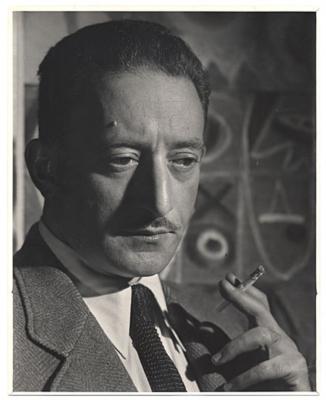
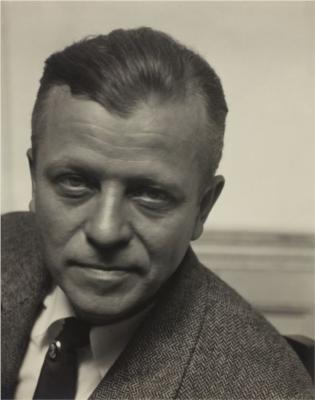
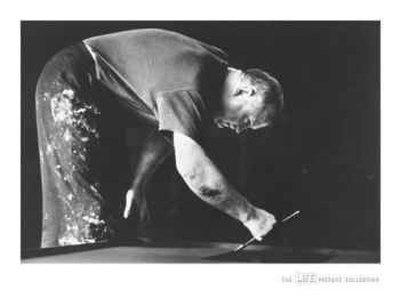
Conrad Marca-Relli
Conrad Marca-Relli spent the first half of his career finding his footing and the second half proving that collage could be as rigorous as painting. Born in Boston in 1913[1], he studied at Cooper Union and spent the late 1930s working on the WPA Federal Art Project, where he met Willem de Kooning and Franz Kline. Those friendships pulled him into the orbit of Abstract Expressionism[1], though his contribution to the movement would be technically distinct from almost everyone else's.
Biography
The breakthrough came in 1953[1] when he began cutting and layering pieces of canvas into interlocking compositions. Where other artists in the group worked with gesture and drip, Marca-Relli worked with shape and edge. The resulting surfaces had the physicality of painting with the precision of construction: interlocking cut forms that implied figures without depicting them. Works like *The Battle* (1956) and *Ajax* (1956) from this period demonstrate the method at its most ambitious, their strongly horizontal compositions evoking bodies in motion without a single representational line.
Recognition came quickly. He participated in the Venice Biennale in 1956[1], earned visiting critic roles at Yale and UC Berkeley, and in 1967 received a retrospective at the Whitney Museum of American[1] Art. His work entered the collections of MoMA, the Metropolitan Museum, and the Guggenheim. He was elected to the American Academy and Institute of Arts and Letters in 1976.
In his later years Marca-Relli simplified his vocabulary further, moving toward geometric rectangular forms in dark palettes. He divided his time between the United States and Italy, dying in Parma in 2000[1].
Timeline
- 1913Born in Boston.
- 1930Studied at Cooper Union.
- 1937Worked on the WPA Federal Art Project, where he met Willem de Kooning and Franz Kline.
- 1953Began cutting and layering pieces of canvas into interlocking compositions.
- 1956Participated in the Venice Biennale.
- 1956Created "The Battle" and "Ajax".
- 1967Received a retrospective at the Whitney Museum of American Art.
- 1976Elected to the American Academy and Institute of Arts and Letters.
- 2000Died in Parma, Italy, at 87.
Notable Works
Tap to view larger.
Next stop
Abstract Expressionism →
Explore the artists and ideas of Abstract Expressionism.
Related Artists



Frequently Asked Questions
What is Conrad Marca-Relli known for?
Conrad Marca-Relli is known for his collage work using canvas. He cut and layered pieces of canvas into interlocking compositions, creating surfaces with the physicality of painting and the precision of construction.What is Conrad Marca-Relli's most famous work?
Conrad Marca-Relli is best known for his large-scale collage paintings. He developed this technique in the early 1950s. Using canvas fragments as his medium, he created textured, abstract compositions. Although no single work overshadows his entire output, certain pieces are particularly significant. "The Battle" (1956[1]), now held by the Whitney Museum of American[1] Art, is a noted example of his collage style. The Solomon R. Guggenheim Museum holds "Composition" (1953), another important early collage. These works show his move towards increasingly large and complex arrangements of shapes. Marca-Relli's method involved affixing canvas pieces to a larger canvas support. He then painted over some areas, integrating the various components. This gave his work a sculptural quality; it blurred the lines between painting and relief sculpture. His collages often suggest architectural forms or human figures, though they remain abstract. He explored themes of conflict and construction throughout his career.What should I know about Conrad Marca-Relli's prints?
Conrad Marca-Relli (born 1913[1]) was associated with Abstract Expressionism[1]. He began exhibiting in New York in 1941[1], but his career was interrupted by military service until 1945. In 1948-49, he spent a year in Rome and Paris. Upon his return to New York, he became a founding member of The Club, an informal group of Abstract Expressionists. He studied ancient and Renaissance art and architecture in Rome in 1951-52. M Marca-Relli is known for his use of collage to create pictorial effects using colour, texture, and depth. From 1960 to 1967 he made annual trips to Europe. The Whitney Museum of American[1] Art, New York, gave him a retrospective in 1967. Marca-Relli moved to Ibiza, Spain, in 1973, and was elected a member of the American Academy and Institute of Arts and Letters in 1976. Marca-Relli is well aware of the collage tradition, as seen in the works of Picasso, Braque, Motherwell and Rauschenberg.What style or movement did Conrad Marca-Relli belong to?
Conrad Marca-Relli is generally associated with Abstract Expressionism[1], a movement that gained momentum in New York City after the Second World War. This style is characterised by non-representational imagery and an emphasis on conveying the artist's inner state or emotions. Within Abstract Expressionism, there were two main tendencies: gestural abstraction and chromatic abstraction. While some artists focused on the energetic application of paint, others explored the emotional resonance of colour. Marca-Relli's work aligns more closely with gestural abstraction due to his use of bold, expressive brushstrokes and dynamic compositions. The term "action painting" was coined to describe this approach, where the act of painting itself became a central focus. The resulting image was seen as an event, capturing a moment of inspiration and direct, spontaneous expression. Although Abstract Expressionism is most closely associated with artists such as Jackson Pollock, Willem de Kooning, and Mark Rothko, Marca-Relli contributed to the movement with his individual approach.What techniques or materials did Conrad Marca-Relli use?
Conrad Marca-Relli is known for his innovative use of materials and techniques, particularly his development of collage painting. He moved beyond traditional painting by incorporating unconventional materials into his canvases. Marca-Relli often used canvas fragments, burlap, and vinyl, assembling them onto the support to create textured surfaces. These materials were adhered using glue, and then integrated with oil paint. This method allowed him to build up the surface of his works, adding depth and a sculptural quality. His application of paint varied, sometimes applying it thickly, at other times thinly, to create contrasts in texture and tone. Marca-Relli's approach to art-making involved a constant experimentation with the physical properties of his chosen media.What was Conrad Marca-Relli known for?
Conrad Marca-Relli (born 1913[1]) was an American[1] artist associated with the Abstract Expressionist movement. He is particularly known for his innovative use of collage techniques. Initially self-taught, Marca-Relli formally studied at Cooper Union for a year in 1930[1]. During the 1930s, he worked for the WPA Federal Art Project, where he met Willem de Kooning and Franz Kline, who introduced him to the work of Pablo Picasso, Henri Matisse, and Joan Miró. He had his first exhibition in New York in 1941. After military service in the Second World War, Marca-Relli became a founding member of The Club, an informal group of Abstract Expressionists. A visit to Mexico in 1953 led to his experimentation with collage, as he ran out of paint. He began creating pictorial effects using colour, texture, and depth by arranging cut-out canvas shapes on larger canvases, often adding touches of oil paint. His collages often feature a central form, sometimes resembling a figure, and display neutral colours and stable forms. He participated in the Venice Biennale in 1956.When did Conrad Marca-Relli live and work?
Conrad Marca-Relli was born Corrado Marca-Relli in Boston, Massachusetts, on 5 June 1913[1]. His family lived in Europe and Boston during his childhood, before settling in New York City in 1926[1]. Marca-Relli's art education included a year at Cooper Union in 1930. By 1931, he had his own studio, earning income by teaching and producing illustrations for newspapers and magazines. From 1935 to 1938, he was employed by the WPA Federal Art Project, working in both the easel and mural divisions. This experience brought him into contact with artists such as de Kooning and Kline, who introduced him to the work of Picasso, Matisse, and Miró. Marca-Relli had his first exhibition in 1941 at the Contemporary Arts Gallery in New York. His career was interrupted by military service from 1941 to 1945. After the war, he returned to New York in 1946. In 1948-49, Marca-Relli spent a year in Rome and Paris. He became a founding member of The Club, an informal group of Abstract Expressionists, after his return to New York. He studied ancient and Renaissance art and architecture in Rome in 1951-52. In 1973, Marca-Relli relocated to Ibiza, Spain. By 1976, he was elected to the American[1] Academy and Institute of Arts and Letters. He lived and worked in both Ibiza and Florida. Marca-Relli died in Parma, Italy, in 2000[1].Where can I see Conrad Marca-Relli's work?
Conrad Marca-Relli's works can be viewed in several prominent museums. In New York City, The Metropolitan Museum of Art, the Museum of Modern Art, and the Whitney Museum of American[1] Art all hold examples. Outside of New York, the Solomon R. Guggenheim Museum also has pieces. Other locations include the Los Angeles County Museum of Art (LACMA) and the University of Michigan Museum of Art in Ann Arbor. Further afield, the Art Gallery of Ontario in Toronto and the Yale University Art Gallery in New Haven also maintain collections. These institutions provide opportunities to study Marca-Relli's collage techniques and his contribution to Abstract Expressionism[1]. His 1967[1] retrospective at the Whitney Museum offered a comprehensive view of his career, and works such as Warrior (1956) demonstrate his innovative use of colour, texture, and depth.Where was Conrad Marca-Relli from?
Conrad Marca-Relli was born in Boston, Massachusetts, on 5 June 1913[1]. His early life was split between Europe and Boston, before his family settled in New York City in 1926[1]. In 1930, Marca-Relli enrolled at Cooper Union, studying there for a year. By 1931, he had his own studio, earning a living by teaching and drawing for newspapers and magazines. From 1935 to 1938, Marca-Relli was employed by the WPA Federal Art Project, working in both the easel and mural divisions. Through this project, he met artists such as de Kooning and Kline, who introduced him to the work of Picasso, Matisse and Miro. Marca-Relli's first exhibition was in 1941 at the Contemporary Arts Gallery in New York. His career was interrupted by military service from 1941 to 1945. In 1946, he returned to New York, and the following year, the Niveau Gallery gave him his first solo show. In 1973 Marca-Relli moved to Ibiza, Spain, and he was elected a member of the American[1] Academy and Institute of Arts and Letters in 1976.Who did Conrad Marca-Relli influence?
Conrad Marca-Relli belonged to the New York School; by 1950[1]-51, artists such as Jackson Pollock, Willem de Kooning, and Mark Rothko had become his mentors. He saw an exhibition of Arshile Gorky's work at the Whitney in 1951, which impressed him. He also viewed work by Barnett Newman and Clyfford Still at Betty Parsons's gallery. In the later 1950s and early 1960s, Marca-Relli was moved by the work of Morris Louis and Kenneth Noland. Louis, along with other Color-field painters, experimented with pouring and staining paint directly onto unprimed canvas. Noland was known for his target and chevron paintings. According to one source, their work used his, then developed from it. They sought to invent a new way of applying colour without gesture or subject matter. Other artists associated with the New York School include Robert Motherwell, David Smith, and Isamu Noguchi.Who influenced Conrad Marca-Relli?
Conrad Marca-Relli's artistic development involved several influences. He was born in Boston in 1913[1] and moved to New York City in the 1930s. There, he worked for the Works Progress Administration (WPA) as an art teacher during the Depression. This experience connected him to a community of artists. Early in his career, Marca-Relli explored representational painting. Later, he moved toward abstraction. Critics often link his work to European modernism, specifically Cubism and Futurism. The collage aesthetic, which became a signature element of his style, may reflect the impact of artists like Kurt Schwitters and Pablo Picasso. Marca-Relli's use of colour and form also suggests an engagement with the work of Henri Matisse. Marca-Relli is often grouped with the New York School. This association places him alongside Abstract Expressionists such as Jackson Pollock and Willem de Kooning. However, Marca-Relli's collage-based approach distinguished him from many of his contemporaries, setting him apart within the broader movement. He died in Parma, Italy, in 2000[1].Who was Conrad Marca-Relli?
Conrad Marca-Relli (1913[1]-2000[1]) was an American[1] artist associated with the New York School of abstract expressionism. Born in Boston, he studied at Cooper Union in New York City during the 1930s. Marca-Relli is best known for his large-scale collage paintings. He combined canvas fragments with paint, creating textured surfaces. These works often feature geometric or biomorphic shapes. His early work from the 1950s used burlap, canvas, and vinyl. He would arrange these materials on the canvas, then fix them with glue before applying paint. His initial solo exhibition occurred in 1947[1] at the Niveau Gallery in New York. He participated in the Venice Biennale in 1954. By the late 1950s, Marca-Relli had gained recognition within the abstract expressionist movement. He taught at the University of California, Berkeley, and Yale University. He spent considerable time in Europe, particularly in Rome and Paris. Marca-Relli's work can be found in the collections of the Museum of Modern Art, the Whitney Museum of American Art, and other major institutions.
Sources
Editorial draws on the following primary and tertiary references for Conrad Marca-Relli.
- [1] wikipedia Wikipedia: Conrad Marca-Relli Used for: biography, birth dates, death dates, identifiers, movement attribution, nationality.
- [2] book guggenheim-guhe00solo Used for: biography, stylistic analysis.
- [3] book guggenheim-handboo00pegg Used for: biography.
- [4] book guggenheim-onehundredpainti00thom Used for: biography.
- [5] book guggenheim-rroseisr00bles Used for: stylistic analysis.
- [6] book Masterpieces of western art : a history of art in 900 individual studies from the Gothic to the present day Used for: biography.
- [7] book CJ Cook, Tyree Used for: stylistic analysis.
Editorial overseen by Solis Prints. Sources verified 2026-10-07. Click a source for details, or hover over [N] in the page above to preview.
Editorial standardsMethodologyCorrectionsAI disclosureAbout the editorial team