

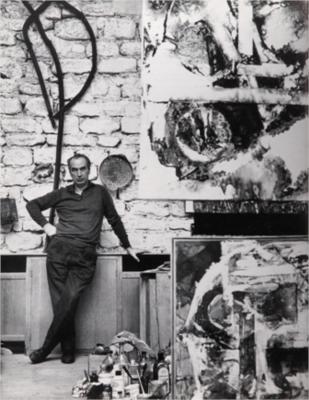
Alexandre Istrati
When Constantin Brancusi invited Alexandre Istrati and his wife Natalia Dumitresco to occupy the studio beside his in the impasse Ronsin, Paris, he was doing more than offering fellow Romanians a foothold in the city. He was naming them executors of his will, a trust that placed two abstract painters at the centre of one of the century's most significant sculptural estates.
Biography
Born in 1915[1] in Dorohoi, in the north of Romania, Istrati arrived in Paris in 1947[1] having trained as a painter in Bucharest. His move toward abstraction was rapid: by 1948 he was showing non-figurative canvases at the Salon des Superindépendants, and in 1949 his first solo exhibition at the Galerie Breteau drew immediate interest from dealers Colette Allendy and Denise René. He was working within the Abstraction Lyrique movement, the European equivalent of American Abstract Expressionism[1], alongside painters including Soulages, Schneider, and Lanskoy.
His canvases from the 1950s onward are characterised by deep greens, bright purples, and intense passages of red and yellow, built in a free lyrical manner that evolved out of an early engagement with the Réalités Nouvelles. He won the Prix Kandinsky in 1953[1]. The friendship with Brancusi lasted until the sculptor's death in 1957, and Istrati and Dumitresco honoured it for the rest of their lives: both are buried alongside Brancusi in the Cimetière du Montparnasse. Istrati continued painting in Paris until his death in October 1991[1].
Timeline
- 1915Born in Dorohoi, Romania
- 1947Arrived in Paris
- 1948Showed non-figurative canvases at the Salon des Superindépendants
- 1949First solo exhibition at Galerie Breteau
- 1953Won the Prix Kandinsky
- 1957Brancusi died; Istrati became an executor of his estate
- 1991Died in Paris in October
Notable Works
Tap to view larger.
Next stop
Abstract Expressionism →
Explore the artists and ideas of Abstract Expressionism.
Related Artists


Frequently Asked Questions
What is Alexandre Istrati known for?
Alexandre Istrati is known for his abstract paintings and his association with Constantin Brancusi. He was part of the Abstraction Lyrique movement, the European equivalent of American Abstract Expressionism[1], alongside painters including Soulages, Schneider, and Lanskoy. He also won the Prix Kandinsky in 1953[1].Who was Alexandre Istrati?
Alexandre Istrati was a Romanian[1] painter who moved to Paris in 1947[1]. Constantin Brancusi named Alexandre Istrati and his wife Natalia Dumitresco executors of his will, which placed the abstract painters at the centre of one of the century's most significant sculptural estates. He continued painting in Paris until his death in October 1991[1].What was Alexandre Istrati's art style?
Alexandre Istrati worked within the Abstraction Lyrique movement. His canvases from the 1950s onward are characterised by deep greens, bright purples, and intense passages of red and yellow, built in a free lyrical manner that evolved out of an early engagement with the Réalités Nouvelles.How did Alexandre Istrati die?
Alexandre Istrati died in 1991[1] at the age of 76.
Sources
Editorial draws on the following primary and tertiary references for Alexandre Istrati.
- [1] wikipedia Wikipedia: Alexandre Istrati Used for: biography, birth dates, death dates, identifiers, movement attribution, nationality.
- [2] book guggenheim-guhe00solo Used for: biography.
- [3] book guggenheim-masterp00solo Used for: biography.
- [4] book guggenheim-twopri00weis Used for: biography.
Editorial overseen by Solis Prints. Sources verified 2026-10-15. Click a source for details, or hover over [N] in the page above to preview.
Editorial standardsMethodologyCorrectionsAI disclosureAbout the editorial team