



Frank Bowling
Bowling's mother was a seamstress in Bartica, British Guiana. His father was a police district paymaster. In 1950, at fifteen, he was sent to England to live with an uncle and finish his education. After National Service in the Royal Air Force, he had planned to become a writer. He enrolled at the Royal College of Art instead.
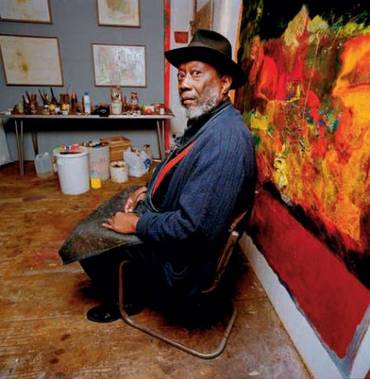
Biography
He graduated in 1962 with the silver medal for painting, the same year and the same institution as David Hockney. The two were part of a generation that would define British art for the next decade, though they went in entirely different directions. Bowling's early work was figurative, strongly influenced by Francis Bacon, and by the Old Masters he studied at the National Gallery: Goya, Rembrandt, Titian, Velazquez. He added Constable and Turner to the list, which was an unusual combination for a young painter from South America working in 1960s London.
A move to New York in the mid-1960s changed everything. Encouraged by the critic Clement Greenberg, he shifted to abstraction, working alongside Rothko, Pollock and Barnett Newman. His Map Paintings, which stencilled the landmasses of South America, Africa and Australia onto fields of poured colour, were shown at the Whitney Biennial in 1971. The maps float on the surface like memories of geography: places remembered rather than charted.
He was the first Black artist elected a Royal Academician in the institution's history. He was knighted in 2020 for services to art. At ninety, he was still working in his London studio, pouring acrylic resin mixed with gel and polyurethane foam onto canvases that glow like stained glass laid flat.
Timeline
- 1934Born in Bartica, British Guiana (now Guyana). His mother ran a successful dressmaking business from a three-storey building called Bowling's Variety Store.
- 1953Emigrated to London at 19, enrolling at Westminster College of Commerce to study English before National Service in the Royal Air Force.
- 1962Graduated from the Royal College of Art in London at 28 with a silver medal for painting, quickly establishing himself in the city's art scene.
- 1966Moved to New York at 32, living at the Chelsea Hotel alongside Warhol and Rothko. He received a Guggenheim Fellowship the following year.
- 1971Exhibited his Map Paintings at the Whitney Museum of American Art in New York at 37, large-scale abstractions featuring the outlines of South America and Africa.
- 1976Returned to London at 42 while maintaining a studio in New York, developing his signature technique of pouring and flinging paint across unstretched canvases.
- 2005Elected Royal Academician at 71, followed by an OBE in 2008 for services to art.
- 2019Celebrated with a major retrospective at Tate Britain in London at 85, spanning six decades of work and bringing renewed attention to his contribution to abstract painting.
Notable Works
Tap to view larger.
Where to See Frank Bowling
2 museums worldwide.
-
-
 1 works
Saint Louis Art Museum
St. Louis, United States
Tue-Sun 10:00-17:00, Fri to 21:00, closed Mon · Free

Next stop
Abstract Expressionism →
Explore the artists and ideas of Abstract Expressionism.
Related Artists




Frequently Asked Questions
Frank bowling facts?
Frank Bowling was born in Guyana, in the Caribbean. He moved to London when he was nineteen.Is frank bowling still alive?
Yes, Frank Bowling is still alive (born 1934).What is Frank Bowling's most famous work?
It is difficult to identify a single "most famous" work by Frank Bowling, as his career has spanned many decades and styles. His early work from the 1960s included pieces such as *Winter Sun* (1961), *Bend Sinister* (1964), and *Bridge* (1964). These paintings are acrylic on canvas. *Winter Sun* exists in two versions from 1961 and 1962. *Bend Sinister* is part of the Hirshhorn Museum collection in Washington, D.C. Later in the 1960s, Bowling continued to produce acrylic works, including *Grave Light* (1965), *Via Blues* (1967), and *Coarse Shadow* (1967). *April Tune* (1969) is in the collection of the Solomon R. Guggenheim Museum in New York. Bowling's extensive output makes it challenging to single out one piece as definitively his most well-known, as different works have resonated at different times and with different audiences.What should I know about Frank Bowling's prints?
Frank Bowling's prints, like those of many artists, exist in a marketplace with specific conventions. Printmakers often create 'limited editions', where the artist decides the number of prints produced. This decision isn't usually due to technical limits but is a choice made by the artist. Each print in a limited edition is numbered, titled, and signed, usually in pencil, following informal but respected conventions. These markings add value, assuring buyers that the print conforms to its description. The edition number is written on the bottom left margin of the print, the title in the centre, and the signature on the right. An 'original print' is conceived and executed solely as a print, often in a numbered edition, and signed by the artist. Each print is made from a plate, stone, screen, or block created for that purpose. There isn't one 'original' from which copies are made; each is individually inked and pulled, making it a 'multi-original' medium.What style or movement did Frank Bowling belong to?
Frank Bowling's artistic affiliations are complex, defying easy categorisation. Born in British Guiana (now Guyana) in 1934, he moved to London in 1953 and studied at the Royal College of Art alongside artists such as David Hockney. Initially, Bowling's work showed figurative elements. However, he moved toward abstraction during a period living in New York in the 1960s. There, he engaged with abstract expressionism and colour field painting. His work from this time often involved large canvases with poured and stained acrylic paint, exploring colour relationships and material properties. While linked to American modernism, Bowling resisted being labelled as solely an American-style artist. He maintained a connection to his British identity and his experiences as a Black artist in both Britain and America. Some critics associate him with a broader transatlantic abstraction, acknowledging his synthesis of European and American influences. Others see his practice as unique, shaped by personal history and ongoing experimentation. Bowling himself resists simple labels, asserting the independence of his artistic vision.What techniques or materials did Frank Bowling use?
Frank Bowling is known for his experimental approach to materials and techniques. He moved away from traditional brushwork. Instead, he explored methods of pouring, dripping, and staining the canvas with acrylic paints. Bowling often manipulates the canvas itself. He tilts it to control the flow of paint, creating layered, textured surfaces. In some works, he embedded objects, such as polystyrene foam, into the paint. This adds a sculptural dimension to his paintings. His interest in colour is evident in his use of layered glazes and translucent pigments. These create luminous effects. Bowling also developed a method of applying paint using a modified power sander, which allowed him to create smooth, blended areas of colour. He has also used gel medium to add texture and depth. His innovative use of materials and techniques has expanded the possibilities of abstract painting.What was Frank Bowling known for?
Frank Bowling (born in British Guiana in 1934) is best known for his large-scale abstract paintings. He moved to London in 1953 and studied at the Royal College of Art alongside artists such as David Hockney and Peter Blake. Bowling's early work incorporated figurative elements; however, he gradually moved towards abstraction. A move to New York in the 1960s exposed him to the work of American abstract expressionists, which had a considerable impact on his style. He began to experiment with colour, form, and texture, developing a distinctive approach to painting. His innovative techniques often involve pouring, dripping, and staining the canvas with acrylic paint. He sometimes embeds objects and gels into the surfaces of his works, creating complex, layered compositions. Bowling's paintings often evoke a sense of depth and movement through his manipulation of colour and light. Throughout his career, Bowling has explored themes of identity, memory, and place. His work is held in major museum collections around the world. He was elected to the Royal Academy of Arts in 2005, and he was knighted in 2020 for services to art.When did Frank Bowling live and work?
Frank Bowling is a Guyana-born British artist, born in 1934 in Bartica. He moved to Britain in 1953. Bowling studied at various London art schools, including the Royal College of Art. There, he associated with artists such as David Hockney, Derek Boshier, and Allen Jones. Bowling is known for his abstract paintings, often large in scale and incorporating colour and texture in innovative ways. His work engages with both European and American abstract traditions. He frequently revisits themes and techniques throughout his career. Bowling's practice has been based in London and New York at different times. He has exhibited widely in both the United Kingdom and internationally. In 2005, he was elected a Royal Academician. A major retrospective of his work was held at Tate Britain in 2019, confirming his position as an important figure in postwar British art. He continues to live and work, mainly in London.When was frank bowling born?
Frank Bowling was born in 1934 in United Kingdom.Where can I see Frank Bowling's work?
Frank Bowling's paintings are held in numerous public and private collections. These include institutions in the United Kingdom, the United States, and elsewhere. In the UK, you can find his work at the Tate Gallery, the Victoria and Albert Museum, and the Royal College of Art, all in London. Outside London, the Scottish National Gallery of Modern Art in Edinburgh also holds pieces by Bowling. In the United States, major museums with Bowling's work include the Metropolitan Museum of Art[6] and the Museum of Modern Art[3] in New York. Further afield, his paintings have been acquired by institutions such as the National Gallery of Jamaica in Kingston. Major exhibitions of Bowling's work have also increased his visibility. A retrospective at Tate Britain in 2019 presented paintings from throughout his career. Such exhibitions often travel, increasing opportunities to view his art. Check museum websites for current exhibition schedules.Where is frank bowling from?
Frank Bowling was United Kingdom, born in 1934.Where was Frank Bowling from?
Frank Bowling is a painter and printmaker. He was born in 1934 in British Guiana (now Guyana), in South America. He moved to London in 1953. Bowling initially studied at evening classes. He then studied at Chelsea School of Art, and later at the Royal College of Art. He was part of a generation of artists who came to Britain from Commonwealth countries after the Second World War. These artists made significant contributions to British art. Bowling's early work was figurative. It often incorporated autobiographical elements and social commentary. His style shifted towards abstraction in the 1960s. During this period, he spent time in New York. He experimented with colour, form, and process. He poured paint onto canvases to create layered effects. Bowling has explored themes of identity, memory, and place throughout his career. His Guyanese heritage has been a recurring source of inspiration. He was elected to the Royal Academy of Arts in 2005. He was awarded a knighthood in 2020 for services to art.
Sources
Editorial draws on the following primary and tertiary references for Frank Bowling.
- [1] museum Museum of Fine Arts Boston Used for: museum holdings.
- [2] museum Whitney Museum of American Art Used for: museum holdings.
- [3] museum Museum of Modern Art Used for: museum holdings.
- [4] museum RISD Museum Used for: museum holdings.
- [5] museum Minneapolis Institute of Art Used for: museum holdings.
- [6] museum Metropolitan Museum of Art Used for: museum holdings.
- [7] book guggenheim-britishartnowame00wald Used for: biography.
- [8] book guggenheim-richardhamilton00hami Used for: biography.
- [9] book Landauer, Susan, The not-so-still life : a century of California painting and sculpture Used for: biography.
Editorial overseen by Solis Prints. Sources verified 2026-10-15. Click a source for details, or hover over [N] in the page above to preview.
Editorial standardsMethodologyCorrectionsAI disclosureAbout the editorial team