



Ed Clark
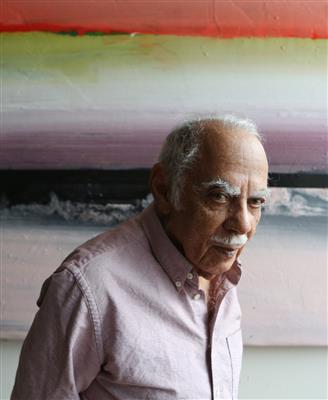
Long before shaped canvases became fashionable in the 1960s, Ed Clark was cutting his supports into ovals and ellipses, dragging paint across unstretched canvas with a push broom. The New Orleans-born painter arrived at these innovations in the mid-1950s, working on the floor in a manner that paralleled Pollock's method yet produced something entirely his own: great sweeping arcs of colour, organic and propulsive, that seemed to move across the picture plane like weather systems.
Biography
Clark trained at the Art Institute of Chicago before moving to Paris in the early 1950s, where he studied at the École des Beaux-Arts and the Académie de la Grande Chaumière. Paris connected him to European gestural painting while sharpening his instinct for scale. Returning to New York, he became part of the 10th Street scene, co-founding the Brata Gallery in 1957[1], one of the pioneering artist-run cooperatives that defined that generation.
Over the following decades Clark divided his time between New York, Paris, Tokyo, and West Africa, and each place left traces in the luminosity and scale of his canvases. He worked consistently and ambitiously for more than six decades, though institutional recognition came slowly. The Museum of Contemporary Art in Los Angeles mounted a major retrospective in 2023, four years after his death, confirming what his peers had long argued: that Clark was one of the most original painters of the Abstract Expressionist generation, not a footnote to it.
He died in New York on 16 August 2019[1], aged 93.
Timeline
- 1926Born in New Orleans.
- 1950Studied at the Art Institute of Chicago.
- 1950Moved to Paris to study at the École des Beaux-Arts and the Académie de la Grande Chaumière.
- 1957Co-founded the Brata Gallery in New York.
- 2019Died in New York at 93.
Notable Works
Tap to view larger.
Next stop
Abstract Expressionism →
Explore the artists and ideas of Abstract Expressionism.
Related Artists


Frequently Asked Questions
What is Ed Clark known for?
Ed Clark is known for his original approach to Abstract Expressionism[1], particularly his use of shaped canvases and his method of applying paint with a push broom. His large, sweeping arcs of colour create organic and propulsive effects, resembling weather systems moving across the picture plane.What is Ed Clark's most famous work?
Ed Clark is best known for his shaped canvases and his use of the push broom to apply paint. Although he produced a large body of work, it is difficult to identify one single piece as his "most famous". Clark began experimenting with shaped canvases in 1964[1], moving away from the traditional rectangle. These works include curves and angles, altering the viewing experience. Examples include Untitled from 1968, an oval canvas, and the 1972 shaped canvas in the collection of the Smithsonian American[1] Art Museum. His technique of using a push broom to spread paint across the canvas also became a signature element of his style. This method allowed him to create broad, sweeping strokes and a sense of movement in his paintings. He adopted this technique in the late 1950s. Clark's work defies easy categorisation. While associated with abstract expressionism, he also incorporated elements of colour field painting. His innovative approach to both form and technique has secured his place in the history of American art.What should I know about Ed Clark's prints?
When assessing Ed Clark's prints, bear in mind some basic facts about the medium. Printmaking is an unregulated activity, but some conventions have developed around editioning, signing, and numbering; these add value to the work. The edition claim is written as a pair of numbers on the left bottom margin of the print. The print number is written above, and the edition size is below. The title of the print is in the middle of the bottom margin. The signature is on the right of the bottom margin of the print. Edition descriptions are always signed in pencil. The largest number is the total number of prints in the edition; the smaller number is the sequential number of the actual print (for example, 35/100). Some artists hold out ten percent as artist’s proofs and number them separately with AP after the number (e.g., 5/100 AP). An 'original print' is conceived by the artist as a print and executed solely as a print, usually in a numbered edition, and signed by the artist.What style or movement did Ed Clark belong to?
Ed Clark (1926[1]-2019[1]) is associated with abstract expressionism; however, he resisted easy categorisation. Clark began his studies at the Art Institute of Chicago in 1947[1], later moving to Paris in 1952. There, he was exposed to European modernism and met artists like Joan Mitchell. Although Clark's early work had affinities with second-generation abstract expressionism, he developed a distinctive approach. In 1956, he created his first shaped canvas, moving away from the traditional rectangular format. He poured paint onto the canvas, manipulating the flow to create dynamic compositions. This technique aligned him with the broader concerns of colour field painting, which prioritised colour and form over representation. Clark's work also connects to the Black Arts Movement. He was a member of the Spiral Group, a collective of African-American[1] artists who addressed issues of racial equality in their work. Although Clark's abstraction was not overtly political, his participation in Spiral reflects his engagement with social issues. Throughout his career, Clark explored different modes of abstraction, defying simple classification.What techniques or materials did Ed Clark use?
Ed Clark is best known for his shaped canvases and the use of a push broom to apply paint. He experimented with materials and methods throughout his career. Early in his career, Clark worked with traditional brushes and paint application. However, he soon sought ways to move beyond these conventional approaches. In the 1950s, he began diluting his paints, allowing them to stain the canvas. This technique created luminous effects and blurred boundaries between colours. Clark's innovation with the push broom came later. He would pour paint onto the canvas and then use the broom to spread it across the surface. This method allowed him to create broad, sweeping strokes and a sense of movement within his compositions. The broom also enabled him to work on a larger scale, producing expansive fields of colour. His shaped canvases further challenged traditional painting formats. Rather than adhering to the conventional rectangle, Clark created canvases with curved or irregular edges. This approach integrated the painting with its surrounding space.What was Ed Clark known for?
Ed Clark (1926[1]-2019[1]) was an American[1] abstract expressionist painter. He is associated with the New York School, a group of artists in the 1940s and 1950s who shifted the centre of the art world to the United States. Abstract expressionism encompassed the process of artistic creation. It stressed energy, action, and kineticism, using conventional technique as a departure point. Some have compared abstract expressionism to jazz. Abstract Expressionism[1] took form in the late 1940s and early 1950s partly as a reaction to the Second World War. Some scholars argue that Abstract Expressionism was promoted in overseas exhibitions by organisations with vested interests in US capitalism. According to this argument, it served as a cultural buttress to US post-war economic dominance, particularly in Western Europe.When did Ed Clark live and work?
Ed Clark (1926[1]-2019[1]) was an American[1] artist affiliated with the abstract expressionist movement. He was born in New Orleans, Louisiana, and he spent his childhood in Chicago. Clark's artistic career began after his service in the US Air Force during World War II. He then studied at the School of the Art Institute of Chicago, and later in Paris under the G.I. Bill. Paris became a significant location for Clark; he lived there intermittently from 1952[1] to 1964. During this period, he encountered European modernism and associated with other American expatriate artists. Clark returned to New York in the mid-1960s, where he continued to develop his abstract style. He experimented with shaped canvases and the use of a push broom to apply paint, creating sweeping gestural marks. Clark maintained a studio in New York City for many years, and he travelled extensively, drawing inspiration from various cultures and environments. He continued to create art until his death in Detroit, Michigan, at the age of 93.Where can I see Ed Clark's work?
Ed Clark's work can be viewed in several museums. In the United States, these include the Metropolitan Museum of Art (New York), the Museum of Modern Art (New York), the Los Angeles County Museum of Art, the Minneapolis Institute of Arts, the Virginia Museum of Fine Arts (Richmond), the Wolfsonian at Florida International University (Miami Beach), and the Charles Hosmer Morse Museum of American[1] Art (Winter Park, Florida). Outside the United States, museums that hold works by Ed Clark include the Royal Ontario Museum (Toronto). Other museums that hold fine art, textiles, and design may also hold work by Ed Clark, such as the National Museums of Scotland (Royal Museum, Edinburgh), the Victoria & Albert Museum (London), the Brighton Museum & Art Gallery, and the Manchester Art Gallery.Where was Ed Clark from?
Ed Clark was born in New Orleans, Louisiana, on 5 May 1926[1]. His family relocated to Chicago, Illinois, when he was a young boy. Clark received early artistic training at the Art Institute of Chicago. He also studied at Skowhegan School of Painting and Sculpture in Maine, and later in Paris. Clark's experiences in both America and Europe shaped his artistic development. After serving in the Second World War, he used the G.I. Bill to study art in Paris. There, he encountered the work of Nicolas de Staël, which had a considerable impact on his developing style. Clark's travels and studies abroad broadened his artistic perspective, influencing his move towards abstraction. He maintained studios in New York and Paris, and he travelled extensively throughout his life. Clark died in Detroit, Michigan, in 2019[1], at the age of 93.Who did Ed Clark influence?
Ed Clark's influence is evident in the work of William T. Williams, an African American[1] artist born around 1940[1]. Williams belongs to a generation that brought Black painting and sculpture to artistic maturity, following the civil rights movement. Williams developed a sophisticated technique comparable to jazz improvisation, interweaving colour and brushwork within a clear structure. This approach allows for variations on a central theme. Williams is concerned with formal issues, but the play of colour and abstract shapes evokes patterns, light, and space. His work seemingly captures an evanescent memory of the artist's past. Clark's work also had an impact on the broader artistic community. He explored the expressive possibilities of form and colour, maintaining a belief in their value. His work resonates with a range of emotional responses.Who influenced Ed Clark?
Ed Clark found inspiration in a range of artists and movements. Jackson Pollock had a particular impact; Clark said that Pollock's paintings resonated with him and opened the way for him to make his own contribution. Clark also expressed interest in older artists such as Rembrandt and Manet, wanting to understand their methods. He created his own abstract response to their works; for example, his painting *For E. M.* (1981[1]) is a version of Manet's *Fish (Still Life)* (1864). Through this process, Clark came to appreciate Manet's use of space and his ability to create both three-dimensional and flat effects in his paintings. Clark also admired Cubists, as well as Miró and Gorky. These influences helped shape Clark's understanding of painting and his own artistic approach.Who was Ed Clark?
Ed Clark (1926[1]-2019[1]) was an American[1] abstract expressionist painter. Born in New Orleans, Louisiana, he is best known for his shaped canvases and use of pure pigment. Clark studied at the Art Institute of Chicago from 1947[1] to 1951. He then moved to Paris in 1952, where he was exposed to European modernism and met artists like Joan Mitchell. This period was formative, influencing his move towards abstraction. He experimented with colour and form, developing his signature style. Returning to New York in 1957, Clark became associated with the second generation of abstract expressionists. He distinguished himself through his innovative techniques. In the late 1960s, he began producing shaped canvases, breaking away from the traditional rectangular format. He also developed a method of applying pigment with a push broom, creating sweeping gestural marks. Clark's work is held in the collections of the Metropolitan Museum of Art, the Museum of Modern Art, and the Whitney Museum of American Art, among others.
Sources
Editorial draws on the following primary and tertiary references for Ed Clark.
- [1] wikipedia Wikipedia: Ed Clark Used for: biography, birth dates, death dates, identifiers, movement attribution, nationality.
- [2] book guggenheim-guggenheimintern00frye Used for: biography.
- [3] book guggenheim-onehundredpainti00thom Used for: biography.
- [4] book guggenheim-transfsi00wald Used for: biography.
Editorial overseen by Solis Prints. Sources verified 2026-10-15. Click a source for details, or hover over [N] in the page above to preview.
Editorial standardsMethodologyCorrectionsAI disclosureAbout the editorial team