



Robert Motherwell
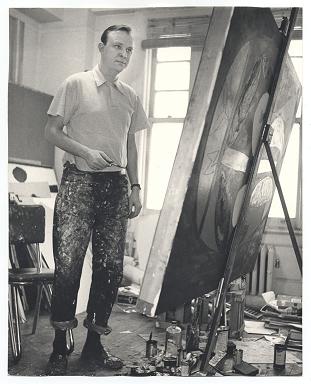
Robert Motherwell, born in 1915, began his academic life studying philosophy at Stanford and Harvard universities. He initially pursued a doctorate in the field, but a significant trip to Europe between 1938 and 1939 redirected his interests. This journey ultimately led him to dedicate himself entirely to painting, a decision that shaped his artistic career.
Biography
Upon returning to New York, Motherwell continued his studies at Columbia University under Meyer Schapiro. Schapiro encouraged him to meet European Surrealists who had sought refuge in the city, including Max Ernst and Marcel Duchamp. Motherwell developed a friendship with the Chilean artist Roberto Matta, who introduced him to the concept of psychic automatism. This technique, combined with his deep intellectual background, strongly influenced his early abstract compositions. His first solo exhibition took place in 1944 at Peggy Guggenheim's Art of This Century gallery.
Motherwell quickly became a central figure in the New York School. He edited the "Documents of Modern Art" series and co-founded the Subjects of the Artist School. His most recognised body of work, the "Elegies to the Spanish Republic" series, commenced in 1948. Comprising over 200 paintings, these works are distinguished by large black ovoid forms set against a lighter background. They explored themes of death and lamentation, serving as a powerful response to the Spanish Civil War.
Beyond the Elegies, Motherwell also created significant collage works and other series, such as his "Open" paintings. He taught at institutions like Black Mountain College and Hunter College, influencing subsequent generations of artists. His creative output consistently explored the emotional and intellectual dimensions of abstraction until his passing in 1991.
Timeline
- 1915Born in 1915.
- 1938Traveled to Europe, redirecting his interests to painting.
- 1939Returned to New York and continued studies at Columbia University.
- 1944First solo exhibition at Art of This Century gallery.
- 1948Began the 'Elegies to the Spanish Republic' series.
- 1991Died in 1991.
Notable Works
Tap to view larger.
Next stop
Abstract Expressionism →
Explore the artists and ideas of Abstract Expressionism.
Related Artists



Frequently Asked Questions
What is Robert Motherwell known for?
Robert Motherwell is known for being a key figure of abstract expressionism in New York. His most recognised body of work is the "Elegies to the Spanish Republic" series, comprising over 200 paintings distinguished by large black ovoid forms set against lighter backgrounds.What is Robert Motherwell's most famous work?
Robert Motherwell is best known for his series *Elegies to the Spanish Republic*. He created these paintings over many years; the first was made in 1948, and he continued to produce versions of the composition until his death in 1991. The *Elegies* are abstract paintings, typically featuring large black ovoid forms and vertical bars arranged against a white background. Motherwell intended these shapes to evoke feelings of mourning and loss, specifically relating to the Spanish Civil War. He did not see them as direct representations. While the *Elegies* are his most recognised works, Motherwell had a long career and produced a varied output. He was associated with the Abstract Expressionist movement, and he experimented with different styles and media throughout his life. His other notable series include the *Beside the Sea* paintings and his open compositions.What should I know about Robert Motherwell's prints?
Robert Motherwell (1915-1991) is recognised as one of the most important figures in American abstract expressionism. Although he is best known for his paintings and collages, printmaking was an important part of his practice. Motherwell made his first prints in the early 1940s, and he continued to produce them throughout his career. He experimented with a range of printmaking techniques, including lithography, etching, aquatint, and screenprinting. He often combined these methods in a single print. His prints often feature the same motifs and themes as his paintings, such as bold, gestural marks, simple shapes, and a limited colour palette. Black is a frequent feature. Motherwell was interested in the expressive potential of colour and form, and he used printmaking to explore these ideas in a different medium. Some of his most well-known prints include the "Beside the Sea" series (1962), and "Africa" (1970). These works demonstrate Motherwell's interest in spontaneity, chance, and the subconscious. His prints are held in the collections of major museums around the world.What style or movement did Robert Motherwell belong to?
Robert Motherwell (1915-1991) was a key figure in the Abstract Expressionist movement in New York. Though considered an action painter, the spontaneous elements of this style are relatively subdued in his work, which is invariably intellectual. He was one of the founders of the short-lived cooperative The Subjects of the Artist in 1948, along with Mark Rothko and Barnett Newman. His work has connections to myth, atavistic symbolism, Surrealism, and a tragic sense of history. Motherwell's paintings use simplified, quasi-geometric designs derived from Picasso and Matisse. He often preferred clear, simple colour contrasts within a restricted range. His early collages have been described as a kind of explosive Cubism. His *Elegies to the Spanish Republic* series, which occupied him for three decades, was not intended as political commentary. Instead, Motherwell described them as a private insistence that a terrible death happened that should not be forgotten; metaphors of the contrast between life and death and their interrelation.What techniques or materials did Robert Motherwell use?
Robert Motherwell, born in 1915, experimented with various techniques and materials throughout his career. In 1943, he and Jackson Pollock explored collage, coinciding with Peggy Guggenheim's preparations for an exhibition at Art of This Century. Although Pollock soon lost interest, Motherwell continued to work with collage. His 1943 work, "Surprise and Inspiration", combines gouache and oil paint with paper collage on cardboard. Motherwell employed cut, torn, and glued paper to create a grid-like structure, which served both as an architectural element and a support for paint application. The handling of materials and the use of shapes separated by black lines in this early collage anticipate the methods and recurring motifs of Motherwell's later output. He is also known for his series of "Elegies to the Spanish Republic", which use a limited black-and-white palette.What was Robert Motherwell known for?
Robert Motherwell (1915-1991) was an Abstract Expressionist, known for his intellectual approach to gestural painting. He was associated with other artists such as Rothko, Barnett Newman, and Willem de Kooning. Motherwell's work often explored themes of contrast between life and death. His paintings are characterised by broad, massive forms, often applied dramatically in black paint against a white canvas. His series *Elegy to the Spanish Republic*, comprising over one hundred versions spanning three decades, is among his best-known works. This series was inspired by the Spanish Civil War and intended as a lamentation for a terrible death that should not be forgotten. Motherwell also made drawings, prints, and collages incorporating paint and ripped paper. He experimented with collage techniques, influenced by European practitioners such as Picasso and Matisse. He taught and lectured extensively throughout the United States and exhibited his work both in the United States and abroad.When did Robert Motherwell live and work?
Robert Motherwell was an American artist associated with the abstract expressionist movement. He was born in Aberdeen, Washington, on 24 January 1915. He died on 16 July 1991 in Provincetown, Massachusetts. Motherwell's initial artistic recognition occurred in the 1940s in New York. In 1945, the Art of This Century gallery in New York held Motherwell's first solo exhibition, which featured paintings, papiers collés, and drawings. During the late 1940s, Motherwell engaged with fellow artists in New York. In 1947, he co-published the single issue of *Possibilities*, a periodical containing statements by artists such as Barnett Newman and Jackson Pollock. In 1948, he, David Hare, Mark Rothko, and William Baziotes established a school called Subjects of the Artist. Motherwell's work was included in the Museum of Modern Art's "Symposium What Abstract Art Means to Me" in 1951, alongside other artists such as Willem de Kooning and Barnett Newman. He continued to exhibit his work throughout his life, securing his place in the history of American art.Where can I see Robert Motherwell's work?
Robert Motherwell's art can be viewed in many prominent collections. In New York City, major museums holding his works include the Solomon R. Guggenheim Museum, the Metropolitan Museum of Art, and the Museum of Modern Art. You can also find examples at the Whitney Museum of American Art. Elsewhere in the United States, notable institutions with Motherwell pieces are the Art Institute of Chicago; the Museum of Fine Arts, Boston; the Philadelphia Museum of Art; the National Gallery of Art in Washington, D.C.; and the Los Angeles County Museum of Art. University collections such as the Fogg Art Museum at Harvard and the Yale University Art Gallery also hold his work. Internationally, Motherwell's art can be seen at the Musée National d'Art Moderne in Paris, the Moderna Museet in Stockholm, the National Gallery of Canada in Ottawa, and the Tate Gallery in London. These various locations offer opportunities to study the scope and development of his artistic output.Where was Robert Motherwell from?
Robert Motherwell was born in Aberdeen, Washington, on 4 January 1915. His family soon relocated to California, where he spent his childhood. Motherwell recalled that he developed an early appreciation for the region's open spaces, bright colours, and expansive skies. As a child, he suffered from asthma, and themes of mortality appeared in his later art. At age eleven, Motherwell received a fellowship to the Otis Art Institute in Los Angeles. Between 1932 and 1937, he studied painting at the California School of Fine Arts in San Francisco; he also obtained a BA in philosophy from Stanford University. Although he wanted to be a painter, his father encouraged him to pursue a more secure career. He later studied art history at Columbia University with Meyer Shapiro, who encouraged him to paint. In 1940, Motherwell met artists such as Marcel Duchamp and Max Ernst.Who did Robert Motherwell influence?
Robert Motherwell (1915-1991) was associated with Pollock, de Kooning and Rothko in the 1950s. He is considered an action painter and a central figure in the Abstract Expressionist movement in New York. In 1948, Motherwell, Rothko, Newman and other artists founded the short-lived cooperative The Subjects of the Artist. From this period onward, Motherwell began his series *Elegy to the Spanish Republic*, completing over one hundred versions in the next three decades. Motherwell's work was intellectual. His *Elegies* were not intended as coded reports or descriptions of specific events. Instead, Motherwell characterised an elegy as a funeral lament, or song, for something one cared about. The Spanish elegies, he stated, were not political, but a personal insistence that a terrible death happened that should not be forgotten. He saw the pictures as general metaphors contrasting life and death. Although black and white dominate the *Elegies*, his palette later became more colourful.Who influenced Robert Motherwell?
Robert Motherwell (1915-1991) was an American Abstract Expressionist painter. His artistic development involved several influences, both European and American. Early in his career, Motherwell was stimulated by the Surrealist movement. After moving to New York in the early 1940s, he met several European Surrealists in exile, including Max Ernst, Marcel Duchamp, and André Breton. These figures encouraged Motherwell's interest in automatism, a technique for releasing unconscious thoughts and feelings through spontaneous mark-making. Motherwell was also affected by the work of modern masters such as Henri Matisse and Pablo Picasso. He studied their use of colour, form, and composition. In addition, Motherwell was part of a circle of American artists, including Jackson Pollock, Willem de Kooning, and Mark Rothko. They shared ideas and approaches to painting, contributing to the emergence of Abstract Expressionism. Motherwell's intellectual interests also shaped his art. He studied philosophy and literature, and his paintings often engage with themes related to existentialism and political concerns.Who was Robert Motherwell?
Robert Motherwell (1915-1991) was an American abstract expressionist painter, associated with artists such as Pollock, de Kooning and Rothko. Born in Aberdeen, Washington, he first studied art at the Otis Art Institute at the age of eleven. Later, he attended Stanford University, then Harvard and Columbia. Meyer Schapiro, an art historian at Columbia, encouraged him to pursue painting. Motherwell is considered an action painter, though his spontaneous, gestural style is relatively subdued. His paintings are often described as intellectual. He co-founded the cooperative The Subjects of the Artist with Rothko, Newman and others in 1948. Motherwell's series *Elegy to the Spanish Republic* is among his best-known works. The Spanish Civil War triggered a moral crisis in the late 1930s, and Motherwell created over one hundred versions of this theme across three decades. He explained that these elegies were not political, but rather a private expression of a terrible death that should not be forgotten, acting as metaphors for the contrast between life and death.
Sources
Editorial draws on the following primary and tertiary references for Robert Motherwell.
- [1] book Jed Perl, Art in America 1945-1970 Used for: biography, stylistic analysis.
- [2] book Susie Hodge, Artistic Circles Used for: biography.
- [3] book guggenheim-handboo00pegg Used for: biography, stylistic analysis.
- [4] book Masterpieces of western art : a history of art in 900 individual studies from the Gothic to the present day Used for: biography, stylistic analysis.
Editorial overseen by Solis Prints. Sources verified 2026-10-07. Click a source for details, or hover over [N] in the page above to preview.
Editorial standardsMethodologyCorrectionsAI disclosureAbout the editorial team