



Arshile Gorky
- Abstract Expressionism
- action painting
- modern art
Arshile Gorky arrived in the United States in 1920[1] as a refugee, having fled Armenia via Tbilisi and Constantinople after the Turkish massacres claimed his mother's life. He would spend the next decade methodically working through Cezanne, then Picasso, in a sustained self-education that drew admiring mockery from de Kooning, who nicknamed him "the Picasso of Washington Square," and genuine respect from the artists around him.
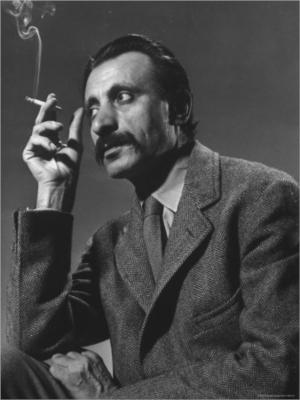
Biography
Born Vosdanik Adoian on 15 April 1904[1] in Khorkom, a village on the southern shore of Lake Van, he renamed himself Arshile Gorky upon settling in New York in 1925[1]. He taught drawing at the Grand Central School of Art from 1926 to 1931 and shared a studio with de Kooning late in that decade. From 1935 to 1937 he worked under the WPA Federal Art Project on murals for Newark Airport, some of the most ambitious public art commissions of the New Deal era.
The decisive shift came in the 1940s, when contact with Matta, Miro, and the European Surrealists freed him from Picasso's influence into something wholly original: a swarming language of biomorphic form, fluid pencil line, and thinned, dripped colour. Andre Breton claimed him for Surrealism in 1944[1]; Robert Hughes later described his mature work as "a grasshopper view of reality." The Liver Is the Cock's Comb (1944, Albright-Knox Art Gallery, Buffalo), measuring 72 by 98 inches, is widely considered his masterwork.
The last two years of his life collapsed under a sequence of disasters: a studio fire in 1946[1] destroyed much of his work; colon cancer followed; then a car accident paralysed his painting arm. On 21 July 1948[1] he hanged himself in Sherman, Connecticut, leaving a note that read "Goodbye my Loves."
Timeline
- 1904Born Vosdanik Adoian on 15 April in Khorkom, a village on the southern shore of Lake Van.
- 1920Arrived in the United States as a refugee after fleeing Armenia via Tbilisi and Constantinople.
- 1925Settled in New York and renamed himself Arshile Gorky, at 21.
- 1926Began teaching drawing at the Grand Central School of Art.
- 1935Began working under the WPA Federal Art Project on murals for Newark Airport.
- 1944André Breton claimed Gorky for Surrealism.
- 1944Completed "The Liver Is the Cock's Comb".
- 1946A studio fire destroyed much of his work.
- 1948Died by suicide on 21 July in Sherman, Connecticut, aged 44, after a car accident paralysed his painting arm.
Notable Works
Tap to view larger.
Next stop
Abstract Expressionism →
Explore the artists and ideas of Abstract Expressionism.
Arshile Gorky prints
Hand-finished archival prints from Arshile Gorky's body of work.


Related Artists



Take Arshile Gorky home.
See all Arshile Gorky prints →Frequently Asked Questions
What is Arshile Gorky known for?
Arshile Gorky was nicknamed the Picasso of Washington Square. He was known for his distinctive figure and Old World demeanour, often wearing a flowing black cape.What is Arshile Gorky's most famous work?
It is difficult to name one single "most famous" work by Arshile Gorky (born Vosdanik Adoian in Armenia, circa 1904[1]). He was nicknamed the Picasso of Washington Square, and his paintings show the influence of many modern European artists. His work evolved through several phases. Early paintings show the impact of Paul Cézanne, Georges Braque and Pablo Picasso. During the 1940s, his work reflected the influence of Surrealists such as Joan Miró and André Masson. Paintings such as *Painting* (1944[1]) show Gorky's techniques and content, as well as his language of free, organic forms. Landscape references appear; the white ground suggests a slice of sky, while the "earth" below has vegetal shapes and floral colours. The techniques and content of Surrealism influenced the development of Gorky's language of free, organic, vitally curvilinear forms. Another important work is *The Waterfall* (1943), now in the collection of the Tate, London. This apparently abstract painting evokes a stream pouring through a rock, surrounded by trees and greenery.What style or movement did Arshile Gorky belong to?
Arshile Gorky (born 1904[1], died 1948[1]) is associated with both Surrealism and Abstract Expressionism[1]. He was born Vosdanik Adoian in Armenia, emigrating to the United States in about 1920[1]. Initially, Gorky's painting was influenced by Cézanne and Picasso. During the 1930s, he associated with Stuart Davis, John Graham, and Willem de Kooning. By the 1940s, the work of European Surrealists, especially Miró, Masson, and Matta, profoundly affected him. He met André Breton, leader of the Surrealist movement, and became friends with other Surrealist émigrés in America. Gorky's work shows magical, dreamlike elements common to Surrealism, as well as the spontaneity of Abstract Expressionism. Some consider him a pioneer of Abstract Expressionism, and a significant influence on its other members. His techniques and content show the impact of Surrealism, especially in his organic forms. Gorky's emphasis on the expressive potential of line, form, and colour anticipated concerns of Abstract Expressionism.What techniques or materials did Arshile Gorky use?
Arshile Gorky, born Vosdanik Adoian, employed a range of techniques and materials in his art. His early work was influenced by artists such as Paul Cézanne, Georges Braque, and Pablo Picasso. In 1944[1], Gorky spent time at Crooked Run Farm in Virginia, where he created numerous drawings as preliminary studies for his paintings. One technique he used was thinning paint with turpentine, allowing it to drip down the canvas; this was a technique suggested by Matta. Gorky's work shows the impact of Surrealism, particularly the art of Joan Miró. This influence is evident in the use of floating abstract units and details such as flamelike shapes. However, unlike Miró, Gorky often enmeshed his forms to create an overall structure. He also explored the expressive potential of line, form, and colour, anticipating concerns of Abstract Expressionism[1]. Gorky's Armenian heritage also played a role in his artistic development. He referred to Armenian stone carving, mural, and manuscript painting as influences. He also drew inspiration from memories of his childhood in Armenia, including the colours and forms of the Armenian countryside.What was Arshile Gorky known for?
Arshile Gorky (born Vosdanig Manoug Adoian, around 1904[1]-1948[1]) was an Armenian-American painter. He is seen as an important figure in the development of abstract expressionism. Gorky emigrated to the United States in 1920[1], settling in New York. Early in his career, he painted in styles that reflected the influence of Paul Cézanne and Pablo Picasso. Works such as "Landscape in the Manner of Cézanne" (circa 1927) show this early direction. During the 1940s, Gorky moved toward a more personal and abstract style. These later works combine biomorphic shapes with intense colour. Paintings like "The Liver Is the Cock's Comb" (1944) and "Agony" (1947) are characteristic of this period. These paintings display a move away from direct representation. They explore themes of memory and nature through fluid lines and forms. His career was marked by a search for artistic identity. Despite the influences of other artists, Gorky ultimately forged his own distinctive visual language. He had an impact on subsequent generations of painters.When did Arshile Gorky live and work?
Arshile Gorky (born Vosdanig Manoug Adoian) was an Armenian-American artist who lived from approximately 1904[1] to 1948[1]. The exact year of his birth is uncertain; Gorky himself provided conflicting information. He emigrated to the United States in 1920[1], escaping the Armenian genocide. He studied at the New School of Design in Boston in the early 1920s, then moved to New York. His early work of the late 1920s and 1930s shows the influence of Post-Impressionism and Cubism, and artists such as Paul Cézanne and Pablo Picasso. During the 1940s, Gorky moved toward a more abstract style, and is often considered one of the first artists to paint in the Abstract Expressionist style. His mature paintings often incorporate biomorphic shapes and fluid lines. Works such as *Water of the Flowery Mill* (c. 1944) are characteristic of this period. A series of personal tragedies in the late 1940s, including a studio fire and a car accident, contributed to his depression. Gorky died by suicide in 1948.Where can I see Arshile Gorky's work?
Arshile Gorky's paintings and drawings are held in many major museum collections. The Museum of Modern Art in New York holds a substantial collection, including important paintings such as "Painting" (1948[1]). The Guggenheim Museum, also in New York, has several works available to view. The Tate Modern in London has paintings by Gorky in its collection. The National Gallery of Art in Washington, D.C., possesses significant examples of his work, as does the Art Institute of Chicago. These institutions offer opportunities to study Gorky's development and stylistic range. Smaller museums and university collections across the United States also hold Gorky pieces. These include the Hirshhorn Museum and Sculpture Garden in Washington, D.C., and the Philadelphia Museum of Art. Examination of museum websites and collection catalogues will provide details on specific holdings and exhibition schedules.Where was Arshile Gorky from?
Arshile Gorky was born Vosdanig Manoug Adoian in the village of Khorkom, Ottoman Empire (now eastern Turkey). Sources differ on the exact year of his birth, with dates ranging from 1900 to 1904[1]. Most current scholarship favours 1904[1]. Gorky's early life was marked by upheaval. He experienced the Armenian genocide, fleeing with his family to Van in 1915. His mother died of starvation in 1919, an event that deeply affected him. In 1920, at around the age of sixteen, Gorky emigrated to the United States. He initially stayed with relatives in Massachusetts, and he then moved to New York City. He enrolled in art schools, briefly attending the Rhode Island School of Design and later the New School of Design in New York. He adopted the name "Arshile Gorky" around 1925, inventing a new identity for himself. The name combined elements; "Arshile" was taken from Achilles, and "Gorky" from the Russian writer Maxim Gorky. This new name reflected his ambition to be seen as an important modern artist.Who did Arshile Gorky influence?
Arshile Gorky, who died in 1948[1], was not widely appreciated during his lifetime. However, younger painters in New York soon began to invoke and imitate his art. They wanted to preserve traditional draughtsmanship and elegance for abstract painting. Gorky himself was influenced by a number of artists. In order to break away from Picasso, he submitted himself to Miró. During the First World War, the early work of Kandinsky stimulated him to greater originality. Later, André Breton inspired him, but Gorky then submitted his art to the Chilean painter Matta y Echaurren, who was much younger. It took Gorky’s craft and devotion to make many of Matta’s ideas look substantial. In the last few years of his life, he transformed these ideas and added his own feelings.Who influenced Arshile Gorky?
Arshile Gorky was influenced by a number of artists throughout his career. Early on, he looked to modern masters as a way to find his own artistic voice. In the late 1930s, Gorky studied the work of Joan Miró as a means of breaking away from the pervasive influence of Pablo Picasso. Around the same time, the early work of Wassily Kandinsky (circa 1910[1]-1918[1]) proved stimulating to Gorky, encouraging him toward greater originality. Later, the Surrealist artist André Breton offered personal encouragement to Gorky. This gave him confidence. However, Gorky also submitted to the influence of Roberto Matta y Echaurren, a Chilean painter. Although Matta was younger, Gorky found inspiration in his work. By the last years of his life, Gorky had transformed these influences, adding his own feelings and ideas. He ultimately moved beyond the pressure of Picasso and discovered his own method of floating shapes. Despite these various influences, Gorky remained a Cubist with an appreciation for French taste.Who was Arshile Gorky?
Arshile Gorky (born Vosdanig Manoug Adoian, around 1904[1]; died 1948[1]) was an Armenian-American painter. He had a significant part in the abstract expressionist movement. His early life was marked by displacement and hardship. He fled his birthplace near Lake Van during the Armenian genocide. Gorky arrived in the United States in 1920[1] and studied at the Rhode Island School of Design and the New School of Design. His early work showed the influence of post-impressionists like Paul Cézanne. Later, he engaged with cubism and surrealism. Artists such as Pablo Picasso and Joan Miró informed his developing style. Gorky explored biomorphic shapes and abstract forms, often alluding to nature and memory. Works such as "The Liver Is the Cock's Comb" (1944) are characteristic of his mature style. Personal tragedies, including a studio fire and a car accident that injured his painting arm, contributed to his suicide in 1948. Despite his relatively short career, Gorky's output had an impact on the development of abstract expressionism. He bridged European modernism and the emerging American avant-garde.Why are Arshile Gorky's works important today?
Arshile Gorky is seen as a link between early modernism and the New York School. Although he died in 1948[1], his paintings gained attention in the 1950s. Initially, Gorky conscientiously imitated modern masters. He avoided self-assertion, and original expression, during the 1920s and 1930s. During the 1940s, he emerged as an innovative figure in American painting. His work enlarged human awareness through visual equivalents to poetic talent. Gorky explored the unknown by perfecting established methods. As he moved into new territory, he modified his graphic tools. These adaptations became his style, expanding the human horizon. He submitted himself to Miró to break free from Picasso. Around 1910[1]-1918[1], Kandinsky stimulated Gorky to greater originality. Later, André Breton inspired him, but Gorky also submitted to the influence of Matta y Echaurren. In his last years, Gorky transmuted these ideas, adding his own feelings. He found his own way to ease the pressure of Picassoid space.
Sources
Editorial draws on the following primary and tertiary references for Arshile Gorky.
- [1] wikipedia Wikipedia: Arshile Gorky Used for: biography, birth dates, death dates, identifiers, movement attribution, nationality.
- [2] book Richard Klin, Abstract Expressionism For Beginners Used for: biography, stylistic analysis.
- [3] book guggenheim-arshi00wald Used for: biography, stylistic analysis.
- [4] book guggenheim-guhe00solo Used for: biography.
- [5] book guggenheim-handboo00pegg Used for: biography.
Editorial overseen by Solis Prints. Sources verified 2026-09-30. Click a source for details, or hover over [N] in the page above to preview.
Editorial standardsMethodologyCorrectionsAI disclosureAbout the editorial team