



Franz Kline
Kline painted black and white. Large canvases, housepainter's brushes, industrial enamel. The strokes are enormous, fast, and structural: they look like bridges, girders, railway trestles, the infrastructure of an industrial city rendered as abstract gesture. He grew up in the coal country of eastern Pennsylvania and the heavy forms of mining and railroad architecture stayed in his work.
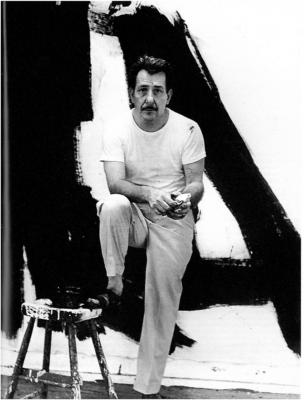
Biography
He studied at Boston University and the Heatherley School of Fine Art in London, then spent the 1940s painting figurative work in New York. The shift to abstraction came suddenly, according to legend, when de Kooning projected one of Kline's small drawings onto a wall using a Bell-Opticon projector. The enlarged image, freed from its original scale, became something else entirely. Kline began painting large.
The black and white paintings of 1950-61 are his contribution. Mahoning, Chief, and Painting Number 2 are decisive, architectural compositions that look spontaneous but were carefully planned. He made small preparatory studies on telephone book pages and newspaper, working out the balance of black and white before scaling up. The white is not background; it is as active and deliberate as the black.
He reintroduced colour in his last years, which surprised people who had defined him by its absence. He died of heart disease in 1962, at fifty-one. The career lasted roughly twelve years. The paintings are in every major museum of modern art.
Timeline
- 1910Born in Wilkes-Barre, Pennsylvania. His father's suicide when Franz was seven led to his enrolment at Girard College in Philadelphia, a boarding school for fatherless boys.
- 1935Completed studies at Boston University at 25, having spent four years training in art. He then travelled to London to study at the Heatherley School of Art before settling in New York in 1938.
- 1940Painted his mural series "Hot Jazz" at 30 for the Bleecker Street Tavern in Greenwich Village, New York. The commission marked an early sign of the bold, gestural style he would later develop.
- 1949Experienced a pivotal breakthrough at 39 when he viewed his small black-and-white sketches enlarged by a projector, recognising their potential as monumental abstract compositions.
- 1950Held his breakthrough exhibition at 40 at the Charles Egan Gallery in New York, showing large-scale black-and-white paintings that established him as a leading Abstract Expressionist.
- 1958Included in the Museum of Modern Art's touring exhibition "The New American Painting" at 48, which visited eight European cities. That year he also began reintroducing colour into his compositions.
- 1962Died in New York City at 52 from rheumatic heart disease, ten days before his birthday. His monumental black-and-white canvases had redefined the possibilities of gestural abstraction.
Notable Works
Tap to view larger.
Where to See Franz Kline
12 museums worldwide.
-
 196 works
National Gallery of Art
Washington D.C., United States
Mon–Sat 10:00–17:00, Sun 11:00–18:00 · Free
-
 16 works
Metropolitan Museum of Art
New York City, United States
Sun–Tue, Thu 10:00–17:00; Fri–Sat 10:00–21:00; closed Wed · Adults $30, students $17 (pay-what-you-wish for NY residents)
-
4 works
Museum of Modern Art
New York City, United States
Daily 10:30–17:30 (Sat until 19:00; first Fri of month until 20:00) · Adults $30, students $17
-
 6 works
Buffalo AKG Art Museum
Buffalo, United States
Mon 10:00–17:00, Thu 10:00–17:00, Fri 10:00–20:00 (until 21:00 on M&T First Fridays), Sat 10:00–18:00, Sun 10:00–17:00, closed Tuesdays and Wednesdays · $24 adults, $20 seniors/college students, $10 youth (5-18), free for children 4 and under and members
-
 5 works
Smithsonian American Art Museum
Washington D.C., United States
Mon–Sun 11:30–19:00 · Free
-
4 works
Whitney Museum of American Art
New York City, United States
Mon–Thu 10:30–18:00, Fri 10:30–22:00, Sat–Sun 10:30–18:00 · $30 adults, $24 seniors and students


Next stop
Abstract Expressionism →
Explore the artists and ideas of Abstract Expressionism.
Franz Kline prints
Hand-finished archival prints from Franz Kline's body of work.


Related Artists



Take Franz Kline home.
See all Franz Kline prints →Frequently Asked Questions
Did franz kline have children?
According to the text, Franz Kline married a British dancer named Elizabeth Parsons. It does not mention whether he had any children.Franz kline art movement?
The biography does not explicitly state the art movement with which Franz Kline was associated. However, it mentions that he was painting while many artists of the nascent New York School were experimenting with Surrealist-inspired biomorphic abstraction.Franz kline famous paintings?
The biography mentions Mahoning, Chief, and Painting Number 2 as examples of his work. It does not provide a comprehensive list of his famous paintings.Franz kline most famous painting?
The biography mentions Mahoning, Chief, and Painting Number 2 as decisive compositions. However, it does not specify which painting is his most famous.How did franz kline paint?
Kline's method involved using large canvases and housepainter's brushes. He created structural compositions that appear spontaneous, but were carefully planned using small preparatory studies.What is franz kline known for?
Franz Kline is known for his black and white paintings, especially those done between 1950 and 1961. He was inspired by graphic illustration, and the massive structures of New York, such as girders and bridges.When did franz kline die?
Franz Kline died in 1962 at the age of 52.Who is franz kline?
Franz Kline was born in Wilkes-Barre, Pennsylvania, in 1910. He attended Boston University and Heatherley's Art School in London before settling in New York in 1939.When was franz kline born?
Franz Kline was born in 1910 in United States. Franz Kline died in 1962, aged 52.Where did franz kline live?
Franz Kline was born in Wilkes-Barre, Pennsylvania, and later lived in New York. He also had a house in Provincetown.What paint did franz kline use?
Franz Kline used housepainter's brushes and industrial enamel. The biography does not specify the brand or type of paint he used.Where is franz kline from?
Franz Kline was United States, born in 1910 and died in 1962.
Sources
Editorial draws on the following primary and tertiary references for Franz Kline.
- [1] museum Buffalo AKG Art Museum Used for: museum holdings.
- [2] museum Cleveland Museum of Art Used for: museum holdings.
- [3] museum Museum of Fine Arts Boston Used for: museum holdings.
- [4] museum Carnegie Museum of Art Used for: museum holdings.
- [5] museum Allentown Art Museum Used for: museum holdings.
- [6] museum John and Mable Ringling Museum of Art Used for: museum holdings.
- [7] book Jed Perl, Art in America 1945-1970 Used for: biography.
Editorial overseen by Solis Prints. Sources verified 2026-08-29. Click a source for details, or hover over [N] in the page above to preview.
Editorial standardsMethodologyCorrectionsAI disclosureAbout the editorial team