


Ellsworth Kelly
Kelly served in the Ghost Army, a secret Second World War unit of about 1,100 artists, actors, and musicians who built inflatable tanks, fake airfields, and fabricated soundscapes to deceive German reconnaissance. The camouflage work taught him about form, shadow, and the deconstruction of the visible.

Biography
He was born in Newburgh, New York, in 1923[2], to a family of Russian Jewish immigrants. His grandmother introduced him to birdwatching at about eight, which started his fascination with shapes and colour in nature. After the war he studied in Paris, where in February 1949[2] he bought a hyacinth at a flower market to cheer himself up and drew it. This started a daily plant-drawing practice he maintained for the rest of his life. He said the plant drawings were the bridge to all his later abstract work. His rule: exact observation, nothing changed, no shading, no surface marks.
The paintings are large, flat, hard-edged fields of colour: single-colour panels, curves cut from canvas, shapes derived from shadows and architectural fragments. They look like they came from geometry, but they came from looking. He lived with his husband, the photographer Jack Shear, from 1984[2] until his death in 2015[2].
Timeline
- 1964Painted "Blue and Orange from Suite of Twenty-Seven Color Lithographs" aged 41.
- 1965Painted "Red over Yellow from Suite of Twenty-Seven Color Lithographs" aged 42.
- 1976Painted "Colored Paper Image V (Blue Curves) from Colored Paper Images" aged 53.
- 1976Painted "Colored Paper Images I, from the series Colored Paper Images" aged 53.
- 1991Painted "Orange Relief with Green" aged 68.
- 1993Painted "Red-Orange Panel with Curve" aged 70.
Notable Works
Tap to view larger.
Next stop
Abstract Expressionism →
Explore the artists and ideas of Abstract Expressionism.
Ellsworth Kelly prints
Hand-finished archival prints from Ellsworth Kelly's body of work.

Related Artists
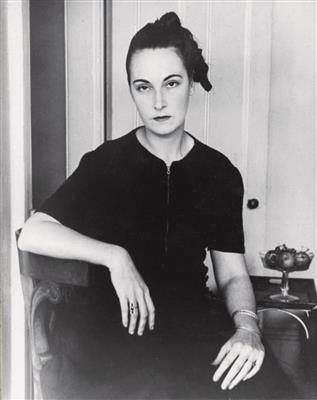
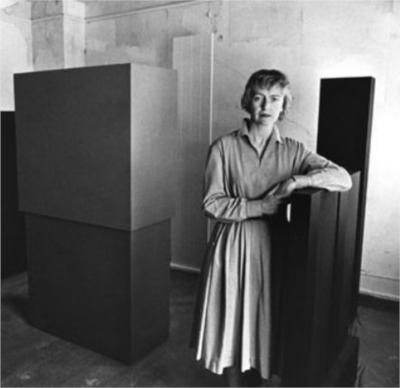
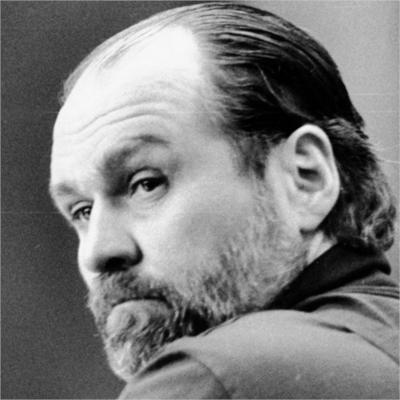
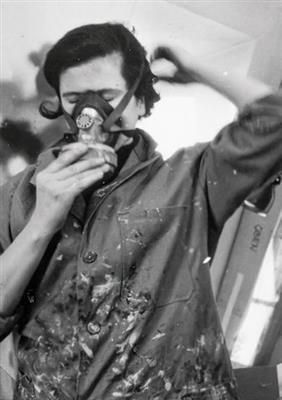
.jpg!Portrait.jpg)
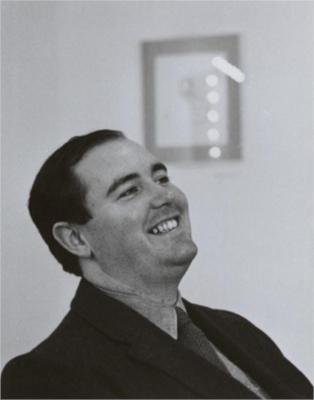
Take Ellsworth Kelly home.
See all Ellsworth Kelly prints →Frequently Asked Questions
Is ellsworth kelly alive?
No, Ellsworth Kelly died in 2015[2].What is ellsworth kelly known for?
Ellsworth Kelly is known for his art being profoundly affected by his studies at the School of the Museum of Fine Arts, Boston, beginning in 1946[2]. He was particularly influenced by the paintings of Max Beckmann and by Byzantine and Romanesque art.What is Ellsworth Kelly's most famous work?
It is difficult to name one single 'most famous' work by Ellsworth Kelly, as his career (from the late 1940s to his death in 2015[2]) was exceptionally productive. He worked in painting, sculpture and prints, and his pieces are held in major collections. However, some specific works and series can be singled out. Kelly's multipanel paintings, starting around 1949[2] with *Window, Museum of Modern Art, Paris*, represent a radical break from illusion and geometric abstraction. These works use multiple joined panels to free shape and colour. Another important work is *Red Blue*. This 1968 painting combines two triangles in a parallelogram, juxtaposing the colours to create visual tension. From 1966 onwards, Kelly created innovative paintings by joining vertical panels, identical in size but different in colour, such as *Blue, Green, Yellow, Orange, Red*. His public commissions include a mural for UNESCO in Paris (1969), and *Curve XXII* (1979), a large sculpture for Lincoln Park, Illinois.What should I know about Ellsworth Kelly's prints?
Ellsworth Kelly (1923[2]-2015[2]) was an American[2] artist known for his abstract paintings, sculptures, and prints. A 1987[2] retrospective at the Detroit Institute of Arts, organised by the American Federation of Arts, focused on his prints. The exhibition catalogue included a text by Richard H. Axsom and a catalogue raisonné. It later travelled to multiple venues, including the Los Angeles County Museum of Art and the University Art Museum, University of California at Berkeley. Kelly's prints often feature bold, simple shapes and flat areas of colour. He was interested in the way shapes and colours interact with each other and with the surrounding space. His work can be seen as a development of the minimalist aesthetic, prioritising clarity and simplicity. He worked with Gemini G.E.L. in Los Angeles and Maeght Editions in Paris to produce his graphic work during the 1960s through the 1980s. Susan Sheehan Gallery in New York held an exhibition of his prints from 1949 to 1989.What style or movement did Ellsworth Kelly belong to?
Ellsworth Kelly's work resists easy classification, though it has been linked with several movements. Early in the 1960s, his art was categorised as Hard-edge painting; however, Kelly stated that he was more interested in mass and colour than edges. Soon after, his work was misconstrued as Op art, a short-lived movement that experimented with colour, line, and abstract patterns to create the illusion of movement and depth. It has also been mistakenly identified with Minimalism[2], a mid-1960s movement that post-dates Kelly's own use of monochrome panel painting. Kelly developed a distinctly American[2] brand of formalist painting in Paris from 1948[2] to 1954. During these years, he began to reduce painting to a barebones simplicity, which some critics called Hard-Edge Abstraction. To free his mind from earlier art, he based his abstractions on shapes he saw in the world around him, especially negative spaces, such as the opening under a bridge, a shadow, or a window.What techniques or materials did Ellsworth Kelly use?
Ellsworth Kelly is associated with hard-edge painting, colour field painting, and Minimalism[2]. He worked in painting, sculpture, and printmaking. Kelly's paintings often feature sharply defined forms and flat areas of colour. He eliminated gestural brushwork in favour of smooth surfaces. He sometimes used multiple canvases to create large-scale, multi-panel works. His interest in simplified forms can be seen in his use of geometric shapes and his reduction of objects to their basic outlines. Kelly's sculptures often explore similar themes of shape and form. He created freestanding sculptures and wall-mounted reliefs, using materials such as aluminium and steel. His prints, like his paintings, often feature bold colours and simplified shapes. Lithography and screenprinting were among his favoured printmaking methods. Throughout his career, Kelly aimed to create art that was direct and immediate, free from symbolism or narrative content.What was Ellsworth Kelly known for?
Ellsworth Kelly (1923[2]-2015[2]) is known for his abstract paintings, sculptures, and prints that explore shape, colour, and form. He often worked with unmodulated colours and hard-edged forms. Kelly studied at the School of the Museum of Fine Arts, Boston, and later at the École des Beaux-Arts in Paris. In France, he studied Romanesque and Byzantine art. He was also introduced to Surrealism and Neo-Plasticism, leading him to experiment with geometric abstraction. After returning to the United States in 1954[2], Kelly developed his signature style of simplified forms and pure colours. He sought to create pictorial objects, minimising any trace of the artist's hand. His canvases became increasingly determined by the intensity of the colours used, often taking on the characteristics of objects themselves. Kelly also created works composed of multiple panels, exploring the relationships between colours and shapes across the different sections.When did ellsworth kelly die?
Ellsworth Kelly died in 2015[2] at the age of 92.When did Ellsworth Kelly live and work?
Ellsworth Kelly (1923[2]-2015[2]) was an American[2] painter, sculptor, and printmaker associated with minimalist art. He is known for his abstract works, often employing bright colours and simple shapes. Kelly was born in Newburgh, New York. He studied art at the Pratt Institute in Brooklyn from 1941[2] to 1942. His studies were interrupted by military service in the Second World War. After the war, he studied at the School of the Museum of Fine Arts, Boston, and then in Paris. Kelly lived in Paris from 1948 to 1954. During this period, he developed his signature style, drawing inspiration from European modernism and architecture. He experimented with form and colour, often creating works composed of multiple panels. Upon his return to the United States, Kelly continued to develop his artistic vocabulary. He moved to New York City, where he became part of the burgeoning art scene. Later in life, he moved to Spencertown, New York, where he lived and worked until his death in 2015. Throughout his career, Kelly's art was exhibited in museums and galleries around the world.Where can I see Ellsworth Kelly's work?
Ellsworth Kelly's pieces have been featured in many exhibitions. A print retrospective, organised by the American[2] Federation of the Arts, toured the United States from 1987[2] to 1990. It began at the Detroit Institute of Arts in September 1987 and visited the Huntsville Museum of Art, Des Moines Art Center, and the Neuberger Museum (Purchase, New York). It later travelled to the Los Angeles County Museum of Art, the University of Oklahoma Museum of Art, the Berkshire Museum, the University Art Museum (Berkeley), and the Hood Museum of Art at Dartmouth College. Kelly had a show of small sculptures at the List Visual Arts Center at M.I.T. (Cambridge, Massachusetts) in late 1987 and early 1988. The Eli Broad Family Foundation in Santa Monica, California, held an exhibition from December 1988 to September 1989. In 1992, the Galerie Nationale du Jeu de Paume (Paris) presented 'Ellsworth Kelly: Les années françaises, 1948-1954[2]'; it later travelled to Münster and Washington, D.C.Where did ellsworth kelly live?
Ellsworth Kelly was born in Newburgh, New York. In 1948[2], he went to France and enrolled at the Ecole des Beaux-Arts in Paris.Where was Ellsworth Kelly from?
Ellsworth Kelly was born in Newburgh, New York, on 31 May 1923[2]. His parents were Allan Howe Kelly, an insurance executive, and Florence Githens Kelly, a former schoolteacher. He grew up in East Orland, a small town in northern New Jersey. Kelly had an early interest in the natural world; he enjoyed birdwatching, an activity that influenced his later art. Kelly's artistic education began at the Pratt Institute in Brooklyn in 1941[2]. However, his studies were interrupted by his service in the United States Army during the Second World War. He served from 1943 to 1945, and was assigned to the 603rd Engineer Camouflage Battalion. After the war, Kelly attended the School of the Museum of Fine Arts, Boston, from 1946 to 1948. He then moved to Paris, where he lived and worked from 1948 to 1954.
Sources
Editorial draws on the following primary and tertiary references for Ellsworth Kelly.
- [1] wikidata Wikidata: Q544899 Used for: identifiers.
- [2] wikipedia Wikipedia: Ellsworth Kelly Used for: biography, birth dates, death dates, identifiers, movement attribution, nationality.
- [3] book Beard, Lee, 1973- author, Butler, Adam, author; Van Cleave, Claire, author; Fortenberry, Diane, author; Stirling, Susan, author, Beard, Lee, 1973- author, Butler, Adam, author; Van Cleave, Claire, author; Fortenberry, Diane, author; Stirling, Susan, author - The Art Book_ New Edition, Mini Format Used for: biography.
- [4] book guggenheim-ellswo00kell Used for: biography.
- [5] book guggenheim-guhe00solo Used for: biography.
Editorial overseen by Solis Prints. Sources verified 2026-09-27. Click a source for details, or hover over [N] in the page above to preview.
Editorial standardsMethodologyCorrectionsAI disclosureAbout the editorial team