Ifafa I by Frank Stella
Ifafa II by Frank Stella
Red Blue Green by Ellsworth Kelly
Seine by Ellsworth Kelly
Untitled by Charlotte Posenenske
Bretagne by Charlotte Posenenske
Spiral Jetty by Robert Smithson
The Dylan Painting by Brice Marden
Untitled by Bill Bollinger
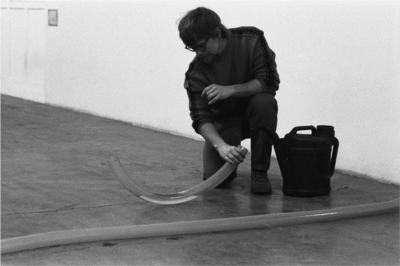
Channel Piece by Bill Bollinger
Untitled by Donald Judd
Almole by Carl Andre

Minimalism

18 artists · 1960–1975

Minimalism[4] emerged in New York in the early 1960s as artists stripped their work down to elemental geometry, industrial materials and serial repetition. Frank Stella's black paintings, begun in 1958, declared that a painting need refer to nothing beyond its own surface. Sol LeWitt extended the logic to three-dimensional structures and wall drawings governed by written instructions, bridging Minimalism and Conceptual Art. Ellsworth Kelly[11] reduced form to single-colour panels whose shapes derive from observed reality: a shadow on a staircase, the curve of a bridge arch. Yayoi Kusama[17]'s Infinity Net paintings covered canvases in obsessive, repeated marks that dissolved figure and ground. The 1966 Primary Structures exhibition at the Jewish Museum brought the movement to wide public attention. Minimalism rejected the emotional gesture of Abstract Expressionism and proposed that the physical presence of the object in real space was enough. Its influence extends through installation art, architecture and design to the present day.

Key Ideas

  • What You See Is What You See

    Stella's phrase became the movement's unofficial motto. Minimalism refused metaphor, symbolism and narrative. A steel cube was a steel cube, not a symbol of anything else. Colour was a material property, not an expressive vehicle. This literalism forced viewers to attend to the physical object and the space around it rather than searching for hidden meaning. The approach was deliberately confrontational: it denied the habits of interpretation that art audiences had been trained to apply.

  • Industrial Materials and Fabrication

    Minimalists used plywood, aluminium, fluorescent light tubes, bricks and steel plate. Many works were fabricated by industrial workshops rather than shaped by the artist's hand. Donald Judd sent specifications to a sheet-metal shop. Dan Flavin bought fluorescent fixtures from hardware stores. The removal of handcraft eliminated traces of personality and placed emphasis on the object's relationship to its environment. Art became something encountered in physical space rather than contemplated through a frame.

  • Systems and Serial Logic

    LeWitt proposed that the idea behind a work could be more important than its execution. His wall drawings exist as written instructions that can be carried out by anyone. His modular cube structures follow mathematical permutations to their logical conclusion. This systematic approach connects Minimalism to Conceptual Art and distinguishes it from the intuitive composition of earlier abstraction. The work is generated by a rule, not by an aesthetic judgement in the moment of making.

Origins

Against Expressionism

By the late 1950s Abstract Expressionism dominated American painting. Stella, Judd and their contemporaries saw its emotional rhetoric as exhausted. Stella's black paintings answered Pollock's drip canvases with methodical stripes. Judd dismissed painting altogether in favour of what he called specific objects: three-dimensional works that occupied real space without pretending to be sculpture in the traditional sense. The Minimalists wanted art that was impersonal, direct and physically present. Their rejection of the artist's hand as a source of meaning was deliberate and polemical.

Primary Structures

The 1966 exhibition Primary Structures: Younger American and British Sculptors at the Jewish Museum in New York brought Minimalism to wide attention. The show included work by Judd, Flavin, LeWitt, Carl Andre, Robert Morris and Anthony Caro. Industrial materials, geometric forms and serial arrangements filled the galleries. Critics debated whether these objects were art at all. The exhibition established Minimalism as a coherent movement and introduced its key figures to a broader public. It also triggered a lasting argument about whether art stripped of content could sustain serious attention.

From Object to Idea

LeWitt's 1967 essay Paragraphs on Conceptual Art, published in Artforum, argued that in conceptual art the idea or concept is the most important aspect of the work. This text pushed Minimalism toward its logical limit. If the system mattered more than the object, the object could be dispensed with. LeWitt's wall drawings existed as instructions before they existed as marks. This shift opened the door to Conceptual Art, Performance Art and Institutional Critique, all of which owe a debt to Minimalism's insistence on stripping art to its essential elements.

In Their Words

“What you see is what you see.”
Frank Stella, Interview with Bruce Glaser, broadcast on WBAI radio, New York (1964)
“The idea becomes a machine that makes the art.”
Sol LeWitt, Paragraphs on Conceptual Art, Artforum (June 1967)
“I am interested in ideas, not merely in visual products.”
Sol LeWitt, Paragraphs on Conceptual Art, Artforum (June 1967)

All Minimalism Artists

18 artists.

Recommended Reading

  • Minimalism: Art and Polemics in the Sixties

    Minimalism: Art and Polemics in the Sixties

    James Meyer · 2001

    Thorough account of Minimalism's development, critical reception and relationship to broader cultural politics of the 1960s.

  • Complete Writings 1959-1975

    Donald Judd · 1975

    Collected essays and reviews by the movement's most articulate advocate, including the foundational text Specific Objects.

  • Sol LeWitt: A Retrospective

    Gary Garrels · 2000

    Comprehensive survey of LeWitt's career from early structures through the wall drawings, with essays on his systematic method.

Frequently Asked Questions

  • What is Minimalism?
    Minimalism[4] was an American movement of the 1960s that stripped art down to its simplest geometric forms, industrial materials and factory-perfect surfaces. Its practitioners rejected the emotional gesture of Abstract Expressionism in favour of impersonal, repeatable units such as cubes, grids, fluorescent tubes and steel plates. The movement centred on sculpture, though painters including Frank Stella and Agnes Martin worked in parallel.
  • When did Minimalism start?
    The movement took shape in New York between 1963 and 1966. Early landmarks include Frank Stella's 1959 Black Paintings, Donald Judd's 1963 wall boxes, Dan Flavin's 1963 fluorescent-tube works and Carl Andre[19]'s 1966 floor pieces. The 1966 exhibition Primary Structures at the Jewish Museum, curated by Kynaston McShine, consolidated the group. Judd's 1965 essay Specific Objects provided the theoretical frame.
  • Who are the most famous Minimalist artists?
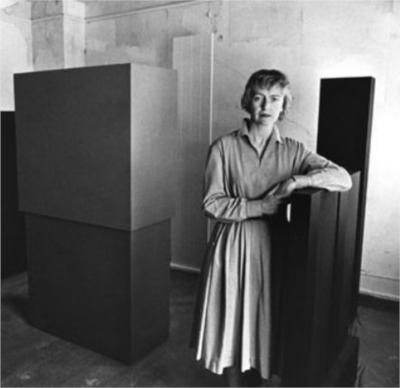
    Donald Judd, Dan Flavin, Carl Andre[19], Robert Morris, Sol LeWitt and Tony Smith lead the sculptural core. Frank Stella, Agnes Martin, Brice Marden[16] and Robert Ryman developed parallel painting practices. Anne Truitt[18] worked with painted wooden forms that predate the movement's formal start by several years. Fred Sandback used lengths of coloured yarn to define geometric volumes in gallery spaces.
  • What defines the Minimalist style?
    Minimalist objects use industrial materials (steel, plywood, fluorescent tube, brick) fabricated to the artist's specification by commercial shops. The work is typically modular, with units arranged in series, grids or straight lines. Judd called these outcomes 'specific objects' because they are neither painting nor sculpture in any conventional sense. Surfaces are anonymous, scale is often architectural, and reference to the artist's hand is eliminated.
  • What is the difference between Minimalism and Conceptual Art?
    Minimalism[4] (1963 to 1970) stayed with the physical object: a cube, a stack, a fluorescent tube on a wall. Conceptual Art (1966 to 1972) removed even the object, locating the artwork in the idea, the instruction, or the certificate. Sol LeWitt moved from Minimalist cubes to Conceptual wall drawings between 1968 and 1970, tracing the transition within a single practice.
  • Why was Minimalism important?
    Minimalism[4] established that sculpture need not be modelled by hand, need not stand on a pedestal, and need not depict anything. Its factory-produced objects changed how museums display art, how galleries sell it, and how later generations conceive of scale, seriality and site-specificity. Richard Serra, Eva Hesse, Felix Gonzalez-Torres and Rachel Whiteread all work within lineages the Minimalists opened.
  • Where can I see the best Minimalist art?
    Dia Beacon in upstate New York, opened 2003, is the largest single Minimalist collection, with entire rooms given to Judd, Flavin, Andre, LeWitt and Agnes Martin. The Chinati Foundation in Marfa, Texas, preserves Judd's permanent installations in former army warehouses. The Museum of Modern Art in New York, the Guggenheim in New York, and Tate Modern in London hold strong supplementary collections.

Sources

Minimalism editorial draws on the following published scholarship.

  1. [1] book James Meyer, Minimalism: Art and Polemics in the Sixties, 2001 Used for: biography, influences, political views, stylistic analysis.
  2. [2] book Donald Judd, Complete Writings 1959-1975, 1975 Used for: biography, exhibition history, stylistic analysis.
  3. [3] book Gary Garrels, Sol LeWitt: A Retrospective, 2000 Used for: biography, stylistic analysis, technique.
  4. [4] wikipedia Wikipedia: Minimalism Used for: biography.
  5. [5] book Marc Botha;, A Theory of Minimalism Used for: biography.
  6. [6] book Carol Strickland and John Boswell, The Annotated Mona Lisa _ba crash course in art history from prehistoric to post-modern _cCarol Strickland and John Boswell Used for: biography.
  7. [7] book Carol Strickland and John Boswell, The Annotated Mona Lisa _ba crash course in art history from prehistoric to post-modern _cCarol Strickland and John Boswell_1 Used for: biography.
  8. [8] book Carol Strickland and John Boswell, The Annotated Mona Lisa _ba crash course in art history from prehistoric to post-modern _cCarol Strickland and John Boswell_2 Used for: biography.
  9. [9] wikipedia Wikipedia: Charlotte Posenenske Used for: biography.
  10. [10] wikipedia Wikipedia: Abbas Kiarostami Used for: biography.
  11. [11] wikipedia Wikipedia: Ellsworth Kelly Used for: biography.
  12. [12] wikipedia Wikipedia: Bill Bollinger Used for: biography.
  13. [13] wikipedia Wikipedia: Carmen Herrera Used for: biography.
  14. [14] wikipedia Wikipedia: Charles Hinman Used for: biography.
  15. [15] wikipedia Wikipedia: Craig Kauffman Used for: biography.
  16. [16] wikipedia Wikipedia: Brice Marden Used for: biography.
  17. [17] wikipedia Wikipedia: Yayoi Kusama Used for: biography.
  18. [18] wikipedia Wikipedia: Anne Truitt Used for: biography.
  19. [19] wikipedia Wikipedia: Carl Andre Used for: biography.

Editorial overseen by Solis Prints. Sources verified 2026-05-30. Click a source for details, or hover over [N] in the page above to preview.

See Minimalism art in person.

Plan your visit to see Minimalism art →

Take Minimalism home.

See all Minimalism prints →
Back to Discover