

.jpg!Portrait.jpg)
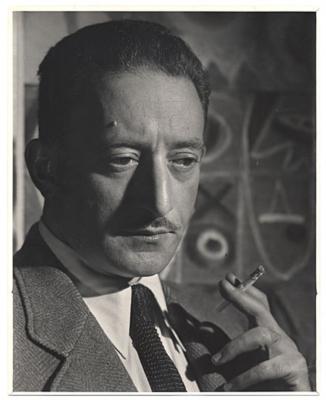
Anne Ryan
At 57, Anne Ryan had already written a novel, a collection of poems, and spent seven years as a printmaker. Then she saw Kurt Schwitters' collages at the Rose Fried Gallery in New York in 1948[1], and everything changed. She described being struck by "the abstract form and tactile quality, at how much power" could exist "on so small a scale." That evening she made her first collage from paper and fabric scraps she found at home.
Biography
Ryan was born in Hoboken, New Jersey in 1889[1], and was largely self-formed as an artist after both parents died during her teenage years. She married, separated in 1923[1], and eventually settled in Greenwich Village, where she moved in literary circles and published under her own name. She began painting in 1938, held her first exhibition at The Pinacoteca on Lexington Avenue in 1941, and in the same year started work at Stanley William Hayter's Atelier 17, the influential printmaking studio that served as a meeting point for European Surrealists and American[1] abstractionists.
The collages she made after the Schwitters encounter are her enduring legacy. Over the six years remaining until her death in 1954[1], she produced more than 400 of them. Most are small, averaging around 8 by 6 inches, and they work with unusual materials: silk, netting, handmade rag paper, and Japanese Washi paper, many of them mounted on sheets made by the paper artist Douglas Morse Howell. The power comes precisely from compression rather than scale.
The work appears in the collections of MoMA, the Metropolitan Museum of Art, the Whitney Museum of American[1] Art, and the British Museum. Ryan took decades to be fully acknowledged alongside the better-known figures of her generation; she is now regarded as one of the significant collage artists of the postwar period.
Timeline
- 1889Born in Hoboken, New Jersey.
- 1923Separated from her husband.
- 1938Began painting.
- 1941Held her first exhibition at The Pinacoteca on Lexington Avenue.
- 1941Began working at Stanley William Hayter's Atelier 17 printmaking studio.
- 1948Began making collages after seeing Kurt Schwitters' work at the Rose Fried Gallery in New York.
- 1954Died at 65. She produced over 400 collages in the last six years of her life.
Notable Works
Tap to view larger.
Next stop
Abstract Expressionism →
Explore the artists and ideas of Abstract Expressionism.
Related Artists




Frequently Asked Questions
What is Anne Ryan known for?
Anne Ryan is known for her collage work, which she began creating at the age of 57 after seeing Kurt Schwitters' collages. Over the next six years, she made more than 400 collages, often using materials such as silk, netting, handmade rag paper, and Japanese Washi paper.What is Anne Ryan's most famous work?
It is difficult to name one single work as Anne Ryan's "most famous". Her career was relatively short, and her work is not as widely known as that of some of her contemporaries. Ryan is best known for her small-scale, abstract collages. These pieces, often no more than a few inches in either direction, are composed of found papers, fabrics, and threads. She used materials such as Japanese papers, scraps of old letters, and remnants of textiles. These collages are characterised by their subtle colour palettes, delicate textures, and intimate scale. Although she exhibited at Peggy Guggenheim's Art of This Century gallery during the 1940s, her work only gained wider recognition after her death in 1954[1]. Since then, numerous exhibitions have presented her collages, and they are now held in the collections of major museums. However, due to the nature of collage, and the variability of her output, no single piece has achieved the status of a signature work.What should I know about Anne Ryan's prints?
Anne Ryan (1887-1954[1]) was an American[1] artist primarily known for her abstract collages. While she is not as widely recognised for printmaking, it is an important, if lesser-known, aspect of her artistic output. Original prints are produced by hand by the artist. The work is conceived specifically to be a print; the artist creates the artwork directly on the plate, woodblock, stone, or screen. Each print in the edition is considered an original. Ryan's prints, like her collages, often display a delicate sensibility and a careful attention to composition. Prints are more closely related to the book in terms of expression; reading the artist's thoughts and dreams. When assessing a print, consider whether it is an original print or a reproduction. An original print is conceived by the artist as a print and executed solely as a print, usually in a numbered edition and signed by the artist. Each print in the edition is an original, printed from a plate, stone, screen, block or other matrix created for that purpose. There is no one original print from which copies are made.What style or movement did Anne Ryan belong to?
Anne Ryan is associated with Abstract Expressionism[1], an American[1] art movement that gained international recognition in the 1940s. Originally called the "New York School", Abstract Expressionism is linked to artists such as Jackson Pollock and Willem de Kooning. Abstract Expressionists worked spontaneously, sometimes using what is called Action Painting. This approach valued gesture and intuition, dispensing with preparatory drawings in favour of marks, shapes, and colours emerging from the subconscious. Although male artists are often more closely associated with Abstract Expressionism, many women artists also worked in the style. These included Alma Thomas, Perle Fine, Lee Krasner, Elaine de Kooning, Grace Hartigan, Joan Mitchell, and Helen Frankenthaler. These women often faced marginalisation and a lack of solo exhibitions, but they created bold works using a range of materials and methods including paint, printmaking, collage, and sculpture.What techniques or materials did Anne Ryan use?
Anne Ryan is best known for her small abstract collages. She began making these in 1948[1], relatively late in her artistic career. Ryan used found papers and fabrics. These included papers from printed ephemera, such as old letters, discarded packaging, and book pages. Her fabrics were equally humble: scraps of cotton, linen, and silk from various sources. She employed a simple construction method. Ryan layered and arranged these materials, then adhered them to a support, often a piece of cardboard. The scale of Ryan's collages is notable. Many are only a few inches in either dimension. This small size creates a sense of intimacy. It also focuses attention on the textures and subtle colour variations within the work. Her approach was intuitive and improvisational. Ryan allowed the materials themselves to guide the composition. The artist's work stands in contrast to the large scale of much mid-century abstract painting. Her collages offer a quiet, personal form of abstraction.What was Anne Ryan known for?
Anne Ryan (1887-1954[1]) was an American[1] artist, best known for her small, abstract collages. She began her artistic career relatively late in life, after working as a writer and poet. Ryan's move towards visual art started in the late 1930s, when she studied with Stanley William Hayter at Atelier 17 in New York. Initially, she focused on woodcuts and prints. However, in 1948[1], she encountered Kurt Schwitters's work, which inspired her to explore collage. Ryan's collages are characterised by their modest scale and use of materials. She often incorporated discarded fabrics, papers, and threads into her compositions, creating subtle textures and tonal variations. These works are abstract; however, they evoke a sense of quiet contemplation. Although Ryan's career as a collage artist was brief, lasting only about six years, she produced over 400 collages during this period. Her work has been exhibited in various museums and galleries, securing her place in the history of American abstract art.Where can I see Anne Ryan's work?
Anne Ryan's work can be viewed in several public collections in the United States. The Phillips Collection in Washington, D.C., holds a number of her small abstract collages. These pieces often incorporate found papers and fabrics. The Brooklyn Museum also possesses examples of Ryan's work. The Museum of Modern Art (MoMA) in New York City includes her pieces in its collection, providing another opportunity to view her art. For those interested in a more regional focus, the Yale University Art Gallery in New Haven, Connecticut, features Ryan's work. These institutions allow the public to engage with her distinctive approach to collage and abstraction. Checking the institutions' websites ahead of a visit is advisable, as artworks on display can change.Where was Anne Ryan from?
Anne Ryan was an American[1] artist, born in Hoboken, New Jersey, in 1889[1]. Her early life was marked by a diverse range of interests; she wrote poetry and short stories, and she was involved in political activism. Ryan did not begin making visual art until later in life. In 1941[1], she studied with Stanley William Hayter at Atelier 17, a New York printmaking workshop. There, she learned engraving, etching, and other techniques. It was after this experience that Ryan began to create the small, abstract collages for which she is best known. She used discarded scraps of fabric, paper, and thread to construct her compositions. These works were often small in scale, and they possessed a delicate, intimate quality. Ryan's work gained recognition in the New York art world during the 1940s and 1950s. She exhibited at galleries such as the Betty Parsons Gallery. Although her career was relatively short, ending with her death in 1954[1], Ryan made a contribution to the development of collage as a fine art form.Who influenced Anne Ryan?
It is difficult to identify specific individuals who directly influenced Anne Ryan. However, some context can be provided. At the School of the Art Institute of Chicago, Joan Mitchell studied with Louis Ritman, who had spent considerable time at Claude Monet's colony in Giverny. There, Ritman moved away from academic art towards a fluid style similar to Renoir and adopted the colours of Impressionism. Mitchell also studied with Kathleen Blackshear, who taught art history and emphasised Romanesque architecture, early Renaissance painting, Cézanne, Cubism and what was then called "primitive art". Blackshear assigned projects such as an Egyptian mural, a Japanese scroll, and a Cubist oil. The Art Institute itself was a significant influence, and Mitchell was inspired by Giotto, Bellini, Chardin, Degas and the Mexican modernists. She copied some works and visited others regularly, such as Manet's still life *Fish*.Who was Anne Ryan?
There are two artists named Anne Ryan, and one named Anne Bremer, who are easily confused. Anne Ryan (1873-1954[1]) was born in LeMars, Iowa. She studied at the School of the Art Institute of Chicago. In 1914[1], she relocated to Los Angeles. She studied with J. H. Vanderpoel, Stanton Macdonald-Wright, and Harry M. Walcott. After her husband, artist Edouard Vysekal, died in 1939, she became director of the Vysekal Studio Gallery in Hollywood, California. She also organised the Los Angeles Group of Eight. She is known for modernist figure and still-life paintings. Anne Bremer (1868-1923) was born in San Francisco. She began studies with Arthur Matthews at the Mark Hopkins Institute of Art, and continued with Emil Carlsen at the San Francisco Art Students League. In 1910, she travelled to New York and then Paris, studying with André Lhote at the Académie Moderne and La Palette in 1911. She returned to San Francisco and served as president of the San Francisco Sketch Club from 1905 to 1907, and as a board member of the San Francisco Art Association. She is known for modern still lifes and stylised figures.What was Anne Ryan's art style?
After seeing Kurt Schwitters' work, Ryan began creating collages, typically small in size, using materials like silk, netting, handmade rag paper, and Japanese Washi paper. Her collages are now considered significant examples of postwar art.
Sources
Editorial draws on the following primary and tertiary references for Anne Ryan.
- [1] wikipedia Wikipedia: Anne Ryan Used for: biography, birth dates, death dates, identifiers, movement attribution, nationality.
- [2] book guggenheim-annialbers00webe Used for: biography.
- [3] book Patricia Albers, Joan Mitchell Used for: biography.
- [4] book Albers, Patricia, Joan Mitchell : lady painter : a life Used for: biography.
- [5] book Post-impressionism : cross-currents in European painting Used for: biography.
- [6] book Post-impressionism : cross-currents in European painting Used for: biography.
- [7] book Landauer, Susan, The not-so-still life : a century of California painting and sculpture Used for: biography.
Editorial overseen by Solis Prints. Sources verified 2026-10-13. Click a source for details, or hover over [N] in the page above to preview.
Editorial standardsMethodologyCorrectionsAI disclosureAbout the editorial team