



About Alexander Orlowski
Polish–Lithuanian Commonwealth · 1777–1832
- military art
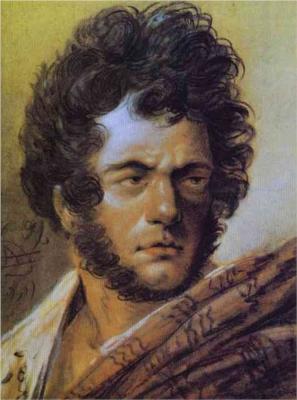
Polish-born painter and early pioneer of lithography in Russia, known for Cossack cavalry scenes; trained under Norblin in Warsaw.
Museums5
Countries4
Largest reported holdingNational Museum in Warsaw, Warsaw · 14 recorded works
Loading map…
Where to see Alexander Orlowski
Collection holdings are reported here; current display varies. Check with each museum before visiting.
-
14 recorded works
National Museum in Warsaw
Warsaw, Poland
-
3 recorded works
National Museum in Kraków
Kraków, Poland


-
1 recorded work
Russian Museum
Saint Petersburg, Russia
-
0 recorded works
National Gallery of Art
Washington D.C., United States
-
0 recorded works
National Gallery of Armenia
Yerevan, Armenia
Also here (6)


Frequently Asked Questions
What should I know about Alexander Orlowski's prints?
When considering Alexander Orlowski's prints, it is helpful to understand some basics about printmaking. "Original prints" include woodcuts, engravings, linocuts, mezzotints, etchings, lithographs and serigraphs. These are produced by hand by the artist; the artwork is created directly on the plate, woodblock, stone, or screen. Each print is considered an original because of this direct creation. Reproductions, sometimes called posters or image prints, are produced by photochemical means. The plates used in reproductions do not wear out, so there are no physical limits to the number of prints that can be made. However, publishers may still limit quantities to increase the edition's value. The definition of an original print has been debated. Some argue that the artist alone must create the master image. Others believe that the intent of the visual statement distinguishes an original print from a reproduction. If the intent is to replicate an image best created in another medium, it is a reproduction, regardless of the technique used. The key is whether the intent is to make a reproduction or an original work of art.Why are Alexander Orlowski's works important today?
Alexander Orlowski's art is relevant because it contributes to the ongoing reassessment of Ukrainian avant-garde and modernist artists. For decades, many Ukrainian artists were obscured or miscategorised within the broader context of Russian or Soviet art. Current narratives seek to restore these artists to their proper place in both Ukrainian and European art history. Figures like Archipenko and Bohomazov have already been restored to prominence, which has benefited their international recognition. Others, like Kavaleridze, Meller, and Boichuk, await further study and wider appreciation. This rediscovery is not without contention, as it intersects with debates about cultural memory and national identity. The tensions between the new and the traditional, the international and the national, which affected the early avant-garde, still resonate today. Orlowski's work, alongside that of his contemporaries, provides lessons relevant to current discussions about creative freedom, identity, and Ukraine's relationship with Europe.What techniques or materials did Alexander Orlowski use?
While specific details of Alexander Orlowski's techniques are scarce, we can discuss the general context of artistic materials and methods. Artists make choices that extend beyond the limitations of their chosen medium. Understanding these techniques and processes is important to art history. Painters have historically employed diverse materials, from natural pigments in fresco to egg tempera, watercolour, and oil. More recent options include acrylics, household emulsions, and mixed media approaches. Sculptors have used wood, marble, and bronze, but contemporary artists also incorporate cardboard, plastic, and found objects. Techniques involve the methods used in the creative process. For painting, this includes knowledge of applying oil paint thickly (impasto) or thinly (glazes). Brushwork can vary from fine and disguised to thick application with a palette knife or stencilling. Sculpture involves carving, modelling, casting, assemblage, and the use of readymades. The architect's choice of materials, such as stone, brick, concrete, iron, steel, glass, and aluminium, often dictates a building's form.Who did Alexander Orlowski influence?
Alexander Orlowski's influence can be traced through various artistic circles, particularly within the Soviet Union. In Tbilisi, Georgia, the relationship between mentor and student shaped artistic trends. Alexander Bandzeladze (1927-1992[1]) influenced Gia Edzgveradze (born 1953). David Kakabadze (1889-1952), with his Parisian career and connections to the Russian and Georgian avant-gardes, also exerted influence. Avtandil Varazi (1926-1977) was appreciated for his object-based reliefs within the dissident artistic community. Artists in the Soviet Union, isolated from international trends, explored abstract art in idiosyncratic ways. Figures such as Masterkova, Kropivnitsky, Nemukhin, and Bandzeladze attest to this exploration. Despite varying familiarity with American and French methods, Soviet artists conveyed a shared sense of expressive purpose through gesture and materials. Cultural identity in the former Soviet Union was often in flux, with artists of diverse backgrounds influencing new generations. For example, an artist of Tatar descent raised in Uzbekistan influenced avant-garde artists in Kazakhstan.Who influenced Alexander Orlowski?
Alexander Orlowski's artistic development was shaped by a range of influences. As a boy, he was fascinated by the colours in his paintbox, an experience that stayed with him throughout his life. He also learned a great deal from his mistakes, recalling how a childhood painting of a piebald horse taught him about the use of black. Later, Orlowski was moved by the paintings of Rembrandt in St Petersburg's Hermitage. He saw how Rembrandt's use of light and dark, and the blending of tones, created a powerful effect, reminding him of Wagner's music. Orlowski also studied with Anton Azbe in Munich. Azbe's school was very popular, and Orlowski observed his teaching methods closely. He also would have been aware of the work of Adolf Holzel, who experimented with abstract calligraphy and expressive forms of painting.What style or movement did Alexander Orlowski belong to?
It is difficult to assign Alexander Orlowski to a single stylistic category. The art of the early 20th century saw many styles emerge, and artists often worked across them. Some scholars place Orlowski within the broad sphere of the Russian avant-garde. This was a wide-ranging movement encompassing many different approaches to art. Cubism, with its interest in form and chiaroscuro, and futurism, with its focus on dynamism, both influenced artists of this period. These styles manifested in classical, academic, romantic, realist, and abstract forms. The avant-garde also looked to the past. Some artists found inspiration in the simplicity and directness of primitive art forms, such as the Russian *lubok* and the icon. This interest in the primitive was linked to a desire for a more direct and authentic way of seeing the world.What was Alexander Orlowski known for?
Alexander Orlowski (1777[1]-1832[1]) was a Polish painter and draughtsman who spent much of his career working in Russia. He was known for his paintings of battle scenes, his studies of horses, and his depictions of Russian peasant life. Born near Siedlce, Poland, Orlowski received artistic training in Warsaw before moving to Saint Petersburg around 1802[1]. There, he gained recognition for his skill in capturing the energy and drama of military subjects. His works often portrayed Cossacks and other soldiers in action, reflecting the military campaigns of the Russian Empire during that period. Beyond battle scenes, Orlowski also created numerous drawings and lithographs documenting the everyday existence of Russian peasants. These works offer insights into their customs, costumes, and social conditions. He also produced studies of horses, demonstrating his understanding of anatomy and movement. Orlowski's varied output reflects his artistic versatility and his interest in both military and genre subjects.
Sources
Where to See guide aggregates verified holdings of Alexander Orlowski's works across the following collections.
- [1] wikipedia Wikipedia: Alexander Orlowski Used for: biography.
- [2] book Palmer, Allison Lee, Historical Dictionary of Neoclassical Art and Architecture Used for: biography.
- [3] book Masterpieces of western art : a history of art in 900 individual studies from the Gothic to the present day Used for: biography.
- [4] book Peter. Leek, Russian Painting Used for: biography.
Editorial overseen by Solis Prints. Sources verified 2026-09-30. Click a source for details, or hover over [N] in the page above to preview.
Editorial standardsMethodologyCorrectionsAI disclosureAbout the editorial team