



![Seated Male Nude [recto] by Agostino Carracci](https://cdn.shopify.com/s/files/1/0833/9292/1935/files/artwork-Agostino_Carracci-d80f3079.jpg?width=480)


Agostino Carracci
- history painting
- portrait
Agostino Carracci began his career not at an easel but at a jeweller's bench, training as a goldsmith before switching to painting in Bologna. With his brother Annibale and cousin Ludovico, he co-founded the Accademia degli Incamminati in 1582[2], the reform academy whose influence on Italian[2] painting would prove far more durable than any single canvas. Where Annibale attracted the larger reputation, Agostino excelled at a craft that contemporaries undervalued: engraving. His reproductive prints after Tintoretto, Titian and Veronese spread knowledge of Venetian colour across Italy before photographs existed.
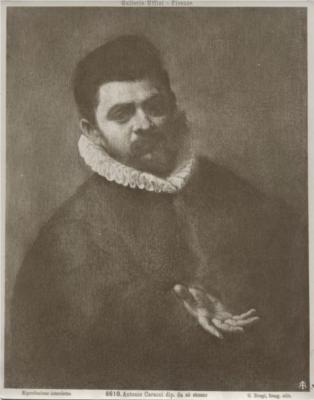
Biography
His masterpiece as a painter, The Last Communion of Saint Jerome (1592[2]), hangs in the Pinacoteca Nazionale di Bologna. The composition is controlled and deeply felt, with the dying saint receiving the sacrament in a soft, Correggesque light that reveals Agostino's careful study of the Parma master. He also contributed to major fresco cycles at Palazzo Fava (1584, Lives of Jason and Medea) and Palazzo Magnani (1590-92, Scenes from the Foundation of Rome), working alongside Annibale on both.
The engraving work that critics sometimes dismissed as mere reproduction turns out to have had an unexpectedly long legacy. His print after Paolo Fiammingo's Love in the Golden Age is recorded as a direct source for Matisse's Le bonheur de vivre (1905-06), connecting a Bologna workshop of the 1580s to Fauvist Paris three centuries later. Agostino died in Parma in March 1602[2], at forty-four, leaving a son, Antonio, who also became a painter.
Timeline
- 1557Born in Bologna, Italy
- 1582Co-founded Accademia degli Incamminati with Annibale and Ludovico Carracci
- 1584Contributed to Palazzo Fava fresco cycle, Lives of Jason and Medea
- 1590Contributed to Palazzo Magnani fresco cycle, Scenes from the Foundation of Rome
- 1592Painted The Last Communion of Saint Jerome
- 1602Died in Parma, Italy
Notable Works
Tap to view larger.
Where to See Agostino Carracci
2 museums worldwide.
-
 36 works
National Gallery of Art
Washington D.C., United States
Mon–Sat 10:00–17:00, Sun 11:00–18:00 · Free
-
 1 works
Weston Park
Weston-under-Lizard, United Kingdom
Varies by month; generally Park & Gardens 10:30–18:00 (or 16:00) and Art Gallery 11:00–16:00 daily · £13.00 adults (Park & Gardens)
Next stop
Browse the movements →
Every movement in the collection, from the Renaissance to Pop art.
Agostino Carracci prints
Hand-finished archival prints from Agostino Carracci's body of work.
 Great Crucifixion (right panel) - Agostino Carracci
From £28.00
Great Crucifixion (right panel) - Agostino Carracci
From £28.00
 The Great Crucifixion (left panel) - Agostino Carracci
From £28.00
The Great Crucifixion (left panel) - Agostino Carracci
From £28.00
 The Virgin Appearing to Saint Jerome - Agostino Carracci
From £28.00
The Virgin Appearing to Saint Jerome - Agostino Carracci
From £28.00
 Saint James Minor, Saint James Major and Saint Matthias - Agostino Carracci
From £28.00
Saint James Minor, Saint James Major and Saint Matthias - Agostino Carracci
From £28.00
 Saint Jerome Surrounded by Mourners - Agostino Carracci
From £28.00
Saint Jerome Surrounded by Mourners - Agostino Carracci
From £28.00
 Mercury and the Three Graces - Agostino Carracci
From £28.00
Mercury and the Three Graces - Agostino Carracci
From £28.00
Related Artists
Take Agostino Carracci home.
See all Agostino Carracci prints →Frequently Asked Questions
What is Agostino Carracci known for?
Agostino Carracci is known for his engravings, which reproduced works by artists such as Tintoretto, Titian, and Veronese. These prints helped to spread knowledge of Venetian colour across Italy. He is also known for co-founding the Accademia degli Incamminati with his brother and cousin.What style or movement did Agostino Carracci belong to?
Agostino Carracci, along with his brother Annibale and cousin Ludovico, is associated with the Carracci Reform. This movement arose from their dissatisfaction with the state of art in Bologna. They aimed to revive painting by drawing upon the strengths of past masters such as Raphael, Correggio, and Titian. Agostino's travels to Venice in 1580[2] and 1582 exposed him to the works of Venetian artists. Annibale also visited Venice in 1588. Their study of these masters led to a synthesis of Raphael's classicism and emphasis on draftsmanship, Correggio's softened forms, and the Venetian school's colourism. Together, the Carracci founded the Accademia dei Desiderosi in 1582, later called the Accademia degli Incamminati. This academy promoted progressive art education, combining theoretical study with practical training. Agostino's detailed anatomical drawings became teaching aids at the academy for two centuries. The Carracci's reform rejected Mannerism, instead advocating for a combination of classicism, naturalism, and Venetian colour.Where can I see Agostino Carracci's work?
Agostino Carracci's paintings and engravings can be viewed in several locations. In Bologna, where he completed several important fresco cycles with his brother Annibale and cousin Ludovico, look to the Fava Palace, the Palazzo Magnani, and the Palazzo Sampieri. The Pinacoteca Nazionale in Bologna holds his celebrated painting, *The Last Communion of St Jerome*. Outside Italy, Carracci's *Allegory of Truth and Time* is in the Royal Collection at Hampton Court. In Oxford, the Christ Church Gallery has both his *Butcher's Shop* and *Madonna above Bologna*. The Matthiesen Gallery, London, holds his *Portrait of a Woman as Judith*. Other works can be found on the continent. The Dresden Gallery possesses Carracci's *Assumption of the Virgin*, *Madonna of St Matthew*, and *St Roch Distributing Alms*. The Louvre in Paris has his *Resurrection of Christ* and *St Luke*. The National Museum in Capodimonte, Naples, has his *Choice of Hercules* and a *Pietà*. The Parma Gallery holds his *Pietà with Saints*.Who did Agostino Carracci influence?
Agostino Carracci, along with his brother Annibale and cousin Ludovico, sought to reform painting away from Mannerist excesses. They wanted to combine Raphael's classicism, Correggio's soft forms, and Venetian colourism. Agostino's travels to Venice in 1580[2] and 1582 to engrave works by Venetian masters exposed his circle to Venetian art. The Carracci established the Accademia dei Desiderosi (later the Accademia degli Incamminati) in Bologna in 1582. It was intended as a progressive learning environment, offering instruction in both artistic theory and practice. Agostino's detailed anatomical drawings became teaching tools at the academy for two centuries. His lectures covered philosophy, geometry, architecture, perspective and cosmography. The academy attracted not only artists but also scholars and aristocrats, who participated in discussions. Around 1615, Giovanni Battista Agucchi noted that many Italian[2] gentlemen and foreigners studied at the Carracci academy, producing work of merit. Annibale Carracci's frescoes in the Palazzo Farnese, begun in 1597, were also enormously influential.Who influenced Agostino Carracci?
Agostino Carracci, along with his brother Annibale and cousin Ludovico, felt that art in Bologna needed reform. They sought to revive painting by studying past masters such as Raphael, Correggio, and Titian. Agostino travelled to Venice in 1580[2] and again in 1582 to engrave works by Venetian artists such as Veronese and Tintoretto. This exposure to Venetian art brought a new artistic vocabulary back to Bologna. The Carracci aimed to combine Raphael's classicism and emphasis on drawing, Correggio's softer forms, and the colourism of Venetian painting. In 1582, Agostino, Annibale, and Ludovico established the Accademia dei Desiderosi, later known as the Accademia degli Incamminati, in Bologna. Agostino provided intellectual leadership, and his detailed anatomical drawings became teaching tools. He lectured on philosophy, geometry, architecture, perspective, and cosmography. The academy fostered discussion among artists, scholars, and aristocrats.Who was Agostino Carracci?
Agostino Carracci was a painter and engraver from Bologna, Italy, who, along with his brother Annibale and cousin Ludovico, co-founded the Accademia degli Incamminati in 1582[2]. He trained as a goldsmith before becoming a painter, and he also studied engraving under Domenico Tibaldi.What was Agostino Carracci's art style?
Agostino Carracci's painting style was influenced by Correggio, as seen in his use of soft light in The Last Communion of Saint Jerome. He also worked on fresco cycles at Palazzo Fava and Palazzo Magnani.How did Agostino Carracci die?
Agostino Carracci died in 1602[2] at the age of 45.
Sources
Editorial draws on the following primary and tertiary references for Agostino Carracci.
- [1] museum Weston Park Used for: museum holdings.
- [2] wikipedia Wikipedia: Agostino Carracci Used for: biography, birth dates, death dates, identifiers, movement attribution, nationality.
- [3] book Elizabeth Gilmore Holt; Project Muse, A Documentary History of Art, Volume 2 _ Michelangelo and the Mannerists, The Baroque and the Eighteenth Century Used for: biography.
- [4] book Elizabeth Gilmore Holt; Project Muse, A Documentary History of Art, Volume 2 _ Michelangelo and the Mannerists, The Baroque and the Eighteenth Century Used for: biography.
- [5] book Lilian H. Zirpolo, Historical Dictionary of Baroque Art and Architecture Used for: biography.
Editorial overseen by Solis Prints. Sources verified 2026-08-04. Click a source for details, or hover over [N] in the page above to preview.
Editorial standardsMethodologyCorrectionsAI disclosureAbout the editorial team