



Abraham Mignon
Mignon trained Maria Sibylla Merian. His teacher, the flower painter and art dealer Jacob Marrel, had married Merian's mother and asked Mignon to instruct his stepdaughter in still-life painting. Merian went on to become one of the most important scientific illustrators of the seventeenth century. It is the kind of connection that rarely appears in art history books about either artist.
Biography
Mignon was born in Frankfurt in 1640 to a French-speaking family who had emigrated from Wallonia. When his family moved to Wetzlar in 1649, he was placed in Marrel's care and trained as a flower painter. Marrel trusted him enough to leave his business in Mignon's hands during frequent trips to the Dutch Republic. By 1664 both had relocated to Utrecht, where Mignon entered the workshop of Jan Davidsz. de Heem, the leading Dutch still-life painter, whose influence was decisive.
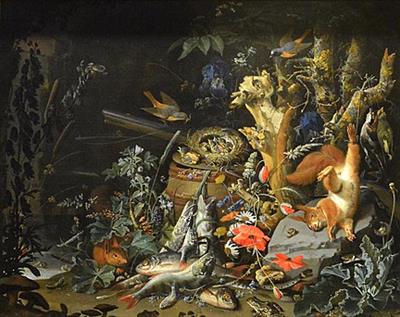
His paintings are lush, dense compositions of flowers, fruit, insects and small creatures, rendered with a precision that straddles decoration and natural history. He married into an artistic dynasty: his wife Maria Willaerts was the granddaughter of the marine painter Adam Willaerts, the daughter of the painter Cornelis Willaerts, and the niece of the fish still-life painter Jacob Gillig. Louis XIV of France and the Elector of Saxony both purchased his work.
He was elected deacon of the Walloon Church in Utrecht in 1672, a position he held for five years, suggesting a level of civic standing that his debts at death would later contradict. He died in Utrecht in 1679, at thirty-nine, leaving two daughters, thirteen children's worth of connections to other painters, and no dated paintings, which has made establishing a chronology of his work difficult.
Timeline
- 1640Born
- 1670Painted "Flowers in a metal vase in a niche"
- 1670Painted "Flowers in a Glass Vase"
- 1674Painted "Flowers and Fruit"
- 1679Died
Notable Works
Tap to view larger.
Where to See Abraham Mignon
35 museums worldwide.
-
 7 works
Louvre
Paris, France
Wed–Mon 09:00–18:00 (Fri until 21:45); closed Tue · €22 adults, free under-18
-
 7 works
Rijksmuseum
Amsterdam, Netherlands
Daily 09:00–17:00 · €25 adults, free under-18
-

-
 5 works
Staatliche Kunstsammlungen Dresden
Dresden, Germany
Tue–Sun 11:00–17:00 · 19€ regular (combined ticket)
-
3 works
Führermuseum
Linz, Austria
Next stop
Baroque →
Explore the artists and ideas of Baroque.
Abraham Mignon prints
Hand-finished archival prints from Abraham Mignon's body of work.
 Still Life with Fruit and a Nautilus Cup - Abraham Mignon
From £28.00
Still Life with Fruit and a Nautilus Cup - Abraham Mignon
From £28.00
 Stilleven met bloemen en een horloge - Abraham Mignon
From £28.00
Stilleven met bloemen en een horloge - Abraham Mignon
From £28.00
 Still Life with Fruit, Foliage, and Insects - Abraham Mignon
From £28.00
Still Life with Fruit, Foliage, and Insects - Abraham Mignon
From £28.00
 The Overturned Bouquet - Abraham Mignon
From £28.00
The Overturned Bouquet - Abraham Mignon
From £28.00
 Fruits and Lobster - Abraham Mignon
From £28.00
Fruits and Lobster - Abraham Mignon
From £28.00
 A Garland of Flowers - Abraham Mignon
From £28.00
A Garland of Flowers - Abraham Mignon
From £28.00
Related Artists


Take Abraham Mignon home.
See all Abraham Mignon prints →Frequently Asked Questions
What is Abraham Mignon known for?
Abraham Mignon is known for his lush, dense compositions of flowers, fruit, insects, and small creatures. These pieces are rendered with a precision that straddles decoration and natural history.What is Abraham Mignon's most famous work?
Abraham Mignon (1640-1679) was a Frankfurt-born still-life painter. He is known for precise compositions that combine Baroque exuberance with naturalistic representation. Mignon trained in his hometown before moving to Utrecht in 1659 with the master Jacob Morel. There, he worked with Jan Davidszoon de Heem, a Dutch still-life painter. Mignon alternated between Frankfurt and Utrecht, becoming a member of the Guild of St Luke in 1669. His paintings often feature moist undergrowth with small animals, reptiles, insects, flowers, and deadly snares. These elements can be interpreted as an allegory of earthly vanity, fading beauty, and the passage of time. Mignon's art is distinguished by its clarity, meticulous drawing, and attention to detail. His still lifes have been interpreted allegorically, contrasting good and evil. For example, snails are juxtaposed with butterflies, which symbolise the soul freeing itself from sin. One of Mignon's well-known works is *Nature as a Symbol of Vanity*, dating from between 1665 and 1679. Another is *Still Life with Fish and Quail's Nest*, circa 1670. Mignon's paintings remained milestones in German taste and were imitated until the Biedermeier period in the late nineteenth century.What should I know about Abraham Mignon's prints?
Abraham Mignon (1640-1679) was a still-life painter of the Dutch Golden Age, known for his detailed depictions of flowers, fruit, and woodland creatures. Although he is not as widely recognised as some of his contemporaries, his works were admired for their technical skill and decorative appeal. Mignon trained with Jan Davidsz de Heem in Utrecht, and his style closely resembles that of his teacher. Like de Heem, he often included insects and other small animals in his compositions, adding a sense of life and movement to his meticulously arranged displays. While Mignon is best known for his paintings, prints were made after his work. These prints allowed for wider circulation of his compositions, making them accessible to a broader audience. Many of these prints were produced by engravers who specialised in reproducing paintings, and they offer a valuable record of Mignon's artistic output. They capture the detail and colour of his original paintings, providing collectors with an opportunity to own versions of his celebrated still lifes.What style or movement did Abraham Mignon belong to?
Abraham Mignon, born in Frankfurt in 1640, is associated with the Baroque style. He is known for still life paintings that blend artistic and scientific elements, a type of illustration common in the seventeenth century. Mignon's technique is precise and clear, combining Baroque exuberance with a taste for analytic, naturalistic representation. His paintings demonstrate both talent and a strong sense of composition. Mignon trained in his hometown before moving to Utrecht in 1659 with the master Jacob Morel. There, he worked with Jan Davidszoon de Heem, a Dutch still life painter. Mignon divided his time between Frankfurt and Utrecht, becoming a member of the Guild of St Luke in 1669. His still lifes often contain allegorical interpretations, contrasting "negative" and "positive" creatures. For example, snails might be juxtaposed with butterflies, which symbolise the soul's liberation. Mignon's works were imitated into the Biedermeier period of the nineteenth century, demonstrating their influence on German taste.What techniques or materials did Abraham Mignon use?
Information about Abraham Mignon's specific techniques or materials is scarce. However, historical context provides some insight into the practices of seventeenth-century painters. During this period in France, painting techniques were often closely guarded secrets, passed down through guilds from master to apprentice. Manuals and "books of secrets" offered recipes and instructions on various artistic processes. These books covered a range of topics, including how to prepare pigments, copy drawings, imitate marble, and create varnishes. Oil painting was considered a relatively new method, and preparing the medium was a significant concern. Recipes often suggested using nut oil with lead white, thickened by sunlight. Turpentine was sometimes added to help layers dry faster. To prepare canvases, artists stretched the material, smoothed it with pumice, sized it with glue, and applied a double ground, typically using raw umber, red brown, lead white, and carbon black. For panels, multiple layers of chalk ground were common.What was Abraham Mignon known for?
Abraham Mignon (1640-1679) was a German still-life painter of the Baroque period. His works often combined artistic skill with scientific observation, fitting into a seventeenth-century tradition that bridged the gap between art and the study of the natural world. After training in his hometown of Frankfurt, Mignon moved to Utrecht in 1659. There, he studied with Jan Davidszoon de Heem, a Dutch still-life painter. Mignon became a member of the Guild of St Luke in 1669. He divided his time between Frankfurt and Utrecht. Mignon's paintings are known for their clarity, achieved through careful drawing and close attention to detail. His subjects included flowers, forest undergrowth, fruit, and game. These elements were rendered with a precise technique. Some experts have proposed allegorical interpretations of his still lifes, suggesting they represent choices between good and evil. For example, snails might be juxtaposed with butterflies, symbolising the soul's liberation from sin. His paintings were imitated into the nineteenth century.Where can I see Abraham Mignon's work?
It is difficult to say exactly where works by Abraham Mignon can be seen today, as many are in private collections. However, some works by artists of the same period are held by public art galleries. For example, the National Gallery of Victoria in Melbourne has Nicolas Poussin's The Crossing of the Red Sea. The Minneapolis Institute of Arts has Poussin's The Death of Germanicus. In Moscow, the Pushkin Museum of Fine Arts holds Poussin's The Continence of Scipio, as well as his work, Landscape with Hercules and Cacus. The Alte Pinakothek in Munich has Poussin's The Adoration of the Shepherds and Apollo and Daphne. The Musée des Beaux-Arts in Nancy has Poussin's The Entry of Christ into Jerusalem. The Metropolitan Museum of Art in New York has Poussin's Landscape with Orion, Midas Washing at the Source of the Pactolus, and The Rape of the Sabines.Where was Abraham Mignon from?
Abraham Mignon was born in Frankfurt, Germany. Details of his early life and training are scarce, but he became a specialist in still-life painting, a popular genre in both the Dutch Golden Age and the broader European Baroque. Mignon's focus on still-life subjects, such as flowers and fruit, aligns him with other artists of the period who catered to the growing demand for decorative and naturalistic works. These paintings often found their way into the homes of the prosperous middle class, reflecting new tastes and habits related to the consumption of luxury goods. The rise of porcelain production in Europe, for example, stimulated demand for paintings that incorporated such objects.Who influenced Abraham Mignon?
Abraham Mignon (1640-1679) was a still-life painter active in the Dutch Golden Age. He is known for his detailed depictions of fruit, flowers, and small animals. Mignon's primary influence was his teacher, Jan Davidsz de Heem (1606-1684). De Heem was a leading still-life painter, working first in Leiden, then in Antwerp, and finally in Utrecht. Mignon joined de Heem's workshop in Utrecht around 1660 and became his most important pupil. De Heem's style, which combined meticulous observation with a decorative flair, had a direct impact on Mignon's work. Other artists who may have influenced Mignon include Jacob Marrel (1614-1681), his stepfather, and Otto Marseus van Schrieck (c. 1619-1678). Marrel, a flower painter, likely provided early training and instilled an interest in botanical subjects. Van Schrieck, known for his paintings of forests with reptiles and insects, may have inspired Mignon's inclusion of similar creatures in his still lifes. However, de Heem's impact remained the most significant, shaping Mignon's artistic direction and contributing to his success in the genre.Who was Abraham Mignon?
Abraham Mignon was a Dutch Golden Age painter born in Frankfurt in 1640 to a French-speaking family. He is known for training Maria Sibylla Merian, who became an important scientific illustrator.Why are Abraham Mignon's works important today?
Abraham Mignon (1640-1679) was a still-life painter of the Baroque period, active in what is now Germany and the Netherlands. He is remembered for his detailed depictions of flowers, fruit, and forest floor subjects. Mignon trained in Frankfurt under still-life painter Jacob Marrel, and later with Jan Davidsz de Heem in Utrecht. De Heem's influence is clear in Mignon's compositions and technique. He became a member of the Utrecht Guild of Saint Luke in 1669. His paintings are admired for their precise observation and careful arrangement. Mignon often included insects, dewdrops, and other small details to create a sense of realism and capture the beauty of nature. These elements add visual interest and complexity to his works. Mignon's works are found in major museum collections, such as the Louvre in Paris, the Rijksmuseum in Amsterdam, and the Ashmolean Museum in Oxford. Although he died relatively young, his output was significant, and his style was influential on other still-life painters of the period. His art provides insight into the 17th-century appreciation for the natural world and the development of still-life painting as a genre.When was Abraham Mignon born?
Abraham Mignon was born in 1640 in the Netherlands. Abraham Mignon died in 1679, aged 39.
Sources
Editorial draws on the following primary and tertiary references for Abraham Mignon.
- [1] museum Maidstone Museum and Bentlif Art Gallery Used for: museum holdings.
- [2] museum Royal Museum of Fine Arts Antwerp Used for: museum holdings.
- [3] museum Gemäldegalerie Alte Meister Used for: museum holdings.
- [4] museum Städel Museum Used for: museum holdings.
- [5] museum Herzog Anton Ulrich Museum Used for: museum holdings.
- [6] museum Liechtenstein Museum Used for: museum holdings.
- [7] academic Encyclopaedia Britannica Editors, Abraham Mignon | Biography & Art Used for: biography.
- [8] book Lilian H. Zirpolo, Historical Dictionary of Baroque Art and Architecture Used for: biography.
- [9] book Allison Lee Palmer, Historical Dictionary of Neoclassical Art and Architecture Used for: biography.
- [10] book Masterpieces of western art : a history of art in 900 individual studies from the Gothic to the present day Used for: biography.
- [11] museum Abraham Mignon | National Gallery of Art Used for: biography.
- [12] museum Still Life with Flowers and a Watch Used for: museum holdings.
- [13] museum Still Life with Fruit and Oysters Used for: museum holdings.
Editorial overseen by Solis Prints. Sources verified 2026-09-30. Click a source for details, or hover over [N] in the page above to preview.
Editorial standardsMethodologyCorrectionsAI disclosureAbout the editorial team