



About Benozzo Gozzoli
- Italian Renaissance
Florentine painter who packed the Medici chapel with portraits, horses, and a baby leopard on a gold leash in his magnificent 1459 fresco cycle.
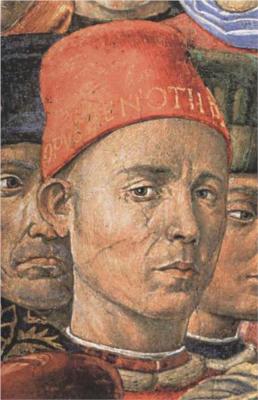
Where to see Benozzo Gozzoli
Collection holdings are reported here; current display varies. Check with each museum before visiting.
-
4 recorded works
Metropolitan Museum of Art
New York City, United States
-
3 recorded works
National Museum in Kraków
Kraków, Poland


-
3 recorded works
National Gallery of Art
Washington D.C., United States
-
3 recorded works
Detroit Institute of Arts
Detroit, United States
-
2 recorded works
Louvre
Paris, France
-
2 recorded works
Gemäldegalerie Berlin
Berlin, Germany
-
2 recorded works
National Gallery
London, United Kingdom
-
1 recorded work
Courtauld Gallery
London, United Kingdom
-
1 recorded work
National Galleries Scotland
Edinburgh, United Kingdom
-
1 recorded work
Kunsthistorisches Museum
Vienna, Austria


Own a piece of it
Benozzo Gozzoli prints
Hand-finished archival prints from Benozzo Gozzoli's body of work.
 Madonna and Child Giving Blessings - Benozzo Gozzoli
From £28.00
Madonna and Child Giving Blessings - Benozzo Gozzoli
From £28.00
 St. Augustine Departing for Milan - Benozzo Gozzoli
From £28.00
St. Augustine Departing for Milan - Benozzo Gozzoli
From £28.00
 The Dance of Salome (detail) - Benozzo Gozzoli
From £37.00
The Dance of Salome (detail) - Benozzo Gozzoli
From £37.00
 Saints Nicholas of Tolentino, Roch, Sebastian, and Bernardino of Siena, with Kneeling Donors - Benozzo Gozzoli
From £28.00
Saints Nicholas of Tolentino, Roch, Sebastian, and Bernardino of Siena, with Kneeling Donors - Benozzo Gozzoli
From £28.00
 The Annunciation (Tondo) - Benozzo Gozzoli
From £37.00
The Annunciation (Tondo) - Benozzo Gozzoli
From £37.00
 Preaching to the Birds and Blessing Montefalco - Benozzo Gozzoli
From £28.00
Preaching to the Birds and Blessing Montefalco - Benozzo Gozzoli
From £28.00
 Madonna and Child - Benozzo Gozzoli
From £28.00
Madonna and Child - Benozzo Gozzoli
From £28.00
 The School of Tagaste (detail) - Benozzo Gozzoli
From £37.00
The School of Tagaste (detail) - Benozzo Gozzoli
From £37.00
View all 17 museums
-
1 recorded work
Harvard Art Museums
Cambridge, United States
-
1 recorded work
Musée du Petit Palais
Avignon, France
-
1 recorded work
Thyssen-Bornemisza Museum
Madrid, Spain
-
1 recorded work
Royal Collection
London, United Kingdom
-
1 recorded work
National Gallery of Canada
Ottawa, Canada
-
0 recorded works
Museum Boijmans Van Beuningen
Rotterdam, Netherlands
-
0 recorded works
Nationalmuseum
Stockholm, Sweden


Can't travel? Bring Benozzo Gozzoli home.
See all Benozzo Gozzoli prints →Frequently Asked Questions
Where can I see Benozzo Gozzoli's work?
Benozzo Gozzoli (born in Florence, 1420/2; died in Pistoia, 1497[1]) painted prolifically in Florence and Rome. His frescoes can be found in several locations. One noted work, The Journey of the Magi (1459), is a fresco in the chapel inside the Palazzo Medici-Riccardi, Florence. You can find Gozzoli's paintings in the following collections: * Fogg Art Museum, Cambridge (Massachusetts) * Musée Condé, Chantilly * Art Institute, Chicago * Museum of Arts, Columbia (South Carolina) * Institute of Arts, Detroit * Musée Jacquemart-André, Paris * Pinacoteca Civica, Piacenza * Museum of Art, Raleigh (North Carolina) * Galleria Borghese, Rome * Galleria Colonna, Rome * Pinacoteca Vaticana, Rome * Musée des Beaux-Arts, Strasbourg * Galleria Sabauda, Turin * Akademie der bildenden Künste, Vienna * National Gallery of Art, Washington * Sterling Clark Museum, Williamstown * Abegg Stockar Collection, ZurichWhat should I know about Benozzo Gozzoli's prints?
Benozzo Gozzoli (1420-1497[1]) was a Florentine painter and pupil of Fra Angelico. He is known for his decorative fresco cycles. Gozzoli's prints often reproduce details from these large works. His most celebrated work is the fresco cycle depicting the Procession of the Magi in the chapel of the Palazzo Medici-Riccardi, Florence, painted between 1459 and 1463. This commission from the Medici family allowed Gozzoli to display finery, costumes, and a cheerful atmosphere. The subject of the Magi was popular with wealthy patrons, as the opulent colours and gold leaf could reflect their status. Gozzoli included portraits of the Medici family within the fresco. Lorenzo de' Medici is said to be represented as one of the Magi. The work's inspiration may derive from Gentile da Fabriano’s Adoration of the Magi. Gozzoli's style combines the early Renaissance with elements of the International Gothic style. His attention to detail may reflect his training as a goldsmith's apprentice under Ghiberti.Why are Benozzo Gozzoli's works important today?
Benozzo Gozzoli, born in Florence around 1421[1], died in 1497[1]. He was a student of Fra Angelico, but his style differed. Gozzoli's works offer insight into the aesthetic preferences and cultural values of Renaissance Florence. Gozzoli received a commission from the Medici family to decorate the walls of their private chapel in Florence. Between 1459 and 1463, he created a fresco cycle depicting the Journey of the Magi. This work is celebrated for its detailed portrayal of a procession, complete with finery, costumes, and a smiling countryside. The chapel provides a glimpse into the festive life of the period. His paintings document contemporary life. The Medici chapel frescoes include portraits of family members, such as Lorenzo de' Medici. Gozzoli's narrative skill, combined with his eye for detail from his goldsmithing apprenticeship under Ghiberti, made his work a mirror of the present.What techniques or materials did Benozzo Gozzoli use?
Benozzo Gozzoli was a painter of the Early Renaissance. He is known to have worked in fresco, a technique that required preparing walls with plaster. First, reed mats were attached to the walls to act as a vapour barrier. A thick, rough coat of plaster, the arriccio, was then applied either over the reed mats or directly onto the wall surface to smooth the surface for painting. Artists, including apprentices, learned how to handle a trowel, mix plaster, and control its consistency, as the drying of the plaster was a factor in fresco painting. Gozzoli's style has been linked to the International Gothic style, particularly his attention to detail and narrative skills. His experience as a goldsmith's apprentice under Ghiberti likely influenced his love for detail. Gozzoli's "Procession of the Magi" in the Palazzo Medici-Riccardi shows an extravagant procession with detailed robes set against a mountain . The rocky rises in the composition suggest familiarity with Ghiberti’s "Gates of Paradise" doors for the Florence Baptistery.Who did Benozzo Gozzoli influence?
Benozzo Gozzoli's influence is most apparent in the generation of painters who followed him in Florence and the surrounding regions of Italy. His detailed narrative frescoes, filled with anecdotal elements and realistic portraits, provided a model for later artists. Though not a direct student, Filippino Lippi absorbed elements of Gozzoli's style. Lippi's work shares a similar attention to detail and a narrative approach to religious subjects. Gozzoli's emphasis on realistic settings and identifiable figures also had an impact on Domenico Ghirlandaio, who further developed the trend towards portraiture within religious scenes. Ghirlandaio's frescoes in the Sassetti Chapel in Florence demonstrate this influence. While the High Renaissance saw a shift away from Gozzoli's more decorative style, his work remained an important example of early Renaissance painting. His frescoes continue to be studied for their historical detail and their contribution to the development of narrative art in Florence.Who influenced Benozzo Gozzoli?
Benozzo Gozzoli (circa 1421[1]-1497[1]) was an Italian[1] Early Renaissance painter. His work displays the influence of several earlier artists, most notably Fra Angelico. Gozzoli worked as an assistant to Angelico, and this close association shaped his early style. Gozzoli's style also shows the impact of other Florentine masters. The influence of Lorenzo Ghiberti, particularly his work on the Gates of Paradise at the Florence Baptistery, can be seen in Gozzoli's attention to detail and narrative composition. The paintings of Masaccio, with their emphasis on realism and perspective, also informed Gozzoli's artistic development. Later in his career, Gozzoli's work began to incorporate elements of the International Gothic style. This is evident in his use of gold leaf, decorative patterns, and elegant figures. While Gozzoli's style evolved over time, the early influence of Fra Angelico remained a constant throughout his career.What is Benozzo Gozzoli's most famous work?
Benozzo Gozzoli is best known for his fresco cycle at the Palazzo Medici-Riccardi in Florence. Painted around 1459-1461[1], the chapel's walls depict the Journey of the Magi. This work is celebrated for its detailed depictions of courtly life and its use of colour. Gozzoli received the commission from Piero de' Medici. The frescoes portray members of the Medici family and other prominent figures as part of the procession. These include Emperor John VIII Palaiologos, Sigismund of Luxembourg, and various members of the Medici family themselves. The chapel itself is small. Gozzoli divided the frescoes into sections, each representing a different part of the journey. The artist employed gold leaf and other luxurious materials to create a sense of opulence. The frescoes offer insight into the political and cultural climate of Florence during the early Renaissance. Gozzoli's attention to detail, combined with his skill in portraiture, makes the Journey of the Magi a significant work of Renaissance art.What style or movement did Benozzo Gozzoli belong to?
Benozzo Gozzoli, born in Florence around 1420, is associated with the International Gothic style. He was a student of Fra Angelico, yet his artistic approach differed. Gozzoli's work is known for its decorative qualities and narrative skill. His fresco cycle, The Journey of the Magi, painted around 1459 in the chapel of the Palazzo Medici-Riccardi in Florence, is a prime example of his style. This work, commissioned by the Medici family, depicts a procession of figures in elaborate costumes set within a detailed mountain setting. The opulence and attention to detail, inherited from his training as a goldsmith's apprentice under Ghiberti, are characteristic of the International Gothic style. While Gozzoli incorporated some of the innovations of the early Renaissance, such as perspective, his focus remained on creating visually appealing and engaging scenes. He used new techniques to enhance the charm and vividness of his depictions of contemporary life, rather than to revolutionise artistic representation. His work provided a record of the colourful life of the period.
Sources
Where to See guide aggregates verified holdings of Benozzo Gozzoli's works across the following collections.
- [1] wikipedia Wikipedia: Benozzo Gozzoli Used for: biography.
- [2] book Beard, Lee, 1973- author, Butler, Adam, author; Van Cleave, Claire, author; Fortenberry, Diane, author; Stirling, Susan, author, Beard, Lee, 1973- author, Butler, Adam, author; Van Cleave, Claire, author; Fortenberry, Diane, author; Stirling, Susan, author - The Art Book_ New Edition, Mini Format Used for: biography, stylistic analysis.
- [3] book Masterpieces of western art : a history of art in 900 individual studies from the Gothic to the present day Used for: biography, stylistic analysis.
- [4] book Meiss, Millard, The great age of fresco; discoveries, recoveries, and survivals Used for: stylistic analysis.
- [5] book Gombrich, E. H. (Ernst Hans), 1909-2001, The story of art Used for: biography.
Editorial overseen by Solis Prints. Sources verified 2026-09-30. Click a source for details, or hover over [N] in the page above to preview.
Editorial standardsMethodologyCorrectionsAI disclosureAbout the editorial team